





A row of dark-clad gabled houses with gray shingle roofs behind trimmed green hedges, mown lawn, and leafy trees under an overcast sky.

AC Maintenance in Cedar Rapids, IA

Tell us about the job

Takes about a minute. No obligation.

Tune-up, service, or cleaningCentral ACLinn County, IA
Step 1 of 2

What ZIP code is the job in?

Linn County saw 344 severe weather events between 2015 and 2024. Hail came 139 times in that span, damaging wind 156 times, and 17 tornadoes touched down. An outdoor condenser sits outside through all of it, exposed to hail dents, flying debris, and branches coming down in high wind. None of that announces itself. A bent fin or a cracked line can sit there quietly until the unit is asked to run hard on a hot day and can't. Getting it looked at before storm season picks up again means finding that damage on your schedule, not during a heat wave.

3 months
June through August, your air conditioner is on duty
82°F
the average summer afternoon it cools against
139 hail events
in ten years, and hail bends the fins on outdoor coils
156 wind events
in ten years, and wind drives debris into outdoor units
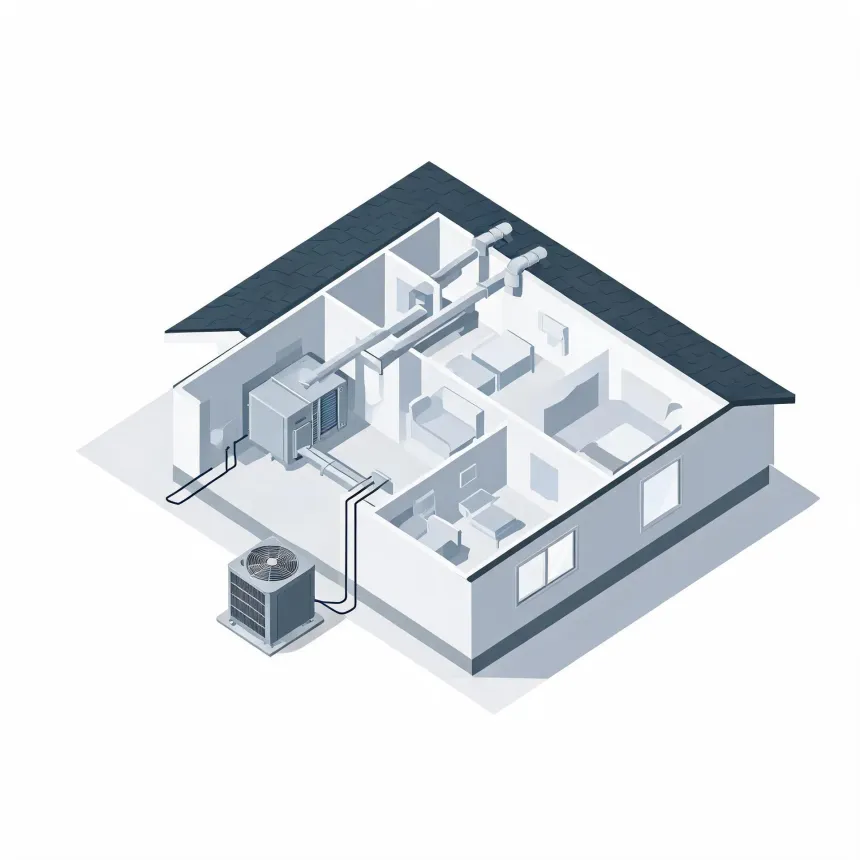
Isometric cutaway illustration of a single-story house showing interior rooms, ceiling ductwork, an indoor air handler, and an outdoor condenser unit connected by lines, in gray and white tones on a white background.
Your air conditioner works hardest from June through August.

NOAA nClimDiv, 1991–2020 normals

Cedar Rapids only runs its AC from June through August, but the air sits heavy the whole time, with dew points averaging 63°F.

Three months of muggy 82°F afternoons is enough to wear a weak part down to failure.

June is when it has to work. May is when you check it.

Cooling runs June through August
Summer afternoons average 82°F
156 damaging wind events from 2015 to 2024

A tune-up before June finds a weak part on a mild day instead of a hot one. The county already logged 156 damaging wind events and 139 hail events between 2015 and 2024, so the condenser outside has likely taken some hits before the first muggy afternoon even arrives. A tech checking it now can catch a bent fin, a low charge, or a capacitor that's close to failing, while the unit is still sitting idle. Wait until July and that same weak part is working against 82 degree afternoons with nowhere to hide.

Have the outdoor unit checked before the next storm finds its weak spot

A tech can check the condenser for hail dents, bent fins, and anything a storm knocked loose before the next one comes through. Get it looked at now and a problem turns up on a calm day, not during a blackout in the middle of a heat wave.

Find a contractor
A man in a cap, dark sweatshirt and tan work pants, seen from behind, climbs porch steps toward a dark green paneled door while carrying a canvas tool bag.
An outdoor air conditioning condenser unit mounted on a concrete pad beside a house, with electrical conduit running to a wall-mounted disconnect box.

What's wrong doesn't always show

A tune-up checks things you'd never see from the thermostat. The refrigerant charge has to sit at a specific level, and a system can run low for a long time before the house stops cooling right. The condenser coil collects dust and grass clippings over time, and a coat of grime on it makes the whole system work harder to shed heat, even though the air coming out still feels fine for a while. The capacitor that gets the compressor and fan motor started can be weeks from failing and show no sign of it until it just doesn't. A tech checks the refrigerant pressure, cleans the coil, and tests the capacitor under load, things a homeowner has no way to do from inside the house. None of this shows up as a symptom until the day it does, usually on the first real hot stretch of the year.

A dirty filter doesn't stop there

A clogged filter chokes airflow across the whole system. The blower works harder to push air through it, which drives up strain on the motor. Behind a starved filter, the evaporator coil runs colder than it should and can ice over. Once ice builds on that coil, the system cools even less, and the ice itself blocks more airflow, so the problem feeds itself until someone shuts the unit off and lets it thaw.

Small problems don't stay small

A capacitor running weak still starts the compressor, just with more strain each time. A compressor is the expensive part to replace, and it's the part a neglected system punishes hardest. Refrigerant that's slipped low makes the compressor work to move a charge that isn't there, which wears it faster than running it right. None of these fail the system outright at first. They just load the cost onto the one part nobody wants to pay for.

An overhead view of a residential air conditioning condenser unit mounted on a concrete pad next to a house with vinyl siding.

Book your AC tune-up in May, before homes here start needing cooling in June.

  1. Jan
  2. Feb
  3. Mar
  4. Apr
  5. May
  6. Jun
  7. Jul
  8. Aug
  9. Sep
  10. Oct
  11. Nov
  12. Dec

A tune-up checks the refrigerant charge, cleans the coils, tests the capacitor and tightens the electrical connections.

A tune-up follows a set order because each part depends on the one before it. The tech starts outside, checking refrigerant pressure against what the system is rated for, since too little charge strains the compressor no matter what else is right. Next comes the condenser coil, cleaned so it can shed heat the way it was designed to. Inside, the evaporator coil gets checked for ice or buildup, and the blower motor and belt, if it has one, get inspected for wear. Electrical connections get tightened, since a loose one generates heat on its own. Last is the capacitor and the contactor, tested under load rather than just looked at, because a capacitor can measure fine sitting still and still fail the moment the compressor asks it to work.