



A nighttime street view of several illuminated two-story red brick homes with front porches, flanked by a large tree.

AC Maintenance in Des Moines, IA

Tell us about the job

Takes about a minute. No obligation.

Tune-up, service, or cleaningCentral ACPolk County, IA
Step 1 of 2

What ZIP code is the job in?

Polk County saw 405 severe weather events between 2015 and 2024. Most of that was wind and hail: 191 damaging wind events and 162 hail events in that span. Seventeen tornadoes touched down too. An outdoor condenser sits outside through all of it, exposed to whatever blows through or falls out of the sky. Hail can dent the fins that let the unit shed heat, and wind-blown debris gets pulled in by the fan and sits against the coil where nobody sees it. A tune-up before storm season gets eyes on the unit while it's still working fine, so damage gets caught instead of found later as a breakdown.

3 months
June through August, your air conditioner is on duty
83°F
the average summer afternoon it cools against
162 hail events
in ten years, and hail bends the fins on outdoor coils
191 wind events
in ten years, and wind drives debris into outdoor units
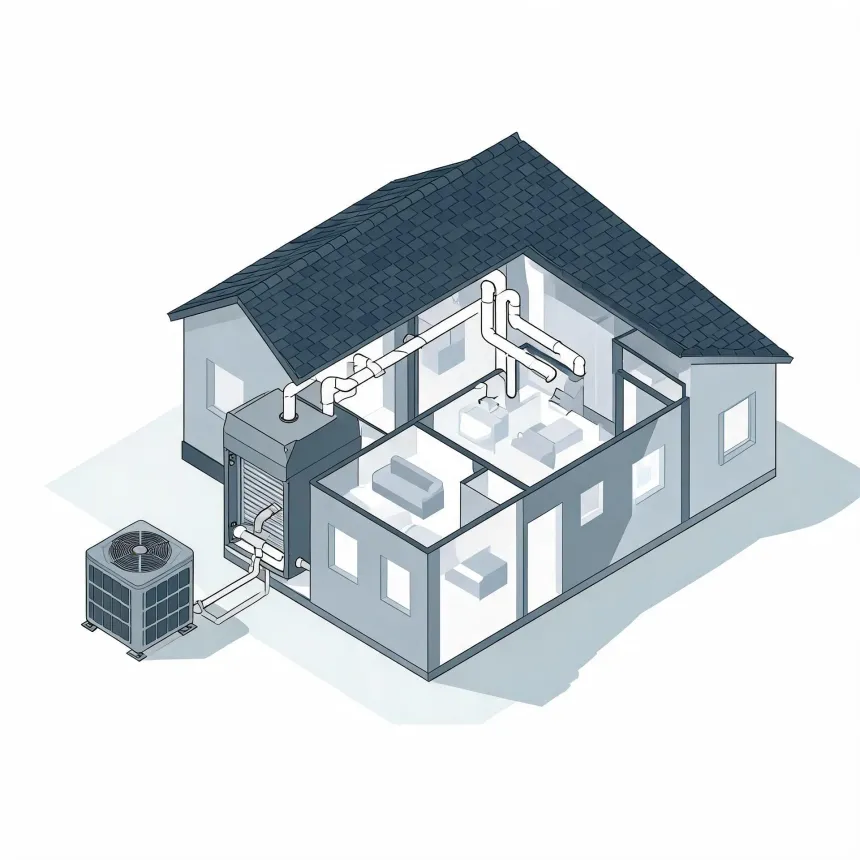
Isometric illustration of a cutaway single-story house showing interior rooms, ductwork running from an indoor air handler, and an outdoor condenser unit on a pad beside the building.
Your air conditioner works hardest from June through August.

NOAA nClimDiv, 1991–2020 normals

Cooling in Polk County starts up in June and runs through August.

May is the month to get the unit checked, before it has to work.

Three months of hard runningJune through August, Polk County afternoons average 83°F with the air feeling heavier still.

Half the homes in Polk County were built in 1982 or later, so a lot of the air conditioners here still have plenty of working life left in them. A yearly tune-up is what keeps it that way. The technician cleans the coil, checks the refrigerant charge, and makes sure the electrical connections are tight before summer puts any load on them. A unit that gets this every year tends to run the way it was built to run for its whole working life, instead of losing efficiency a little at a time until something fails. If your system came with the house, a check this spring tells you what shape it's really in.

Have the outdoor unit checked before storm season gets to it

Wind and hail come through Polk County most years, and the condenser sits outside taking all of it. A tune-up now gets a technician eyes on the unit before summer load hides a problem behind a breakdown.

Find a contractor
A man in a cap, dark t-shirt and tan work pants walks up concrete steps toward a dark green front door, carrying a waxed canvas tool bag, with a potted shrub beside the entry.
An outdoor residential air conditioning condenser unit mounted on a concrete pad, surrounded by gravel with a blue sky in the background.

Skip a Year and the Wear Doesn't Pause With It

Skip a season and the unit doesn't fail right away. It keeps running, just worse. Dust builds on the coil fins and the system loses some of its ability to shed heat, so the compressor runs longer to do the same job. Longer run times mean more heat sitting in parts that were only built to handle so much of it. A capacitor that's starting to weaken gets no easier a season than the one before. It just gets asked to do the same job with less in reserve, and eventually it can't start the compressor at all. None of this shows up as a warning. It shows up as the unit not turning on.

A Dirty Filter Backs Up the Whole System

Air has to pass through the filter before it reaches the coil. When the filter loads up with dust, less air gets through, and the evaporator coil runs colder than it should. Past a certain point it frosts over. Once ice builds on the coil, it blocks even more airflow, and the unit can end up running without cooling the house at all.

The Drain Line Decides Where the Water Goes

The evaporator coil pulls moisture out of the air, and that water has to leave through the condensate drain. Algae and dirt build up inside that line the same way they do in any drain that sits wet. A clogged line backs water up into the pan under the coil, and from there it finds the nearest way out, usually down through the ceiling or wall below the unit.

Aerial view of a gray central air conditioning condenser unit on a concrete pad next to a house with vinyl siding.

Book your AC tune-up in May, before homes here start needing cooling in June.

  1. Jan
  2. Feb
  3. Mar
  4. Apr
  5. May
  6. Jun
  7. Jul
  8. Aug
  9. Sep
  10. Oct
  11. Nov
  12. Dec

A tune-up checks the refrigerant charge, cleans the coils, tests the capacitor and tightens the electrical connections.

A tune-up covers the parts of the system that wear down slowly and quietly fail. The technician checks the refrigerant charge against what the manufacturer specifies, because a system low on charge makes the compressor work harder to hit the same temperature. Electrical connections get tightened, since a loose connection builds resistance, and resistance builds heat right at the lug. The capacitor gets tested under load rather than just looked at, because a capacitor can measure fine sitting still and still fail the moment the compressor tries to start. The condenser coil gets cleaned so it can shed heat the way it was designed to, and the contactor gets checked for pitting, since that's the part switching the compressor on and off every single cycle. None of this fixes something broken. It finds the part that's close to breaking while it still has an easy fix.