





A dark two-story house with a wraparound covered porch sits behind a trimmed hedge and a mown lawn, framed by two large leafy trees.

AC Maintenance in Independence, IA

Tell us about the job

Takes about a minute. No obligation.

Tune-up, service, or cleaningCentral ACBuchanan County, IA
Step 1 of 2

What ZIP code is the job in?

Check the filter yourself once a month and swap it when it looks gray or clogged. A dirty filter is the one thing that causes real damage if it's ignored, since it chokes the airflow across the coil and can lead to a frozen coil or a struggling compressor. Walk outside too and look at the condenser. Keep leaves, grass clippings and anything else out of the fins, and trim back any plants so air can move freely around it. Inside, make sure nothing is blocking the vents or the return grille. Beyond that, leave the refrigerant level, the electrical connections and the coil cleaning to a licensed contractor, since those need tools and training you won't have at home.

3 months
June through August, your air conditioner is on duty
81°F
the average summer afternoon it cools against
33 hail events
in ten years, and hail bends the fins on outdoor coils
93 wind events
in ten years, and wind drives debris into outdoor units
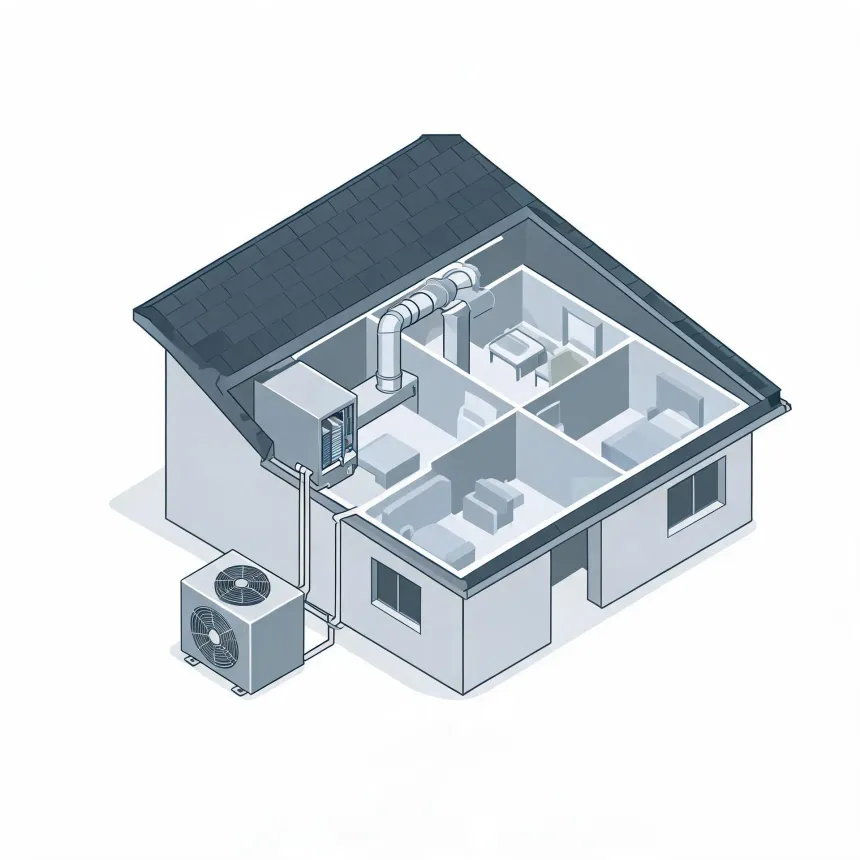
Isometric cutaway illustration of a single-story house showing interior rooms, ceiling ductwork connected to an indoor air handler, and an outdoor condenser unit beside the exterior wall.
Your air conditioner works hardest from June through August.

NOAA nClimDiv, 1991–2020 normals

AC runs June through August in Buchanan County.

May is the month to get it checked here, before it has to work.

Half the homes here were built by 1973, old enough that a yearly check matters

Half the homes here were built by 1973
Cooling runs June through August
Summer afternoons average 81°F

Buchanan County sees its share of rough weather, including 93 damaging wind events and 33 hail events over the past ten years. None of that is aimed at your AC specifically, and none of it changes what the unit needs. A condenser sitting outside takes whatever the sky does regardless of the maintenance schedule. What a yearly check does is catch the ordinary wear, a weak capacitor, a low charge, a dirty coil, before it turns into a breakdown in the middle of summer. One visit before the season starts covers it.

Book it before the season

It starts running hard in the first month of the season here. Book the check the month before.

Find a contractor
A man in a cap, gray long-sleeve shirt and tan work pants carries a canvas tool bag up concrete steps toward a dark green paneled front door, with a potted shrub to the right.
A gray cylindrical air conditioning condenser unit mounted on a concrete pad next to a light-colored vinyl-sided house exterior.

What a yearly check catches before it fails

The capacitor is the part most likely to fail without any warning, and a gauge can show it losing strength before it fails outright. A tech checks refrigerant pressure too, since a system low on charge cools poorly and strains the compressor to do it. The coil gets a real cleaning, not just a glance, because dirt on the coil acts like a blanket and makes the whole system work harder to move the same heat. Electrical connections get checked for corrosion and looseness, since a loose connection builds heat at that spot every time the unit runs. None of this shows up by looking at the outside of the unit. It shows up months later as a compressor that won't start or a system that runs constantly and still can't keep up.

The drain can stop a working system cold

The condensate line carries off the water the coil pulls out of the air, and it runs slow and warm, which is exactly what algae needs to grow. Once it clogs, the pan fills and the float switch cuts the system off, or if there's no switch, the water backs up and spills out of the pan. Nothing else on the unit is broken. It just has nowhere for that water to go.

The coil hides its own damage

A coil caked with dirt loses its grip on moisture, and the fins stay wetter longer between cycles, which lets scale and grime build up faster than on a clean coil. The buildup also narrows the airflow path through the fins, so the blower works harder to push the same air across it. A dirty filter speeds this along, but even a clean one doesn't stop it forever. The coil needs its own cleaning on its own schedule.

An outdoor air conditioning condenser unit on a concrete pad next to the gray vinyl siding of a residential home.

Book your AC tune-up in May, before homes here start needing cooling in June.

  1. Jan
  2. Feb
  3. Mar
  4. Apr
  5. May
  6. Jun
  7. Jul
  8. Aug
  9. Sep
  10. Oct
  11. Nov
  12. Dec

A tune-up checks the refrigerant charge, cleans the coils, tests the capacitor and tightens the electrical connections.

Skip enough checks and the system doesn't fail all at once. The capacitor weakens a little more each season, the coil collects a little more dirt, and the unit keeps running through it because that's what it's built to do, right up until the point it can't. A compressor that's been drawing hard off a weak capacitor for a year doesn't give notice before it quits. A coil that's gone years without cleaning isn't pulling the moisture or the heat it used to, so the system runs longer to do the same job, and that extra runtime wears on everything else in it. None of this shows up as a strange noise or a warning sign you'd catch walking past the unit. It shows up as a system that runs almost constantly and still falls behind, and then one summer it doesn't come on at all.