A dark two-story house with a covered front porch and shrubs, framed by large leafy trees, photographed from ground level across a mown green lawn with blurred grass in the foreground.

AC Maintenance in Vinton, IA

Tell us about the job

Takes about a minute. No obligation.

Tune-up, service, or cleaningCentral ACBenton County, IA
Step 1 of 2

What ZIP code is the job in?

The charge and the coil tell on themselves

A refrigerant gauge shows a low charge before the house ever feels warm for it. The same visit, a tech can see a coil going green with corrosion or caked in dust, both of which choke airflow long before the air coming out feels wrong.

A weak capacitor still starts the unit

A capacitor can test weak and still kick the compressor on every time, right up until the day it doesn't. Caught during a tune-up, it's a part swapped on a slow morning instead of a breakdown on the hottest day of the year.

3 months
June through August, your air conditioner is on duty
82°F
the average summer afternoon it cools against
64 hail events
in ten years, and hail bends the fins on outdoor coils
52 wind events
in ten years, and wind drives debris into outdoor units
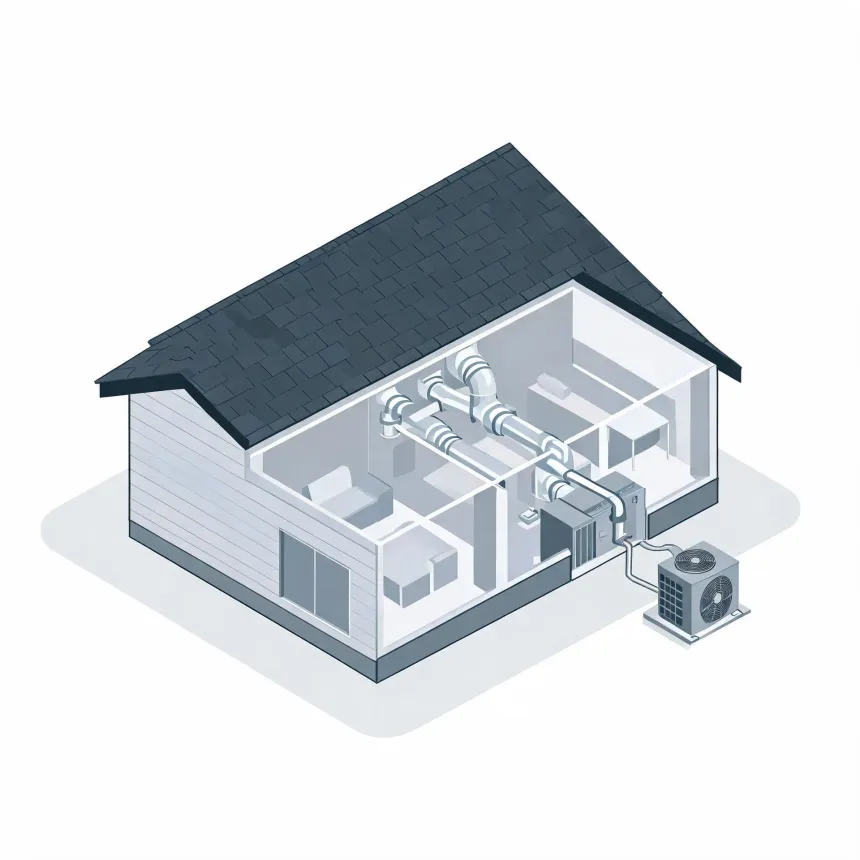
Isometric cutaway illustration of a house with a dark shingled roof, showing interior ductwork connected to an indoor air handler and an outdoor condenser unit beside the building.
Your air conditioner works hardest from June through August.

NOAA nClimDiv, 1991–2020 normals

Air conditioners in Vinton run about three months a year, June through August.

One tune-up before June covers the stretch this unit actually has to work.

Benton County weather takes out power, not air conditioners

157 severe weather events from 2015 to 2024
15% of homes statewide lost power a day or more in 2024
52 damaging wind events from 2015 to 2024

Half the homes in Benton County were built in 1964 or earlier. An air conditioner doesn't last that long, but in a lot of these houses it's the second or third system to run through the same ductwork, and nobody's handed you a maintenance log when you move in. That's the real argument for a yearly check instead of waiting for a problem. A tech looking at the unit once a year builds a picture of how it's running over time, so a slightly weak capacitor or a coil losing efficiency shows up as a change from last year, not just a guess. Skip the yearly look and the first sign of trouble might be the unit not starting at all.

Get this year's system on record before summer

If you don't know how many systems have run through your ductwork, a yearly check is what builds that history. Book the tune-up now and a tech can catch a weak capacitor or a coil losing efficiency while it's still an easy fix.

Find a contractor
An outdoor air conditioning condenser unit mounted on a concrete pad beside a house, with electrical conduit running to a wall-mounted disconnect box.

Skipped maintenance doesn't break the unit today

A skipped tune-up doesn't make the unit quit right away. It keeps running, just worse. Dirt builds up on the coil and airflow drops, so the compressor works harder to move the same amount of heat. That strain shortens its life. A dirty filter does the same thing from the other direction, starving the system of airflow until something downstream pays for it. None of this shows up as a sudden noise or a smell. It shows up as a house that takes longer to cool, a unit that runs longer than it used to for the same result. By the time it's obvious, the part that failed was usually weak for a while before it gave out.

A gauge and a reading, not a glance

A thorough tune-up means the tech hooks up gauges and checks refrigerant pressure against what the system calls for, pulls the blower wheel if it looks dirty, and tests the capacitor and contactor under load instead of eyeballing them. A quick visit means someone looks at the unit, listens for a minute, and leaves. Both get written up as a tune-up.

Ask what the filter and drain line looked like

A tech who checked the condensate drain line and cleared it, or who pulled the filter and told you its condition, did more than glance at the unit. Both are easy to skip, and both are common reasons a system backs up or starts short-cycling once the real heat sets in.

Aerial view of a gray central air conditioning condenser unit on a concrete pad next to a house with vinyl siding.

Book your AC tune-up in May, before homes here start needing cooling in June.

  1. Jan
  2. Feb
  3. Mar
  4. Apr
  5. May
  6. Jun
  7. Jul
  8. Aug
  9. Sep
  10. Oct
  11. Nov
  12. Dec

A tune-up checks the refrigerant charge, cleans the coils, tests the capacitor and tightens the electrical connections.

A proper tune-up starts outside at the condenser fan and coil, making sure the fan spins freely and the coil fins aren't bent flat against airflow. Inside, the tech checks the evaporator coil and the blower wheel, since a coil caked in dust or a wheel coated in grime cuts airflow the same way a dirty filter does. Refrigerant gets checked against the system's actual charge, not just a glance at the lines. The capacitor and contactor get tested under load, because a capacitor can read weak and still start the compressor every time until it doesn't. The condensate drain line gets checked for a clog, since a backed-up line can shut the system down or let water sit where it shouldn't. Electrical connections get tightened, since a loose connection generates heat and wears out the part it's feeding.