11 months of run time
Mini splits here carry both the summer cooling and most of the winter heat, since gas handles the rest. That kind of year-round load wears parts faster than a unit that only runs part of the year.
No calling every shop in Johnson County
A blinking light on your mini split is the system telling you something specific, and which color or pattern it is changes what's wrong. This page goes through what the blink codes mean and what usually causes them. Skip the search for who repairs these units in Iowa City and get matched with one local contractor who works on mini splits all year.
Skip the callsA blinking light on a mini split is a fault code, and the number of blinks or the color pattern points to a specific problem rather than a general warning. Most indoor units flash a count you can read like Morse code, pausing between sets, and that pattern usually traces back to things like a frozen coil, a blocked drain line, a communication error between the indoor and outdoor unit, or a refrigerant issue. Winters here get hard enough that outdoor units can ice over if the defrost cycle isn't working right, which is a common cause of a blink code showing up when the system is running in heat mode. The exact meaning depends on the brand, since Mitsubishi, Daikin, Fujitsu and others each use their own codes, so matching the pattern to the right chart matters before anyone starts taking the unit apart. The blinking itself won't tell you which part failed, only that the system has caught something wrong and shut down or is trying to protect itself.
Cooling runs June through August
Three months of cooling, June through August, means the compressor side gets a hard push every summer here, often right when the blinking starts.
Heat runs October through May
Eight months of heat, October through May, means the same unit is leaning on its heat pump side most of the year, with little downtime to hide a fault.
Power here costs 13.00 cents per kilowatt-hour
At 13.00 cents per kilowatt-hour, a blinking unit that's short-cycling or running a stuck defrost cycle costs you more every day it goes unfixed.
NOAA nClimDiv 1991-2020 · EIA-861 2025
Some blink patterns match a code list the manufacturer publishes for that model. Mitsubishi, Fujitsu, Daikin and the rest each use their own counts and colors, so the same two blinks can mean a clogged filter on one brand and a communication fault on another. If you still have the manual or can find the model number on the indoor unit, the pattern tells you what the system is reporting before anyone opens it up. That saves a visit spent just narrowing down the problem. A contractor who works on mini splits through the summer rush and the winter cold here has likely seen your brand's codes enough times to know what they usually mean on sight.
Other times the light blinks and there is no public list, or the pattern does not match anything in the manual you can find. Some manufacturers only release full code tables to licensed techs, and some patterns point to a board-level fault that needs a meter to confirm. Guessing from a blink alone risks replacing a part that was never the problem. This is where calling someone who installs and repairs these units regularly matters more than the code itself. They carry the diagnostic tools and the service documentation that a homeowner searching online does not have access to, and they can usually tell you over the phone whether it is worth a visit.




Mini splits here carry both the summer cooling and most of the winter heat, since gas handles the rest. That kind of year-round load wears parts faster than a unit that only runs part of the year.
Instead of calling around and repeating the blink pattern to different companies, you describe it once to a local contractor who works on these systems all season and knows what that code usually means.


A licensed pro who works in Johnson County gets your request.
One form replaces the calls you'd make to find a mini split pro.
Sending the form costs nothing.


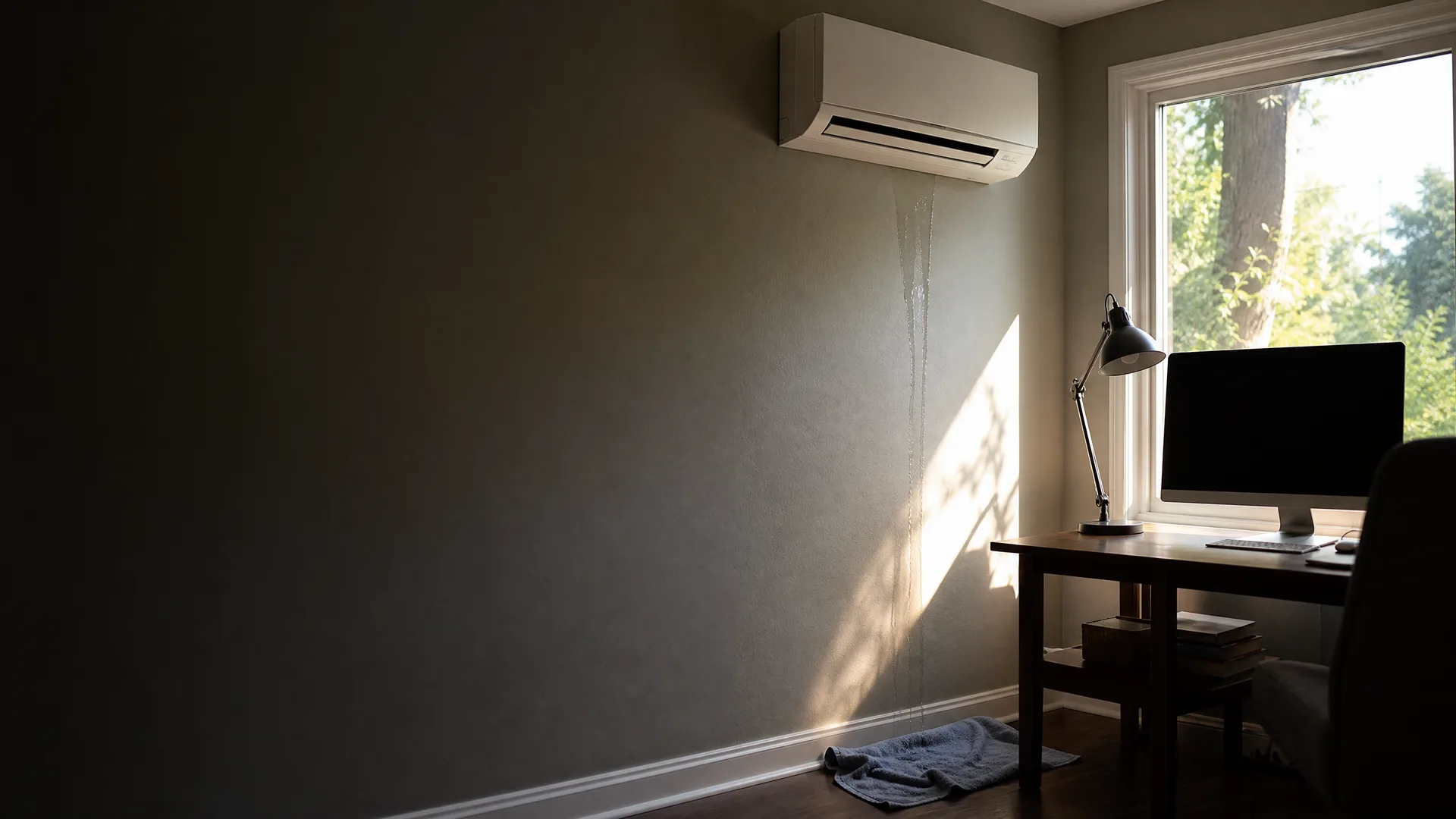
You're at your desk on a July afternoon, the kind where the air outside sits heavy and the mini split has been running since morning. You notice the wall under the indoor unit first, a dark streak soaking down toward the baseboard. The light on the unit is blinking, steady, like it's been doing it for a while. You grab a towel from the bathroom and lay it against the wall, then look up and see a drop forming at the corner of the unit before it falls. The room still feels cool enough, the air still moving out of the vent, but the wall keeps getting wetter and the towel is already soaked through.
Three months of summer cooling isn't much strain by itself, but your mini split in Iowa City also carries most of the winter heat, so the compressor rarely gets a true break. A blink that shows up now is more likely a real fault than a fluke.
NOAA nClimDiv 1991-2020

No light, no noise out of place. The curtains nearby barely move from the airflow, but the room holds its temperature steady. A unit doing this is reading the room right and sending air where it should, no code waiting to be read.

Dust has built up across the casing, and the panel is lit with a pattern instead of sitting dark. That grime says the filter hasn't been serviced in a while, and the blink underneath it is the unit telling you exactly which system it's unhappy with.

A blinking light on your mini split is telling you something specific: how many blinks, how fast, what color. Match that to the indoor unit's brand and you know roughly what failed before anyone opens the panel. That's the whole answer. What happens next is someone local tracing it to the actual part, whether that's a clogged drain line, a bad sensor, or a compressor under strain from a Johnson County winter.
That part is the harder one to arrange on your own, calling around to find someone who works on your brand, explaining the blink pattern over the phone to three different shops, then weighing quotes that don't describe the same job. One request here goes to one licensed contractor near Iowa City who sees these units every season and knows what that code usually means on your system. No repeat calls, no pile of quotes to sort through, just someone who shows up knowing what to check first.



Explain it one time
A licensed pro who repairs mini splits in Johnson County gets your request.
