





Aerial view of a square outdoor air conditioning condenser unit on a concrete pad beside a house wall with a sliding glass door.

AC Repair in Boone, IA

Tell us about the job

Takes about a minute. No obligation.

RepairCentral ACBoone County, IA
Step 1 of 2

What ZIP code is the job in?

Most AC calls come down to a handful of usual suspects. The capacitor is one. It gives the compressor and fan motor the jolt they need to start, and when it weakens the system struggles to kick on or shuts off on its own. A dirty condenser coil is another. When it's caked with dirt and grass clippings, the system can't shed heat properly and it runs long and hard trying to keep up. Low refrigerant almost always means a leak somewhere in the line, not normal use, since the system doesn't consume refrigerant over time. And a clogged drain line will trip the safety switch and shut the whole system down to protect against water damage, even though nothing else is wrong.

3 months
June through August, your air conditioner is on duty
82°F
the average summer afternoon it cools against
40 hail events
in ten years, and hail bends the fins on outdoor coils
37 wind events
in ten years, and wind drives debris into outdoor units
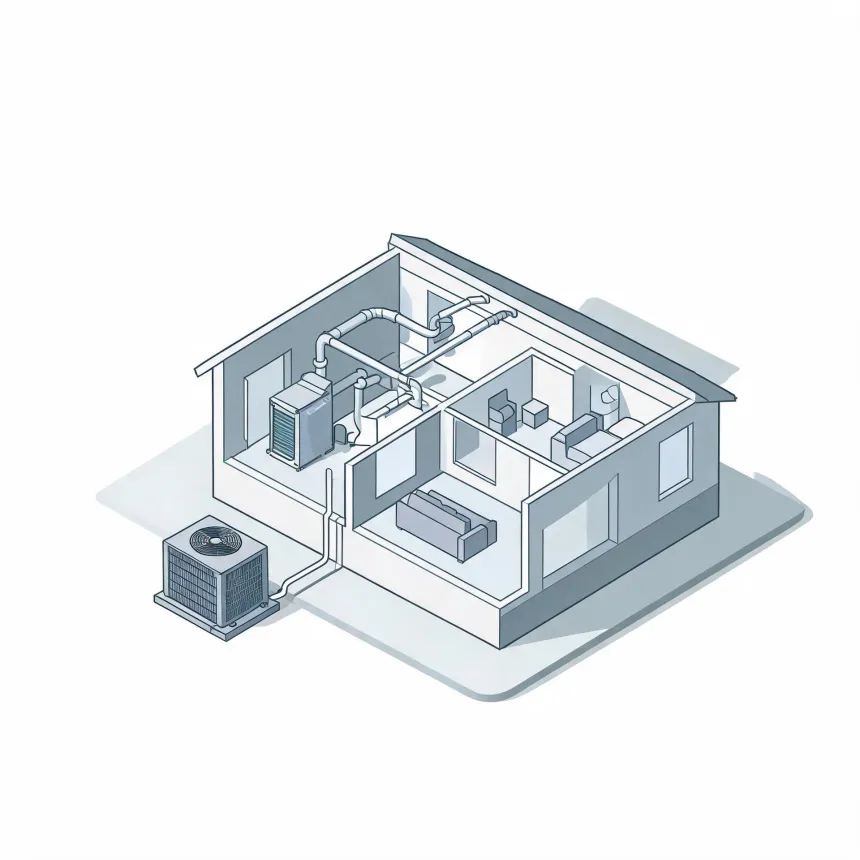
Isometric line illustration of a cutaway house showing interior rooms, a furnace or air handler with ductwork, and an outdoor condenser unit beside the building.
Your air conditioner works hardest from June through August.

NOAA nClimDiv, 1991–2020 normals

An aging compressor rarely fails on its own, it usually drags a weak capacitor or low charge down with it.

If the system is old and the repair bill is climbing, that's the point to ask about replacing it instead of patching it again.

Half the homes in Boone County date to 1960 or earlier, old enough that the AC may be on its last stretch

Half the homes here were built by 1960
Cooling runs June through August
Summer afternoons average 82°F

Three months of cooling a year, June through August, with afternoon highs around 82, is a light workload compared to most places. A system here isn't fighting long stretches of extreme heat day after day. So when something goes wrong, it's less likely the unit was simply run into the ground and more likely one part failed, like a capacitor or a coil that needed cleaning. That's worth knowing before you decide whether to fix it. A repair on a system that hasn't been overworked usually holds up well, since the rest of the unit isn't far behind it.

Worth asking what the repair is buying you

If the AC came with the house, ask the contractor how much life is left in it before you pay for the repair. A capacitor or coil job is worth doing on a system with years ahead of it. That's a different call if the unit is already old.

Find a contractor
A man in a cap, work shirt and tan pants, seen from behind, carries a canvas tool bag up concrete steps toward a dark green front door, with a potted shrub to the right.
An outdoor air conditioning condenser unit mounted on a concrete pad surrounded by gravel, photographed against a partly cloudy blue sky.

What to check before you call

Before anyone comes out, check the thermostat batteries and make sure it's set to cool and below room temperature. Go outside and look at the condenser. If the fan isn't spinning at all, or it's spinning slow and sounds like it's straining, that's worth mentioning when you call. Check the breaker panel too. A tripped breaker will shut the whole system down with no other warning. Inside, pull the air filter and hold it up to a light. If you can't see light through it, airflow is choked and that alone can cause the coil to freeze or the system to short cycle. Look at the vents and feel whether air is moving at all, even if it's not cold. And check the outdoor unit for anything blocking it, leaves, grass clippings, a fence panel too close. None of this tells you exactly what's wrong, but it rules out the simple stuff before you pay someone to find it.

Warm air instead of cold

The system runs, the fan moves air, but what comes out of the vents isn't cold. This points to low refrigerant, a failing compressor, or a coil so dirty it can't pull heat out of the air anymore. It's rarely a quick fix, since the cause is inside the system rather than something you can see or clean yourself.

Short cycling or won't stop running

A system that shuts off a few minutes after starting is usually tripped up by a dirty coil, a weak capacitor, or a thermostat sensing the room wrong. One that runs constantly and still can't cool the house is usually low on refrigerant or losing its grip on the airflow it needs. Either sign means a part needs attention before it takes something else down with it.

Overhead view of an outdoor AC condenser unit on a concrete pad next to a house with a dark shingle roof.

A new air conditioner would save little on running costs in Boone County, so the repair decision comes down to the unit's condition.

  • A new one at the federal minimum, 13.4 SEER2$180 a year
  • An older air conditioner$200 a year

Estimates for a typical Boone County home, compared with an older unit built to the previous federal minimum, from EIA household energy data, Iowa fuel prices and NOAA climate normals. Your home will differ.

Repair makes sense when a part like a capacitor or contactor has failed.

Replacement makes sense when the compressor has failed or the system uses R-22 refrigerant, which is no longer made.

A diagnostic call starts outside at the condenser. The contractor checks that the fan spins freely and the compressor kicks on, then checks the refrigerant pressure with gauges, since that number points at a leak or a failing compressor before anything gets opened up. Back inside, they check the air handler and coil, looking for ice, dirt, or a drain line backed up enough to trip the float switch. They'll test the capacitor directly rather than guess from the symptoms, since a weak one can still start the system some of the time. Electrical connections get checked too, since a loose wire can mimic a bad part and send you toward the wrong repair. By the end they can usually point to the one part that failed rather than just the symptom it caused.