






A row of dark-painted single-story cottages with gabled shingle roofs behind a mowed lawn, a trimmed hedge in the left foreground and large leafy trees overhead under an overcast sky.

AC Repair in Cedar Rapids, IA

Tell us about the job

Takes about a minute. No obligation.

RepairCentral ACLinn County, IA
Step 1 of 2

What ZIP code is the job in?

Linn County saw 344 severe weather events between 2015 and 2024. That includes 156 damaging wind events, 139 hail events, and 17 tornadoes touching down. An outdoor AC unit sits outside through all of it, with nothing but a thin coil and a fan blade between it and whatever comes through. Hail dents the fins and bends them shut, which chokes off airflow even when the unit still turns on. Wind-blown branches and debris do the same kind of damage, sometimes without leaving a mark you'd notice from the back porch. A unit that still runs after a storm isn't the same as a unit that came through it clean.

3 months
June through August, your air conditioner is on duty
82°F
the average summer afternoon it cools against
139 hail events
in ten years, and hail bends the fins on outdoor coils
156 wind events
in ten years, and wind drives debris into outdoor units
Isometric line illustration of a cutaway single-story building showing interior rooms, ceiling ductwork, an indoor air handler, and an outdoor condenser unit connected by a line set.
Your air conditioner works hardest from June through August.

NOAA nClimDiv, 1991–2020 normals

A struggling compressor draws more current the longer it runs.

Let a refrigerant or airflow problem ride and the compressor pays for it, not just the thermostat setting.

Three months of hard running is what this unit has to survive

Cooling runs June through August
Summer afternoons average 82°F
156 damaging wind events from 2015 to 2024
The first hot week finds every weak partCooling starts in June here, and whatever didn't get fixed over the winter shows up fast.

When a storm has already been ruled out, the next question is how the unit is holding up under a Cedar Rapids summer. Three months isn't long, but afternoons averaging 82 degrees mean the compressor is running close to flat out most of that stretch. A unit that's lost some refrigerant or has a weak contactor can still start up and blow air, so it won't always announce itself the way storm damage does. That's the harder case to catch from outside, and it's also the one that gets worse the longer it runs. A tech checking the charge, the electrical connections and the coils will find it before the compressor takes the damage instead of the thermostat.

A unit that survived the storm still needs a look

If the unit outside took hail or a branch this year, don't go by whether it still turns on. Bent fins and a damaged coil can choke airflow long before the system quits. Have it checked now so a storm mark doesn't turn into a compressor problem later.

Find a contractor
A man in a cap and olive work shirt carries a canvas tool bag up concrete steps toward a dark green panelled front door of a house with horizontal siding and a potted shrub.
A gray cylindrical air conditioning condenser unit mounted on a concrete pad next to a light-colored vinyl-sided house exterior.

What you can check before the truck shows up

Before anyone comes out, there are a few things worth looking at yourself. Check the thermostat first. Make sure it's set to cool and set below room temperature, and if it runs on batteries, swap them. Go outside and look at the condenser. If the fan isn't spinning and you don't hear any hum, check the breaker panel for a tripped breaker before assuming the worst. Look at the coil and the fins around the unit. If you see them caked with grass clippings, leaves or dirt, that alone can choke off airflow enough to stop the system cooling right. Inside, pull the air filter and hold it up to a light. If you can't see light through it, it's restricting airflow to the point the coil can freeze over, and a frozen coil will often get blamed for a failed compressor when the real problem is upstream of it. Check the vents in each room to make sure none are closed or blocked by furniture. Last, look for ice on the copper lines running to the outdoor unit. Ice there means something is wrong with airflow or charge, and running the system more will only make it worse, so switch it off and let it thaw before anyone touches it.

The capacitor is usually the first thing to go

The start and run capacitor gives the compressor and fan motor the push they need to get going. Heat wears it down over time, and once it's weak the compressor can hum and struggle to start instead of kicking on clean. A fan that spins slow or not at all, or a unit that clicks and tries a few times before it catches, usually points here. It's a small part, but a motor that keeps trying to start against a bad capacitor can burn itself out in the process.

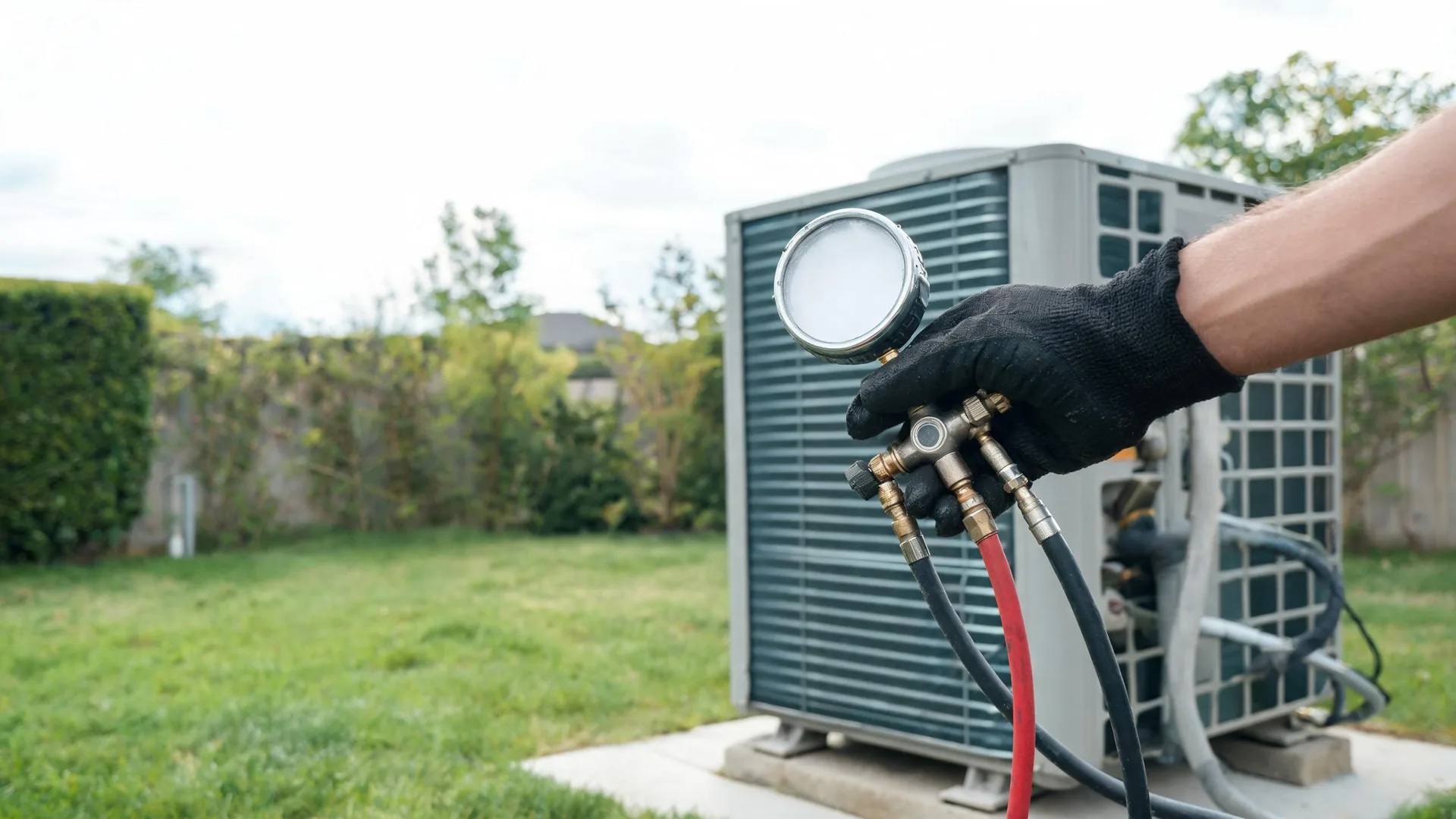
Low refrigerant means a leak, not just a top-off

An AC doesn't use up refrigerant the way a car uses gas. If the charge is low, it's low because it's leaking out somewhere, usually at a fitting, a coil, or a line that's rubbed through. Adding refrigerant without finding the leak just means doing it again later, and running the system low on charge for a long stretch makes the compressor work harder than it's built for. That's the part nobody wants to replace, so catching a slow leak early is worth more than it looks.

Overhead view of a gray residential air conditioning condenser unit mounted on a concrete pad beside a house with asphalt shingle roofing.

A new air conditioner would save little on running costs in Linn County, so the repair decision comes down to the unit's condition.

  • A new one at the federal minimum, 13.4 SEER2$160 a year
  • An older air conditioner$180 a year

Estimates for a typical Linn County home, compared with an older unit built to the previous federal minimum, from EIA household energy data, Iowa fuel prices and NOAA climate normals. Your home will differ.

Repair makes sense when a part like a capacitor or contactor has failed.

Replacement makes sense when the compressor has failed or the system uses R-22 refrigerant, which is no longer made.

Not every problem is worth fixing, and a tech who's been doing this a while can usually tell early. Age matters less than what's actually failed. A bad capacitor or contactor is a small, cheap part on any unit and worth replacing even on an older system. A compressor is a different question. It's the most expensive part out there, and once it's failing, the rest of the unit is usually old enough that sinking money into just that one part doesn't make sense. The other thing to weigh is the refrigerant it uses. Older systems run on a refrigerant that's being phased out, and getting it serviced can cost more than the same repair on a newer unit, simply because the refrigerant itself is harder to get. A unit that needs one part fixed is a repair. A unit where the compressor's going and the refrigerant is the old kind is usually a sign to stop patching it and start pricing a new one.