





Aerial view of a gray central air conditioning condenser unit on a concrete pad next to a house with vinyl siding.

AC Repair in Oelwein, IA

Tell us about the job

Takes about a minute. No obligation.

RepairCentral ACFayette County, IA
Step 1 of 2

What ZIP code is the job in?

Cooling in Oelwein runs June through August, and most AC trouble shows up right at the start of that stretch. The system sits unused all spring, then gets asked to run hard the first warm week of June. Whatever was already weak, a tired capacitor, a low charge, a clogged filter nobody changed, gets found out fast. If your AC is struggling now, in May, that same part is worth checking before June arrives. A repair done before the season starts holds up better than one done once the heat sets in.

3 months
June through August, your air conditioner is on duty
80°F
the average summer afternoon it cools against
24 hail events
in ten years, and hail bends the fins on outdoor coils
43 wind events
in ten years, and wind drives debris into outdoor units
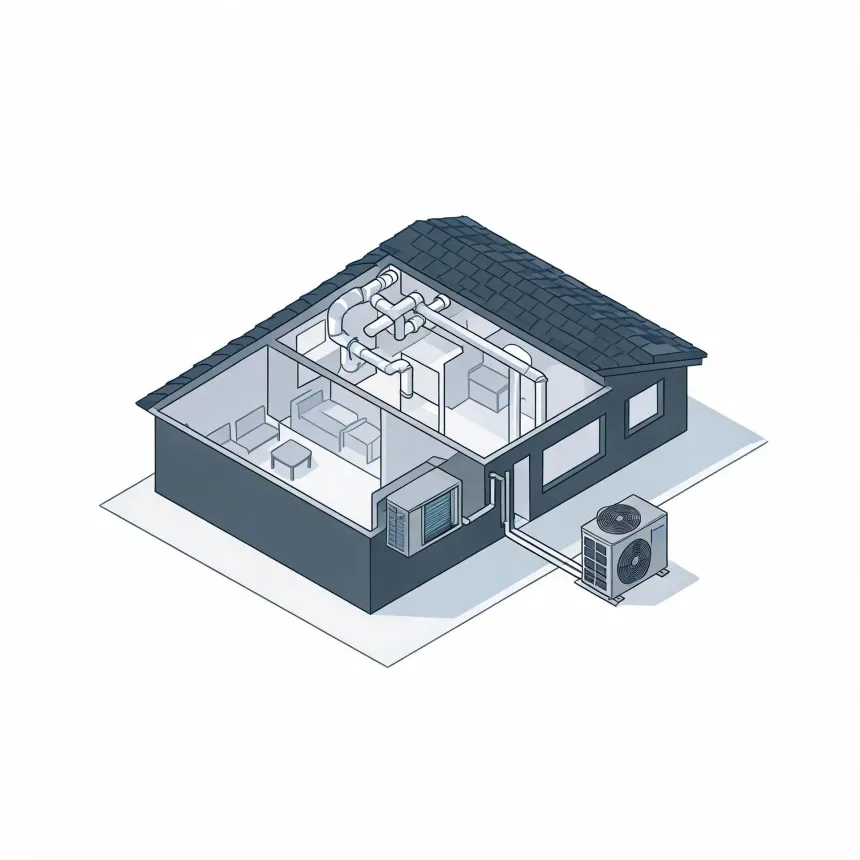
Isometric line illustration of a cutaway single-story house showing interior rooms with furniture, ceiling ductwork, an indoor air handler, and an outdoor condenser unit connected by lines along the exterior wall.
Your air conditioner works hardest from June through August.

NOAA nClimDiv, 1991–2020 normals

Summers here are short, three months of cooling and afternoon highs around 80.

An AC in Oelwein isn't worn down by the climate, so when it breaks, repair is usually the right call.

Half the homes here date to 1954 or earlier, so the AC itself is often older than the house wiring

Half the homes here were built by 1954
Cooling runs June through August
Summer afternoons average 80°F
A mild climate, so repair usually makes senseThree months of cooling a year means less wear on the system to begin with

If the AC in your house came with it, ask the contractor how much life it has left, not just what today's fix will solve. A unit near the end of its run can be patched once and still fail again next season. That's a fair question to ask before the repair starts, not after it's done. The contractor working on the unit can tell you its age and condition without guessing.

Get it looked at early

Problems tend to show up in the first weeks of the season, when the load hits a part that was already weak.

Find a contractor
An outdoor air conditioning condenser unit mounted on a concrete pad beside a house, with electrical conduit running to a wall-mounted disconnect box.

What actually gives out

Most AC failures start with something small that was already struggling before the unit ever quit. The capacitor loses its charge over time and stops giving the compressor and fan motor the kick they need to start. The contactor's switch pits and burns from making and breaking the circuit over and over. A dirty coil cuts off airflow and makes the compressor work against itself until it overheats. A low refrigerant charge almost always means a leak somewhere in the lines, not the system using it up. None of these happen because a unit is run hard. They happen because a weak part finally gets asked to do its job under load and can't.

What you'll notice first

The AC runs longer than it used to and still doesn't get the house as cool. Short cycling is another early sign, the unit kicks on, shuts off, then starts again before the house has cooled at all. Warm air coming out of the vents, a hissing or clicking near the outdoor unit, water pooling near the indoor coil. Any of these means something is already failing, not just working harder than usual.

What's worth a call now

A strange smell or a grinding, squealing noise from the outdoor unit means a part is wearing out, not just dirty. Ice on the refrigerant lines points to restricted airflow or a low charge, either one needs a contractor, not a thermostat adjustment. Waiting usually doesn't fix any of this. It gives the weak part more chances to fail completely, often at the worst possible time.

An overhead view of a residential air conditioning condenser unit mounted on a concrete pad next to a house with vinyl siding.

A new air conditioner would save little on running costs in Fayette County, so the repair decision comes down to the unit's condition.

  • A new one at the federal minimum, 13.4 SEER2$130 a year
  • An older air conditioner$140 a year

Estimates for a typical Fayette County home, compared with an older unit built to the previous federal minimum, from EIA household energy data, Iowa fuel prices and NOAA climate normals. Your home will differ.

Repair makes sense when a part like a capacitor or contactor has failed.

Replacement makes sense when the compressor has failed or the system uses R-22 refrigerant, which is no longer made.

A repair call usually comes down to one part failing, not the whole system giving out. A compressor is the expensive part to replace, and most repairs never touch it. If the compressor itself has failed, that's the one case where putting more money into the unit is worth questioning. Everything else, a capacitor, a contactor, a blower motor, is a normal fix on a system that still has good years left in it. Age matters more than the repair itself. The same failure on a newer unit and an old one can call for different answers, even though the part is identical.