A low-angle view across a mown lawn toward a two-story dark-sided house with a covered front porch, flanked by large green trees under an overcast sky.

AC Repair in Ottumwa, IA

Tell us about the job

Takes about a minute. No obligation.

RepairCentral ACWapello County, IA
Step 1 of 2

What ZIP code is the job in?

Check the thermostat and the breaker first

Make sure the thermostat is set to cool and the setpoint is actually below room temperature. Then check the breaker panel for the outdoor unit and the furnace or air handler. A tripped breaker or a thermostat bumped to the wrong mode causes a surprising number of no-cool calls, and both are worth ruling out before anything else.


Look at the filter and the outdoor unit

Pull the air filter and hold it up to a light. If you can't see light through it, that's choking airflow and can cause the coil to freeze over. Outside, check that the condenser isn't buried in leaves or grass clippings, since the unit needs open airflow around it to shed heat. Neither fix needs a tool, but if the coil is already frozen, let it thaw before anyone tries to diagnose what's underneath.

3 months
June through August, your air conditioner is on duty
83°F
the average summer afternoon it cools against
27 hail events
in ten years, and hail bends the fins on outdoor coils
69 wind events
in ten years, and wind drives debris into outdoor units
Isometric cutaway illustration of a single-story house showing interior rooms with furniture, overhead ductwork, an indoor air handler unit, and an outdoor condenser unit connected by lines at the side of the building.
Your air conditioner works hardest from June through August.

NOAA nClimDiv, 1991–2020 normals

A refrigerant leak just means low charge today, but a compressor running low on charge overheats and wears fast.

The longer a struggling AC runs, the more parts it can take down with it, so a small problem now beats a compressor replacement later.

Half the homes in Wapello County were built in 1958 or earlier, old enough that the AC has likely been replaced at least once

Half the homes here were built by 1958
Cooling runs June through August
Summer afternoons average 83°F
Three months of work a yearCooling runs June through August here, with afternoon highs around 83°F.

If the AC in your home isn't the one it was built with, find out how old the current one is before you pay for a repair. The data tag on the outdoor unit has the manufacture date on it. A compressor or coil swap on a unit already old enough to be a replacement itself is worth weighing against a new system instead of just fixing what's in front of you. A contractor can look at both in the same visit, what it takes to fix what's wrong now and how much life is likely left after that.

Ask how much life it has left

If your system came with an older house, it may be near the end of its life. Ask how much life it has left before paying for a big repair.

Find a contractor
A man in a dark shirt and brown work pants, seen from behind, carries a worn duffel bag up stone steps toward a dark green front door of a house with light siding and a potted shrub.
A gray residential air conditioning condenser unit mounted on a concrete pad outdoors, surrounded by green grass under a partly cloudy blue sky.

Every cycle wears something a little more

A capacitor is usually the first part to give out. It stores the charge that kicks the compressor and fan motor into motion, and that charge gets weaker with every cycle. Eventually the motor just hums instead of turning over. Contactors fail the same way, worn down by the small arc that happens each time they open and close. The compressor itself tends to go last, and usually not on its own. It fails because something upstream let it run hot or low on charge for too long before anyone caught it. None of these parts care about the calendar. What wears them out is how many times they've started and stopped, and whether anything was already wrong with the system while they did it.

Warm air instead of cold

If the blower runs but the air coming out isn't cold, the problem is usually on the refrigerant side, not the fan. A dirty outdoor coil, a low charge, or a failing compressor can all leave you with air movement and no cooling. This is different from no airflow at all, and it points the repair in a different direction.

Short cycling or never shutting off

An AC that turns on and off every few minutes is usually struggling with a bad thermostat sensor, a dirty coil, or a refrigerant problem. One that runs constantly and never satisfies the thermostat is usually losing the fight against heat, often from a charge that's too low or a coil that's too dirty to do its job. Either pattern is hard on the compressor and worth having looked at before it gets worse.

An outdoor air conditioning condenser unit on a concrete pad next to the gray vinyl siding of a residential home.

A new air conditioner would save little on running costs in Wapello County, so the repair decision comes down to the unit's condition.

  • A new one at the federal minimum, 13.4 SEER2$210 a year
  • An older air conditioner$220 a year

Estimates for a typical Wapello County home, compared with an older unit built to the previous federal minimum, from EIA household energy data, Iowa fuel prices and NOAA climate normals. Your home will differ.

Repair makes sense when a part like a capacitor or contactor has failed.

Replacement makes sense when the compressor has failed or the system uses R-22 refrigerant, which is no longer made.

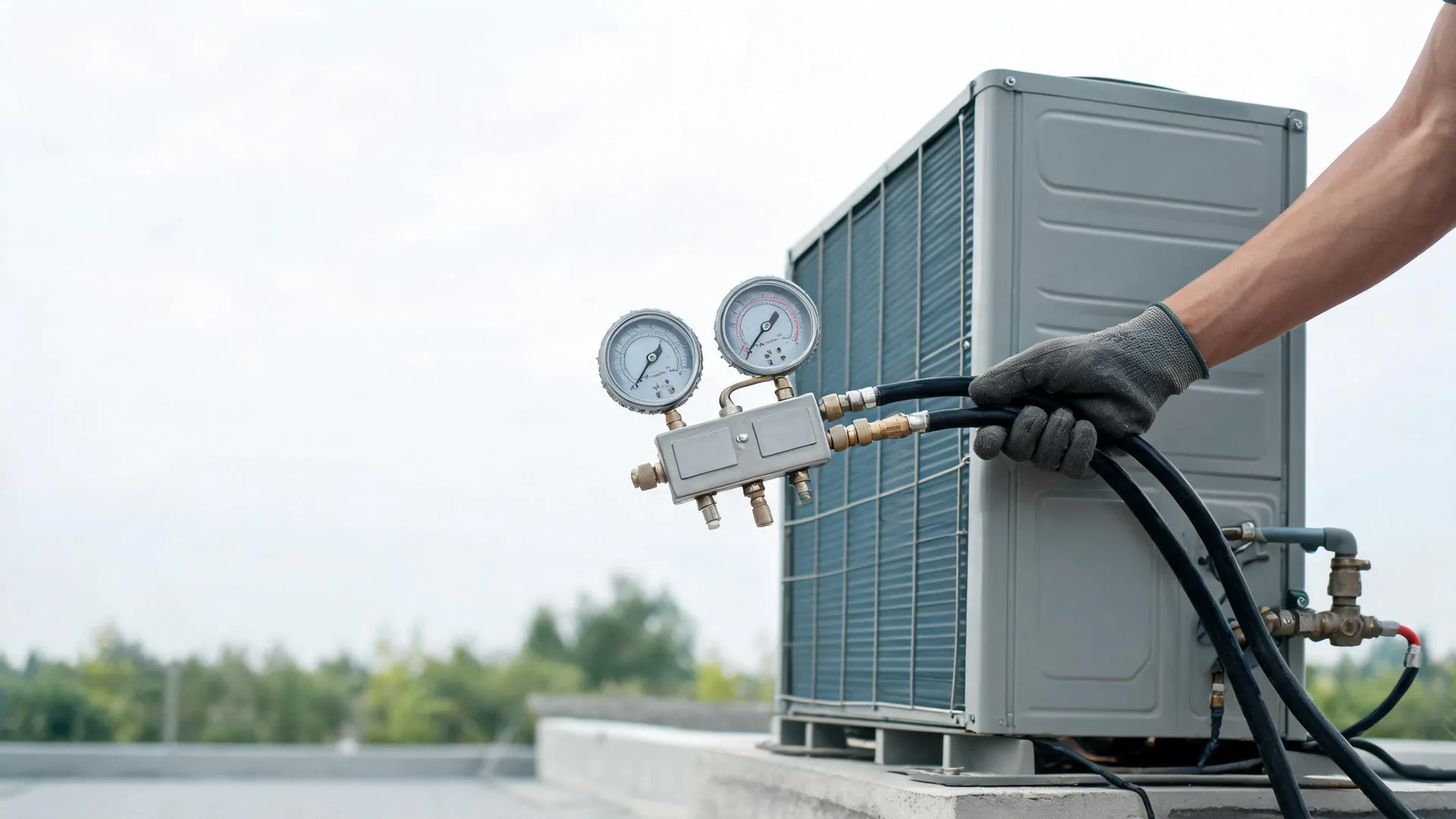
A diagnostic visit starts with gauges, not guesses. A tech connects them to the system to read refrigerant pressure on both the high and low side, because that tells more about what's wrong than anything visible from outside the cabinet. From there it's a check of electrical readings at the capacitor, the contactor, and the compressor itself, since a part can look fine and still be failing. The indoor coil gets checked too, often hiding behind the blower where you'd never see it without pulling a panel. Airflow gets measured, not eyeballed, because a coil can look clean and still not be moving enough air. By the end, the tech should be able to point to the one part actually causing the problem, not just the symptom it's producing.