







An outdoor air conditioning condenser unit mounted on a concrete pad next to a blue-sided residential house at sunset.

AC Repair in Sioux Center, IA

Tell us about the job

Takes about a minute. No obligation.

RepairCentral ACSioux County, IA
Step 1 of 2

What ZIP code is the job in?

Cooling in Sioux Center runs June through August. May is worth a look before that starts, because a system that struggled last August doesn't fix itself sitting idle over the winter. The same weak capacitor or low charge is still there, and the first hot week in June is what finds it. Once the load hits, a part that was already marginal is the one that gives out. Getting a problem looked at early in the season, or before it, means less waiting on a hot day for someone to get to you.

3 months
June through August, your air conditioner is on duty
82°F
the average summer afternoon it cools against
42 hail events
in ten years, and hail bends the fins on outdoor coils
67 wind events
in ten years, and wind drives debris into outdoor units
Isometric line illustration of a cutaway house showing interior rooms, ceiling ductwork, an indoor air handler unit, and an outdoor condenser connected by lines along the exterior wall.
Your air conditioner works hardest from June through August.

NOAA nClimDiv, 1991–2020 normals

Summer here runs June through August, with afternoon highs averaging 82.

Three months of real load is enough to finish off a capacitor or compressor that was already weak.

Half the homes here were built by 1973, and so was the AC that may still be running

Half the homes here were built by 1973
Cooling runs June through August
Summer afternoons average 82°F
Weather here is not what's hard on your ACSioux County saw 159 severe weather events in ten years, but that's not what wears out a compressor.

If your AC came with the house, ask your contractor how much life it has left before you commit to another repair. A system that old is past the point where every repair is worth doing. Sometimes the fix is small and makes sense. Sometimes the compressor itself is failing, and the honest answer is that the next breakdown is the one that doesn't get fixed. A straight answer on which one you're looking at is worth more than a quick patch.

Get it looked at early

Problems tend to show up in the first weeks of the season, when the load hits a part that was already weak.

Find a contractor
A man in a cap, dark shirt and olive pants climbs porch steps toward a dark green paneled door, carrying a worn canvas duffel bag, with a potted shrub beside the entry.
An outdoor residential air conditioning condenser unit mounted on a concrete pad, surrounded by gravel with a blue sky in the background.

What a struggling AC sounds and feels like before it quits

A system that's struggling makes noise about it before it quits. Warm air from the vents when it's been running a while, or air that cools but never gets the room down to where the thermostat is set, means it's losing the fight against the load. Short cycles, where it kicks on and off every few minutes instead of running a steady stretch, put more wear on the compressor than a long run does. A hissing sound points to refrigerant escaping somewhere in the line. Ice on the refrigerant line or the coil itself means airflow or charge is off, and running it that way only pushes the compressor harder. Water pooling near the indoor unit usually means the condensate line is clogged, not the refrigerant system, but it still needs attention before it backs up further. None of these get better left alone. The part that's struggling now is the one that quits outright later.

What actually wears a capacitor out

A capacitor stores the charge that kicks the compressor and fan motor into motion. Heat is what degrades it, and every start draws on it again. Over time it loses its ability to hold that charge, until one day it can't deliver enough to start the compressor at all. That's the hard stop, not a slow decline you can catch early by listening.

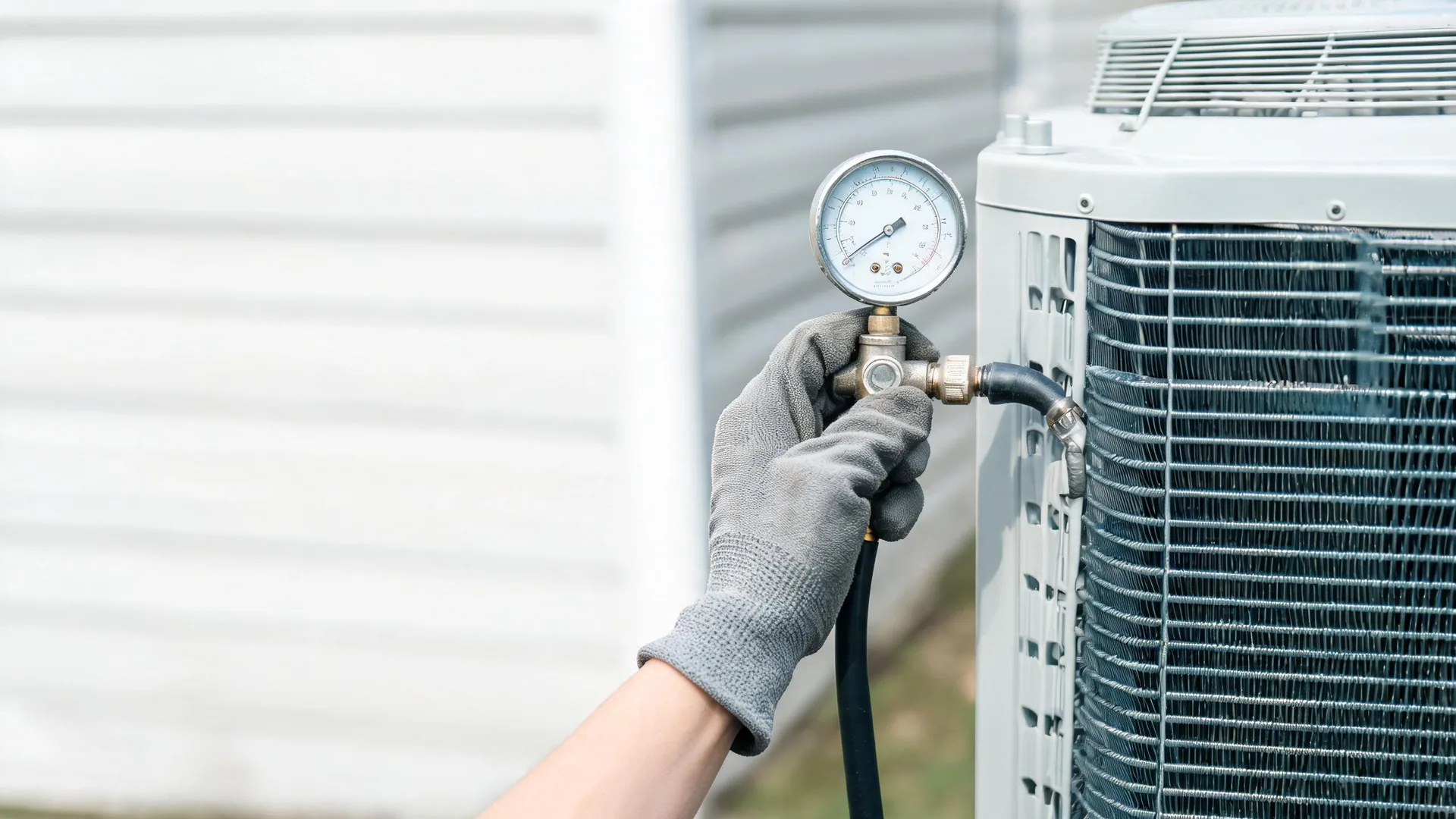
Why low refrigerant is never a one-time fix

Refrigerant doesn't get used up. If the charge is low, it's leaking out somewhere in the line set or the coil, and adding more without finding that leak just means doing it again next season. A slow leak can run a compressor hot for months before anyone notices the air isn't as cold as it used to be.

An outdoor air conditioning condenser unit installed beside the exterior wall of a blue vinyl-sided house at sunset.

A new air conditioner would save little on running costs in Sioux County, so the repair decision comes down to the unit's condition.

  • A new one at the federal minimum, 13.4 SEER2$160 a year
  • An older air conditioner$180 a year

Estimates for a typical Sioux County home, compared with an older unit built to the previous federal minimum, from EIA household energy data, Iowa fuel prices and NOAA climate normals. Your home will differ.

Repair makes sense when a part like a capacitor or contactor has failed.

Replacement makes sense when the compressor has failed or the system uses R-22 refrigerant, which is no longer made.

A repair is worth doing when one part failed and the rest of the system is carrying its load fine. A capacitor, a contactor, a fan motor. Those fail on their own without taking anything else down with them, and replacing one brings the system back to where it was. The compressor is different. It sits at the center of the system, and when it's struggling, everything else has usually been working harder to cover for it. A contractor who opens the unit can tell you which kind of failure this is. That answer matters more than what the repair costs.