Three lit brick homes on a tree-lined residential street photographed at dusk.

AC Repair in Washington, IA

Tell us about the job

Takes about a minute. No obligation.

RepairCentral ACWashington County, IA
Step 1 of 2

What ZIP code is the job in?

Three months of real work

Air conditioners in Washington County run from June through August, with afternoon highs around 83°F. That is a normal summer cooling load. A system here wears out the same way systems wear out anywhere. A weak capacitor, a low charge, a dirty coil. Nothing about this county's summers pushes a unit harder than it would run elsewhere.


So look for the usual cause

A breakdown here almost always traces back to one part failing or one thing going out of adjustment. That is good news for the repair. A contractor can check the common failure points first, rather than guessing at something unusual about the house or the weather.

3 months
June through August, your air conditioner is on duty
83°F
the average summer afternoon it cools against
32 hail events
in ten years, and hail bends the fins on outdoor coils
49 wind events
in ten years, and wind drives debris into outdoor units
Isometric cutaway illustration of a house showing attic ductwork, an indoor air handler, refrigerant lines running outside, and an outdoor condenser unit on a pad.
Your air conditioner works hardest from June through August.

NOAA nClimDiv, 1991–2020 normals

Cooling starts in June here, right after a May that asked nothing of the system.

The jump from idle to full load in June is when a weak capacitor or low charge finally gives out.

Half the homes here were built by 1964. The AC inside yours has its own age, worth checking.

Half the homes here were built by 1964
Cooling runs June through August
Summer afternoons average 83°F

Most AC trouble announces itself before the system quits for good. Warm air from the vents while the thermostat is set low is the most common one. Short cycling is another. The system kicks on, runs a few minutes, and shuts off before the house cools at all. Listen for it too. A hum from outside with no fan movement usually means the capacitor isn't kicking the compressor over. Grinding or rattling from the outdoor unit means a motor bearing or a loose part, not something that fixes itself. Water pooling near the indoor unit means a clogged condensate line or drain pan, and it's worth a call before it backs up into the house. Any of these is worth a service call. None of them gets better by waiting.

Get the usual fix

Nothing about this area is especially hard on it. It's most likely the usual problem with the usual fix.

Find a contractor
A man in a cap, dark long-sleeve shirt and tan pants walks up concrete steps toward a green front door, carrying a canvas tool tote, with a potted shrub beside the entry.
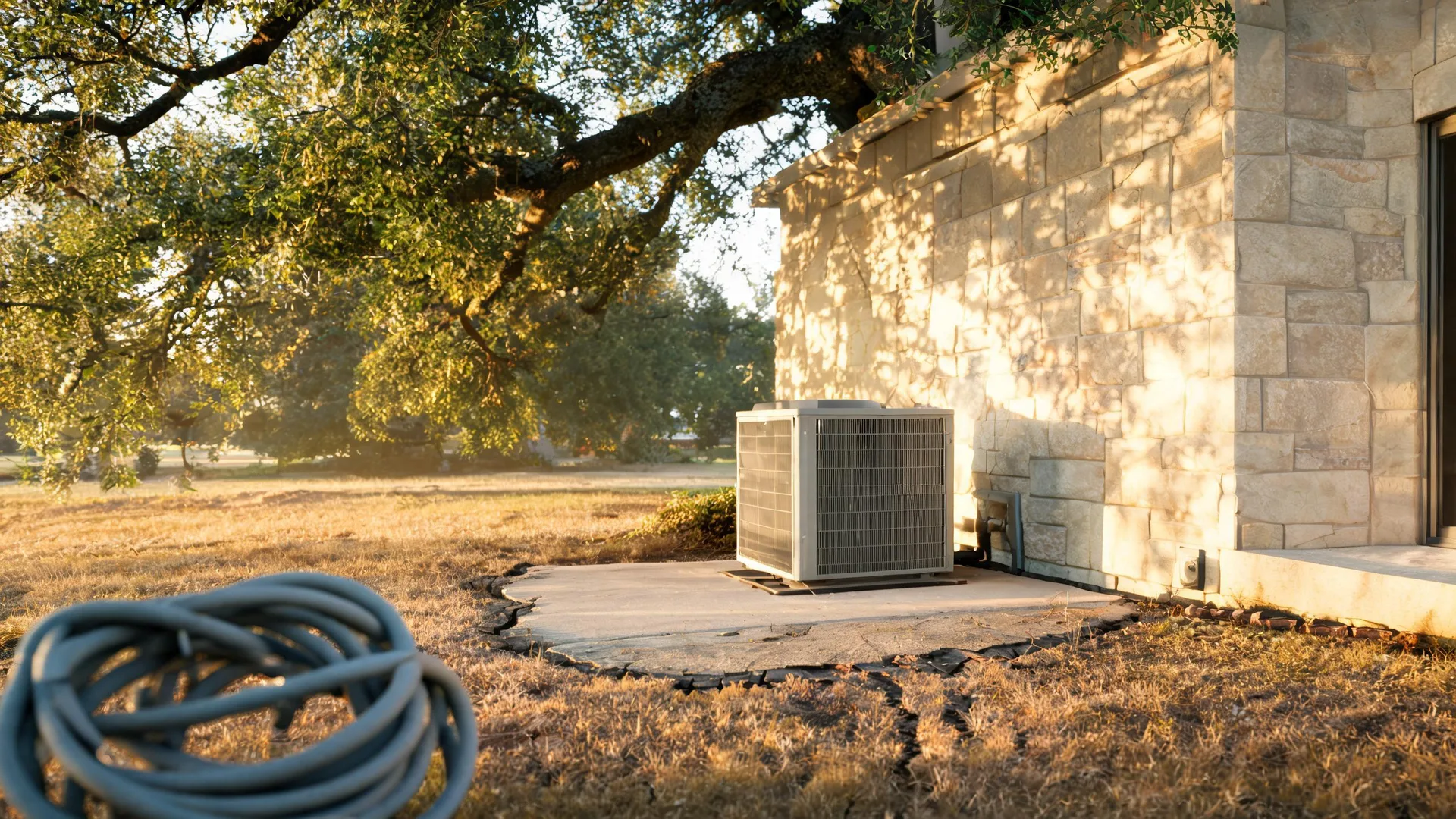
An outdoor air conditioning condenser unit mounted on a concrete pad beside a house, with electrical conduit running to a wall-mounted disconnect box.

What to check before you call

Before anyone comes out, check the filter. Pull it and hold it up to a light. If you can't see through it, that's enough to choke off airflow and ice the coil. Next, go outside and listen and look. The outdoor fan should be spinning free, not wobbling or grinding, and the unit shouldn't be caked in grass clippings or crowded by overgrown shrubs. Inside, check the thermostat battery if it runs on one, and make sure it's set to cool and set below room temperature. Check the breaker panel too. A tripped breaker on the outdoor unit will stop the compressor cold while the indoor blower keeps running, which can trick you into thinking the whole system died. If the system is running but the air isn't cold, feel the supply vents against the return. A small difference means something's wrong with cooling, not airflow. A big difference between rooms usually points to the ducts, not the unit itself. None of this tells you exactly what's broken, but it rules out the things that aren't worth paying a service call to fix.

A frozen coil keeps freezing

Once ice starts building on the indoor coil, running the system longer doesn't melt it. It adds to it. The ice blocks airflow further, the compressor keeps working against that restriction, and what started as a dirty filter or low charge can end with liquid refrigerant coming back into a compressor that was only built to handle gas.

A failing capacitor takes the compressor with it

A weak capacitor makes the compressor struggle to start, drawing more current each time it tries. That extra strain heats the windings. Keep running it in that state and the compressor can burn out, turning a capacitor swap into a full compressor replacement.

An outdoor central air conditioning unit mounted on a concrete pad beside a blue-sided house at sunset.

A new air conditioner would save little on running costs in Washington County, so the repair decision comes down to the unit's condition.

  • A new one at the federal minimum, 13.4 SEER2$200 a year
  • An older air conditioner$210 a year

Estimates for a typical Washington County home, compared with an older unit built to the previous federal minimum, from EIA household energy data, Iowa fuel prices and NOAA climate normals. Your home will differ.

Repair makes sense when a part like a capacitor or contactor has failed.

Replacement makes sense when the compressor has failed or the system uses R-22 refrigerant, which is no longer made.

A diagnostic visit starts outside at the condenser and inside at the air handler, because a cooling complaint can come from either end. The tech checks refrigerant pressure on the gauges, tests the capacitor and contactor, and watches whether the compressor and fan start clean or struggle. Inside, they'll pull the filter, check the blower, and look at the coil for ice or buildup. They'll also check the temperature split between the return air and the supply air, since that number points to whether the problem is the refrigerant charge or something restricting airflow. Most of this is done with the system running, because a part can look fine sitting still and still fail under load.