




A low ground-level view across a mown lawn toward a dark two-story house with a covered front porch, flanked by large leafy trees under an overcast sky.

AC Repair in Waterloo, IA

Tell us about the job

Takes about a minute. No obligation.

RepairCentral ACBlack Hawk County, IA
Step 1 of 2

What ZIP code is the job in?

Summers here run about three months, June through August, with afternoon highs around 82. That's a normal cooling load. It doesn't push an AC harder than it's built for. So when a unit in Waterloo starts short cycling, blows warm air, or trips a breaker, the cause is usually something ordinary. A weak capacitor. A low refrigerant charge. A dirty coil. A thermostat wiring issue. Hail and wind do pass through this area often enough to bend fins or knock an outdoor unit out of alignment, so if yours sat through a storm, that's worth checking too. Either way the approach is the same. Find what's actually wrong before replacing parts.

3 months
June through August, your air conditioner is on duty
82°F
the average summer afternoon it cools against
51 hail events
in ten years, and hail bends the fins on outdoor coils
62 wind events
in ten years, and wind drives debris into outdoor units
Isometric cutaway illustration of a single-story house showing interior ductwork and an air handler connected by lines to an outdoor condenser unit on a pad beside the building.
Your air conditioner works hardest from June through August.

NOAA nClimDiv, 1991–2020 normals

May is the month before cooling starts in Black Hawk County.

A unit with a weak part usually shows it in the first hot week of June, not later.

Half the homes in Waterloo were built in 1966 or earlier

Half the homes here were built by 1966
Cooling runs June through August
Summer afternoons average 82°F

Warm air from the vents with the thermostat set low usually means the compressor isn't keeping up or the charge is low. A hissing or bubbling sound near the lines points to a refrigerant leak, not something that fixes itself by adding more. Short cycling, where the unit kicks on and off every few minutes, is often a dirty coil or a failing capacitor making the compressor work harder to start. Ice on the lines or the indoor coil usually traces back to restricted airflow, a dirty filter, a blocked return, or a blower motor that's quit pulling its weight. If the outdoor fan isn't spinning but the unit is drawing power, that capacitor is a likely suspect too. None of these clear up by running the system longer. They get worse.

Get the usual fix

Nothing about this area is especially hard on it. It's most likely the usual problem with the usual fix.

Find a contractor
A gray cylindrical air conditioning condenser unit mounted on a concrete pad next to a light-colored vinyl-sided house exterior.

What to check first

Before anyone comes out, a few things are worth checking. Make sure the thermostat is set to cool and the setpoint is below room temperature. Look at the filter. If it's gray and packed with dust, swap it, since restricted airflow alone can cause warm air or ice on the coil. Check the breaker, and look for a reset or lockout button on the outdoor unit if it has one. Walk outside and look at the unit itself. Leaves, grass clippings, or anything pressed against the fins block airflow and make the system work harder than it should. If the outdoor fan isn't turning at all and you hear a hum, don't keep flipping the breaker. That points to an electrical problem, and resetting it again won't fix it. None of this tells you exactly what's wrong, but it tells you what isn't, and that's worth knowing before someone shows up.

A failing capacitor takes the compressor with it

A compressor that keeps struggling to start on a weak capacitor runs hotter than it should on every attempt. That heat breaks down the windings a little more each time it happens. A capacitor is a small, simple part to replace. A compressor that has been overheating for weeks is a much bigger job, and sometimes not worth doing on its own.

A refrigerant leak only gets bigger

A system low on charge has to work harder to cool the same air, and the compressor runs hotter doing it. Running the system longer does not seal the leak. The refrigerant keeps escaping from the same spot, the charge keeps dropping, and the compressor keeps taking the damage until someone finds where it's leaking and closes it up.

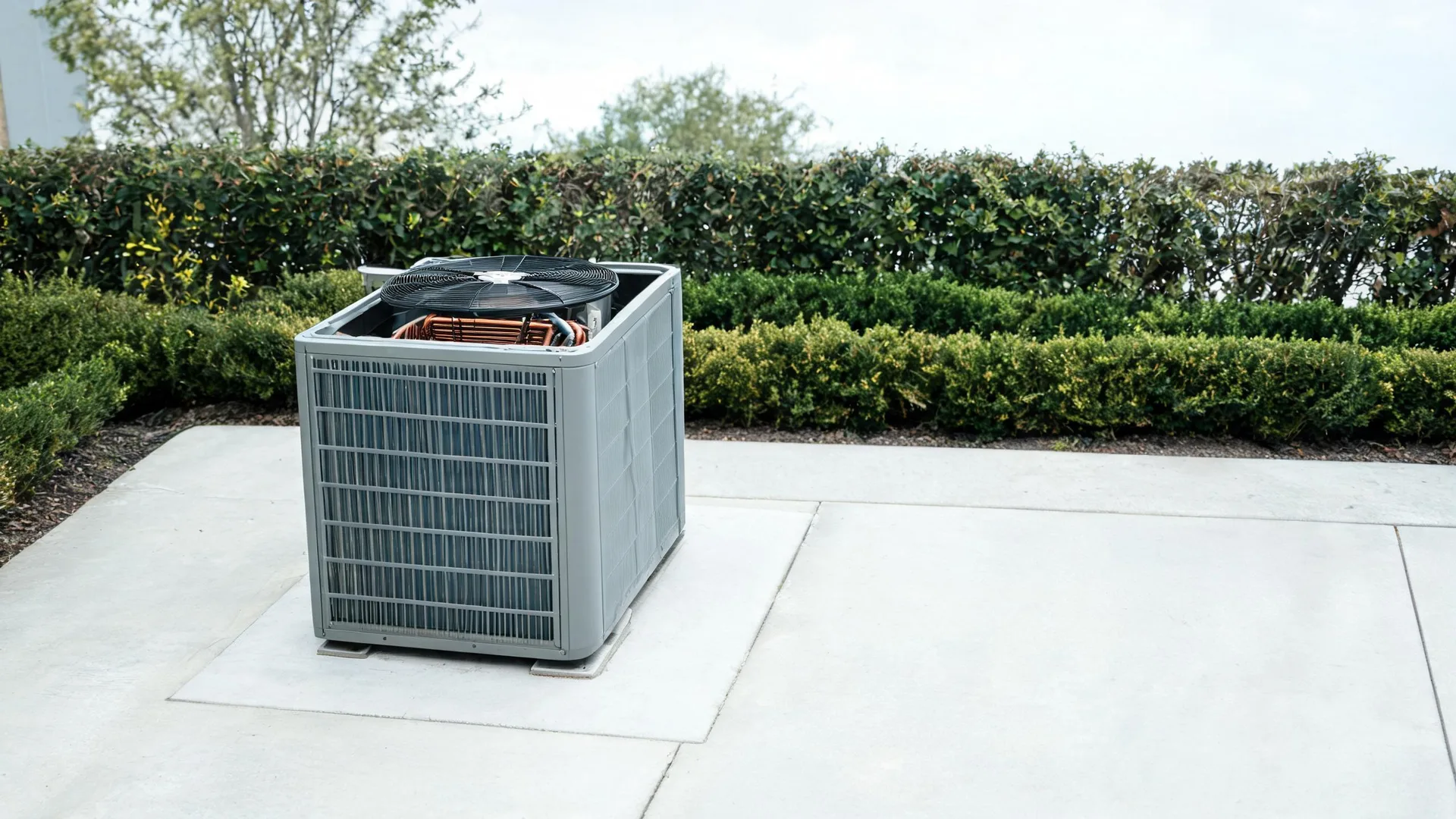
An outdoor air conditioning condenser unit mounted on a concrete pad next to a blue-sided residential house at sunset.

A new air conditioner would save little on running costs in Black Hawk County, so the repair decision comes down to the unit's condition.

  • A new one at the federal minimum, 13.4 SEER2$160 a year
  • An older air conditioner$170 a year

Estimates for a typical Black Hawk County home, compared with an older unit built to the previous federal minimum, from EIA household energy data, Iowa fuel prices and NOAA climate normals. Your home will differ.

Repair makes sense when a part like a capacitor or contactor has failed.

Replacement makes sense when the compressor has failed or the system uses R-22 refrigerant, which is no longer made.

A repair is almost always worth doing on its own. A capacitor, a contactor, a fan motor, these are small parts that fail on their own schedule and don't say anything about the rest of the system. Replacing one is a straightforward job and the AC goes back to running the way it did before. Replacement starts to make sense when the compressor itself is damaged, since that's the most expensive part in the unit and the one everything else depends on. It's also worth asking how old the system is before sinking money into it. A unit nearing the end of its working life can rack up one repair after another, each one fixing a different part, while the compressor underneath keeps getting weaker. At some point the question isn't whether the repair will work. It will. The question is whether it's the last one this unit needs or just the next one.