





A row of dark-painted single-story cottages with gabled shingle roofs behind a mowed lawn, a trimmed hedge in the left foreground and large leafy trees overhead under an overcast sky.

AC Repair in Waukee, IA

Tell us about the job

Takes about a minute. No obligation.

RepairCentral ACDallas County, IA
Step 1 of 2

What ZIP code is the job in?

Summers here run about three months, June through August, with afternoon highs averaging 83. That is a normal cooling load. Nothing about it works a system harder than it would in any other home in this climate zone. So when an AC in Waukee starts short cycling, blows warm, or trips its breaker, the cause is almost always something ordinary. A weak capacitor. A low refrigerant charge. A dirty coil, or a clogged filter choking the airflow. Zone 5A homes lean on heating more than cooling, so the AC here gets a shorter season than the furnace does. A problem like this usually has a straightforward fix, as long as whoever looks at it finds the actual cause instead of guessing.

3 months
June through August, your air conditioner is on duty
83°F
the average summer afternoon it cools against
54 hail events
in ten years, and hail bends the fins on outdoor coils
96 wind events
in ten years, and wind drives debris into outdoor units
Isometric cutaway illustration of a small house showing interior rooms, ductwork, an indoor air handler, and an outdoor condenser unit connected by lines, on a plain white background.
Your air conditioner works hardest from June through August.

NOAA nClimDiv, 1991–2020 normals

Cooling starts in June here, right after May.

June's first hot days put a real load on an AC for the first time since last summer, and a weak part usually fails right then.

Half the homes in Dallas County were built in 2006 or later, so most AC units here are still within their working life

Half the homes here were built by 2006
Cooling runs June through August
Summer afternoons average 83°F

Get the usual fix

Nothing about this area is especially hard on it. It's most likely the usual problem with the usual fix.

Find a contractor
A man in a cap and olive work shirt carries a canvas tool bag up concrete steps toward a dark green panelled front door of a house with horizontal siding and a potted shrub.
A gray cylindrical air conditioning condenser unit mounted on a concrete pad next to a light-colored vinyl-sided house exterior.

What actually wears out in an AC

A capacitor gives the compressor its starting kick every single cycle. Thousands of cycles in, it weakens and stops delivering that kick strongly enough, and the compressor struggles to start or won't start at all. A contactor closes and opens just as many times, and the contacts pit and burn until they stick or stop conducting. Neither of those depends on how hot it gets outside. They depend on how many times the system has cycled on and off. A coil collects dust and debris every time the fan moves air, not just on the hottest afternoons, so a dirty coil shows up after a long mild season almost as often as a hot one. Low refrigerant is not something a system uses up through normal running. It means there's a leak at a fitting or in the line set, and the charge will keep dropping until that leak gets found and sealed. A filter left too long chokes airflow across the coil, and a coil starved of airflow can ice over even while the house still feels warm. In a system's early years, failure almost always comes down to one worn part, not the whole unit giving out at once.

What you can check yourself

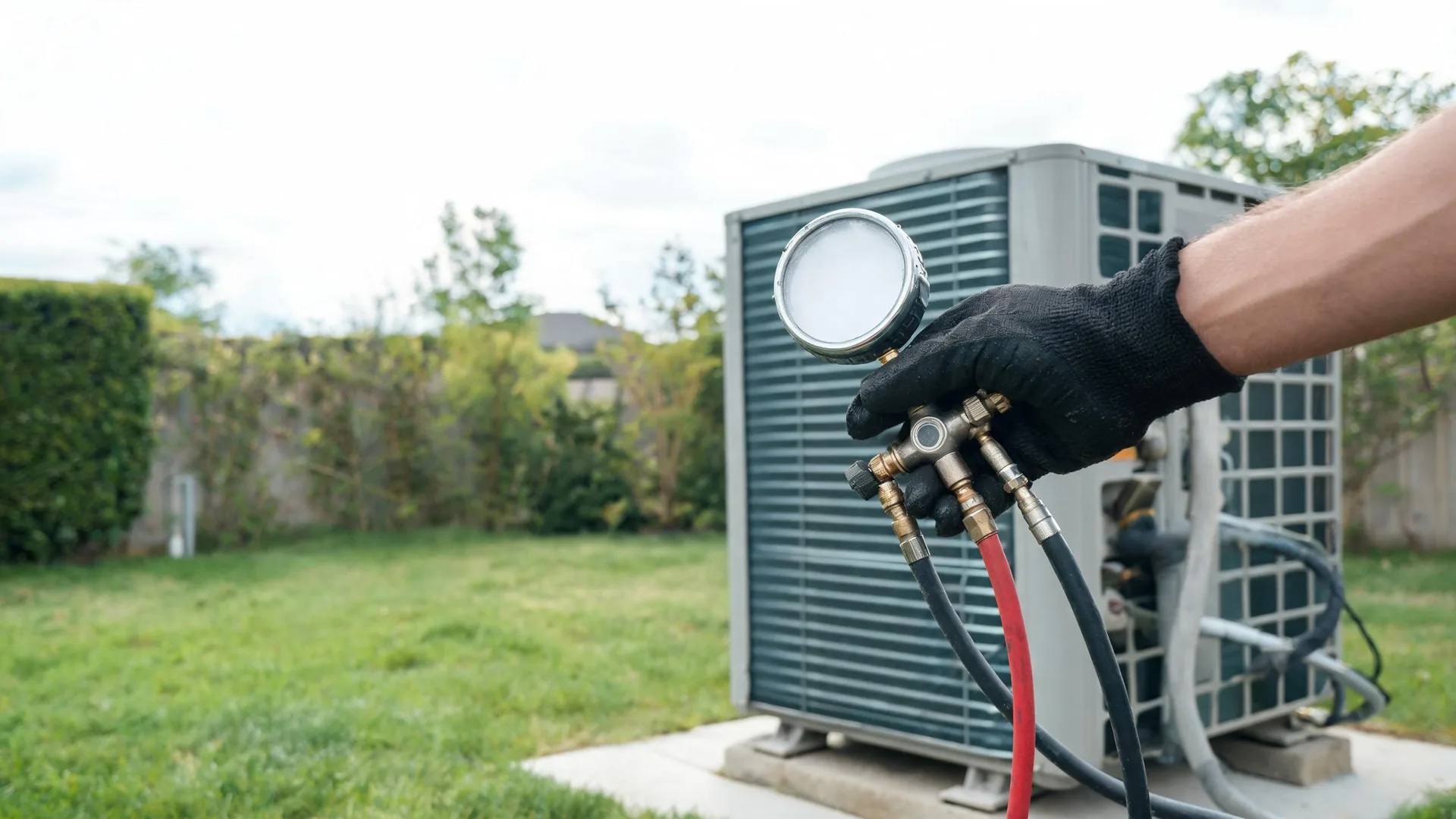
Look at the thermostat first. Make sure it's set to cool and set below room temperature, and check the batteries if it has a screen that looks dim. Then check the breaker panel. A tripped breaker for the outdoor unit will cut the whole system off. Go outside and look at the condenser. If the fan isn't spinning and you don't hear any hum, that points to the capacitor or contactor. If it's running but the air inside is barely cool, check the filter. Pull it out and hold it up to a light. If you can't see light through it, that's choking the airflow and the coil behind it.

What to leave alone

Don't pull the access panel off the outdoor unit or touch anything inside it. The capacitor holds a charge even with the power off and can shock you. If you see ice on the refrigerant line or the indoor coil, turn the system off at the thermostat and let it thaw instead of chipping at it. Running the system with ice on the coil only pushes liquid refrigerant back toward the compressor, which can damage it. Once it's thawed, a technician still needs to find why it iced over in the first place, whether that's airflow or a low charge.

Aerial view of a residential air conditioning condenser unit mounted on a concrete pad next to a house with vinyl siding and a sliding glass door.

A new air conditioner would save little on running costs in Dallas County, so the repair decision comes down to the unit's condition.

  • A new one at the federal minimum, 13.4 SEER2$200 a year
  • An older air conditioner$210 a year

Estimates for a typical Dallas County home, compared with an older unit built to the previous federal minimum, from EIA household energy data, Iowa fuel prices and NOAA climate normals. Your home will differ.

Repair makes sense when a part like a capacitor or contactor has failed.

Replacement makes sense when the compressor has failed or the system uses R-22 refrigerant, which is no longer made.

A repair call should answer one question. What part actually failed. A capacitor or a contactor is a quick, contained fix, and once it's swapped the system runs the way it always did. A seized compressor or a cracked heat exchanger is a different problem. That's not a part failing inside a healthy system, that's the system itself giving out. A technician should be able to find the failed part and tell you plainly which kind of problem you've got. If they can point to it, replace it, and the system's back to normal, that's a repair. If fixing one thing just reveals the next part about to go, that pattern is telling you something too.