A row of dark-sided houses with brown shingled gable roofs behind tall trimmed hedges, with a mowed lawn in the foreground and overhanging tree branches against an overcast sky.

AC Maintenance in Council Bluffs, IA

Tell us about the job

Takes about a minute. No obligation.

Tune-up, service, or cleaningCentral ACPottawattamie County, IA
Step 1 of 2

What ZIP code is the job in?

A dirty filter starves the coil

When the filter clogs, the indoor coil doesn't get enough airflow across it. The coil can get too cold and ice over instead of pulling heat out of the air. Once that happens the system cools poorly no matter how long it runs.

The drain line needs a clear path

The indoor coil pulls moisture out of the air, and that water has to leave through the condensate drain. If the line clogs with algae or sludge, water backs up and can shut the system down or spill out near the furnace. Checking that it drains freely is part of keeping the system running.

4 months
June through September, your air conditioner is on duty
84°F
the average summer afternoon it cools against
51 hail events
in ten years, and hail bends the fins on outdoor coils
56 wind events
in ten years, and wind drives debris into outdoor units
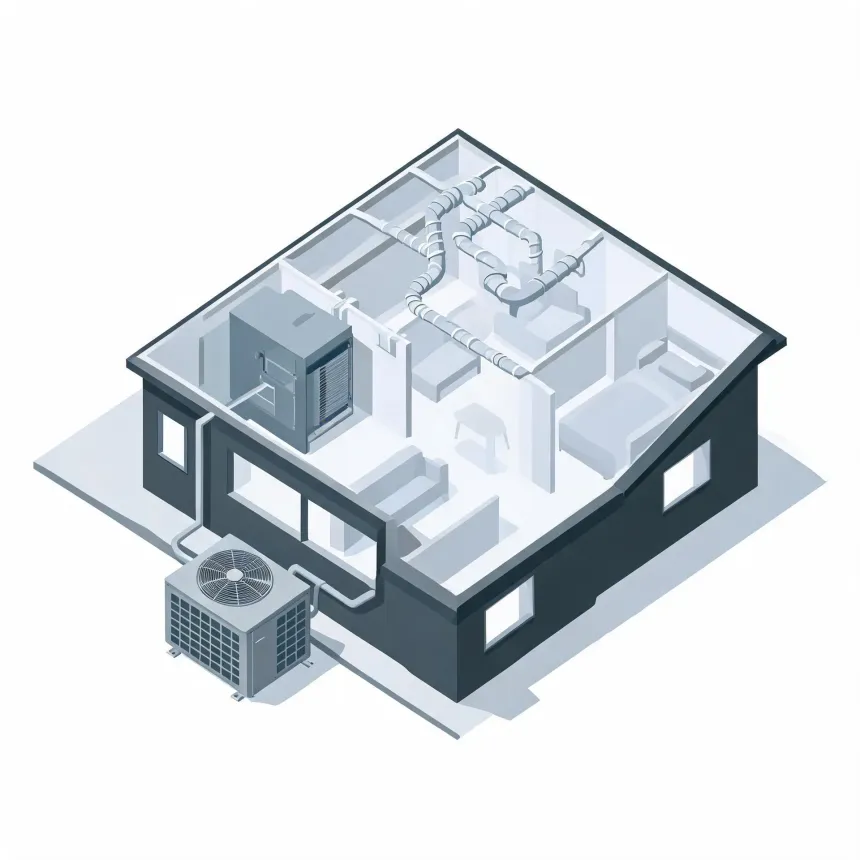
Isometric cutaway illustration of a small house showing interior rooms with furniture, ceiling ductwork and an air handler, plus an outdoor condenser unit connected by refrigerant lines beside the building.
Your air conditioner works hardest from June through August.

NOAA nClimDiv, 1991–2020 normals

Cooling in Pottawattamie County starts in June.

May is the month to get the AC checked, before it has to work.

Half the homes here were built by 1967, and a system that old needs eyes on it every year

Half the homes here were built by 1967
Cooling runs June through September
Summer afternoons average 84°F
Four months of work hereCooling runs June through September, with afternoon highs averaging 84°F.

If your AC came with a house built decades ago, you can't tell from the thermostat whether the system is original too. A yearly check is how you find out before it has to work hard. A tech can look at what a filter change can't show you. Refrigerant pressure. The condition of the electrical connections. Whether the compressor is drawing more power than it should. Finding a weak part in the spring means it gets fixed on a mild day instead of failing on the worst one of the summer.

Book it before the season

It starts running hard in the first month of the season here. Book the check the month before.

Find a contractor
A man in a cap, dark long-sleeve shirt and tan work pants walks up concrete steps toward a dark green front door, carrying a worn canvas duffel bag.
An outdoor residential air conditioning condenser unit mounted on a concrete pad, surrounded by gravel with a blue sky in the background.

What gets worse quietly

A system that never gets looked at doesn't fail all at once. Dust builds up on the condenser fins outside until the unit can't shed heat the way it should. The compressor runs hotter and stays on longer to reach the same temperature. Electrical connections loosen with the vibration of normal running, and a loose connection arcs and burns instead of carrying power cleanly. None of this shows up as a sudden breakdown. It shows up as a system that runs longer, cools less, and draws more power than it used to, until the day it doesn't start at all.

Short cycles mean something's wrong

An AC that shuts off a few minutes after starting, then kicks back on soon after, isn't resting. It could be a dirty coil, a refrigerant problem, or a failing part telling the compressor to stop before it overheats. A system that cycles short wears out faster than one that runs a full, steady stretch.

Warm air from the vents is a warning, not a quirk

If the thermostat is set low and the air coming out still isn't cold, something in the system already isn't doing its job. That could be low refrigerant, a blocked coil, or a failing compressor. Waiting it out usually means the next step is no cold air at all.

Aerial view of a gray central air conditioning condenser unit on a concrete pad next to a house with vinyl siding.

Book your AC tune-up in May, before homes here start needing cooling in June.

  1. Jan
  2. Feb
  3. Mar
  4. Apr
  5. May
  6. Jun
  7. Jul
  8. Aug
  9. Sep
  10. Oct
  11. Nov
  12. Dec

A tune-up checks the refrigerant charge, cleans the coils, tests the capacitor and tightens the electrical connections.

A tune-up starts outside at the condenser. The tech shuts off power to the unit, pulls off the top grille if needed, and washes dust and cottonwood fluff out of the fins so the coil can shed heat again. Inside, they check the refrigerant charge against what the system calls for, since too little means poor cooling and too much strains the compressor. They test the capacitor and contactor, the parts that get the compressor and fan motor started and running, because a weak capacitor is one of the most common reasons a system won't start on a hot day. They check amp draw on the motors against the rating on the nameplate, tighten electrical connections, and confirm the blower moves the right amount of air across the evaporator coil. None of this is guesswork. It's measured against numbers printed on the equipment itself.