Overhead view of a gray residential air conditioning condenser unit mounted on a concrete pad beside a house with asphalt shingle roofing.

AC Repair in Clinton, IA

Tell us about the job

Takes about a minute. No obligation.

RepairCentral ACClinton County, IA
Step 1 of 2

What ZIP code is the job in?

A dirty condenser coil makes the whole system work harder

The outdoor coil needs airflow to dump heat from the refrigerant. When it's caked with grass clippings, cottonwood fluff or dirt, the system can't shed that heat and has to run longer to cool the house. Left alone, that extra strain is what burns out a compressor.


A failing capacitor shows up as a fan that won't start

The capacitor gives the compressor and fan motor the jolt they need to get going. When it weakens, you'll hear the unit hum but the fan blade won't turn, or the whole system clicks and shuts back off. It's a small part, and it's usually the reason a system that was fine yesterday won't start today.

3 months
June through August, your air conditioner is on duty
82°F
the average summer afternoon it cools against
50 hail events
in ten years, and hail bends the fins on outdoor coils
75 wind events
in ten years, and wind drives debris into outdoor units
Isometric line illustration of a cutaway single-story building showing interior rooms, ceiling ductwork, an indoor air handler, and an outdoor condenser unit connected by a line set.
Your air conditioner works hardest from June through August.

NOAA nClimDiv, 1991–2020 normals

Cooling runs June through August here.

The first hot stretch in June is when a weak capacitor or a dirty coil finally gives out.

Half the homes in Clinton County date to 1957 or earlier, old enough that the AC is not the original equipment

Half the homes here were built by 1957
Cooling runs June through August
Summer afternoons average 82°F
Clinton County weather, same as anywhere171 severe weather events in Clinton County between 2015 and 2024, nothing unusual for Iowa

A struggling system still gets the house cold, so it's easy to let it ride. That's the wrong read on what's happening inside the unit. A compressor working against low airflow or low refrigerant is running hotter than it's built for, and heat is what wears out windings and bearings. A weakening capacitor doesn't fail clean either. It lets the motor struggle to start, pulling harder each time, until the motor itself takes the damage that the capacitor was supposed to absorb. None of this shows up as a dead system right away. It shows up as a system that still runs, still cools some, right up until the part carrying the strain finally gives out and takes another part down with it.

Get it looked at early

Problems tend to show up in the first weeks of the season, when the load hits a part that was already weak.

Find a contractor
A man in a cap and olive work shirt carries a canvas tool bag up concrete steps toward a dark green panelled front door of a house with horizontal siding and a potted shrub.
A gray cylindrical air conditioning condenser unit mounted on a concrete pad next to a light-colored vinyl-sided house exterior.

What to check before you call

Start at the thermostat. Make sure it's set to cool, not fan only, and set a few degrees below room temperature so the system has a reason to run. Go to the breaker panel next. A tripped breaker for the outdoor unit will leave the indoor fan blowing but the compressor dead quiet outside. Walk out and look at the condenser fan. If it's not turning and you hear a hum instead, that's a capacitor or a motor, and it's worth telling the tech before they show up. Pull the air filter and hold it up to the light. If you can't see through it, swap it, because a clogged filter starves the coil of airflow and ices it over. If there's already ice on the indoor coil or the line running outside, shut the system off and let it thaw. Running it iced up only pushes liquid refrigerant back toward the compressor, and that's a worse problem than the one you started with. Last, look at the outdoor unit itself. Grass, leaves or anything piled against the sides keeps it from shedding heat the way it needs to. None of this fixes a bad part. It just tells you, and the tech, where to start.

Warm air from the vents means the system stopped moving heat, not just air

If the blower is running but the air coming out isn't cold, the problem is usually refrigerant charge or airflow across the indoor coil, not the fan itself. A system low on refrigerant will keep blowing air that never gets cold, and running it that way for days can let liquid refrigerant reach the compressor, which is a far bigger repair.

Short cycling wears out the parts that start the system

A unit that kicks on, runs a few minutes, then shuts off and starts again is short cycling. It can mean a clogged filter, a failing thermostat sensor, or a compressor that's overheating and tripping its own safety switch. Every start puts the hardest strain on the capacitor and compressor, so a system doing this repeatedly is wearing out the parts that get it running each time.

Aerial view of a residential air conditioning condenser unit mounted on a concrete pad next to a house with vinyl siding and a sliding glass door.

A new air conditioner would save little on running costs in Clinton County, so the repair decision comes down to the unit's condition.

  • A new one at the federal minimum, 13.4 SEER2$180 a year
  • An older air conditioner$190 a year

Estimates for a typical Clinton County home, compared with an older unit built to the previous federal minimum, from EIA household energy data, Iowa fuel prices and NOAA climate normals. Your home will differ.

Repair makes sense when a part like a capacitor or contactor has failed.

Replacement makes sense when the compressor has failed or the system uses R-22 refrigerant, which is no longer made.

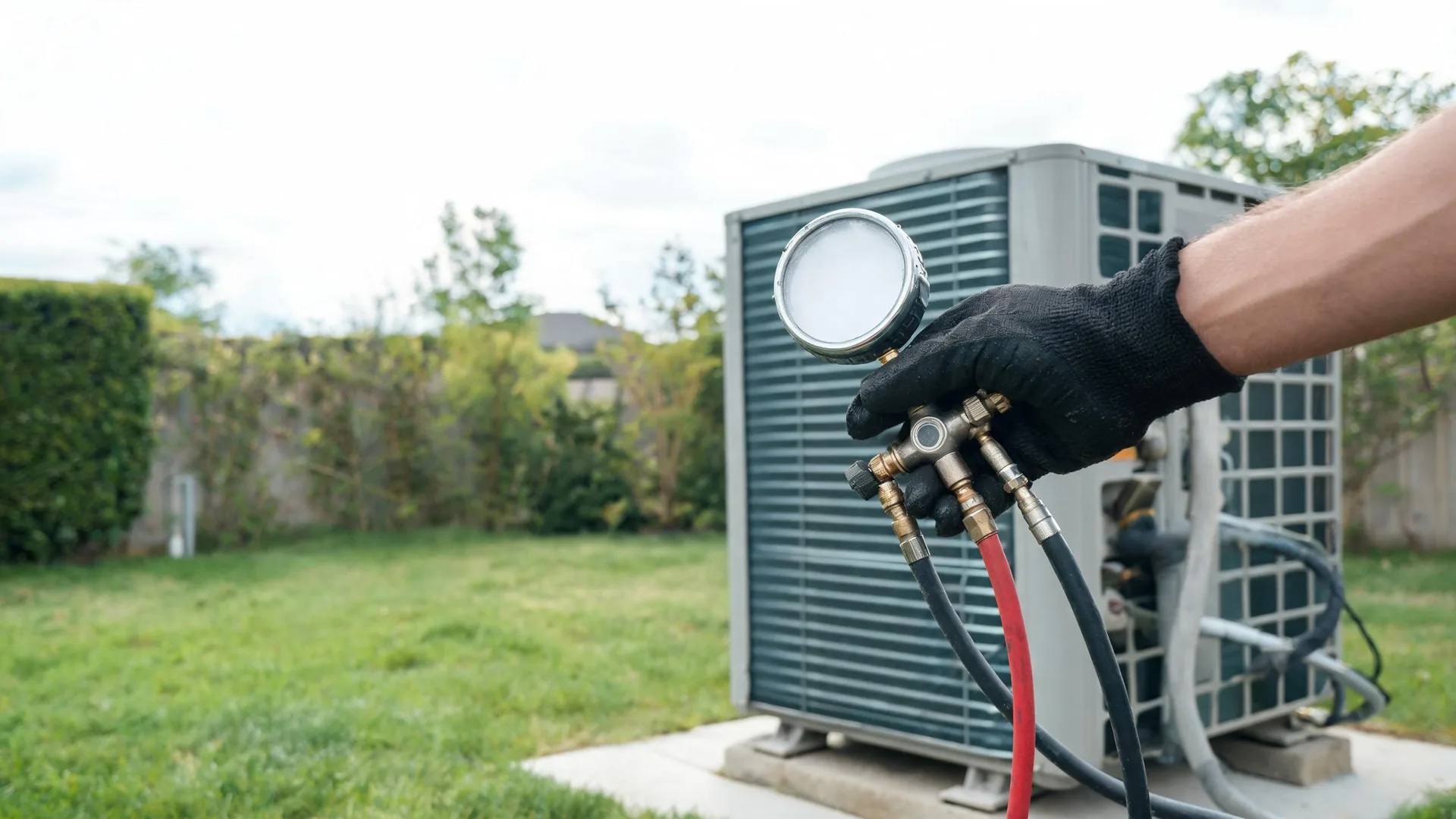
A diagnostic visit starts with questions, not tools. The tech wants to know what the system was doing, when it started, whether it's been getting worse. Then they check pressures on the gauges and the temperature of the air coming out of the vents compared to the air going in. That difference tells them whether the system is actually moving heat or just moving air. From there it's electrical checks, the capacitor, the contactor, the wiring at the disconnect. A tech can usually narrow a complaint down to a likely part before touching a wrench, because the symptoms and the readings point the same direction. The visit ends with a reading, not a guess, a pressure or an amp draw or a capacitor tested against what's stamped on its case.