A quiet residential street at dusk lined with illuminated two-story brick houses and mature trees.

AC Repair in Council Bluffs, IA

Tell us about the job

Takes about a minute. No obligation.

RepairCentral ACPottawattamie County, IA
Step 1 of 2

What ZIP code is the job in?

Four months of real work

Your AC runs June through September here, with afternoon highs averaging 84°F. That's a normal summer load for a central air system. When a unit struggles through weather like that, the cause is usually a specific part wearing out, not the heat itself.


Look for the usual culprit

A system that cooled fine last summer and is acting up now has probably developed a common fault. A weak capacitor. A dirty coil. A refrigerant leak. A clogged filter choking the airflow. A contractor can narrow it down by checking how the unit is cooling, what sounds it's making, and how old the parts are.

4 months
June through September, your air conditioner is on duty
84°F
the average summer afternoon it cools against
51 hail events
in ten years, and hail bends the fins on outdoor coils
56 wind events
in ten years, and wind drives debris into outdoor units
Isometric line illustration of a cutaway single-story house showing interior rooms, ceiling ductwork and an air handler, connected to an outdoor condenser unit on a pad beside the building.
Your air conditioner works hardest from June through August.

NOAA nClimDiv, 1991–2020 normals

AC starts running in June here, right after a quiet month in May.

The first hot stretch is when a weak part finally gives out, so early June is when repair calls spike.

Most AC failures trace back to a handful of parts, and they tend to go in the same order. The capacitor is usually first. It gives the compressor and fan motor the jolt they need to start, and it weakens with age until one day it can't do the job, so the unit hums but the fan doesn't spin. Next is the condenser coil. If it's coated in dirt or the fins are bent shut, the system can't dump heat outside no matter how hard it runs, and it starts icing up or tripping off. Refrigerant leaks are another common one. A system doesn't use up refrigerant, so if the charge is low, it's leaking somewhere, usually at a fitting or a worn coil. Behind most of these is a filter nobody changed, which starves the system of airflow and makes every other part work harder than it should.

Half the homes here were built in 1967 or earlier

If your AC came with the house, it may be original or close to it. A repair can still be the right call, but it's worth asking the contractor how much life is left in the unit before you put money into one.

Find a contractor
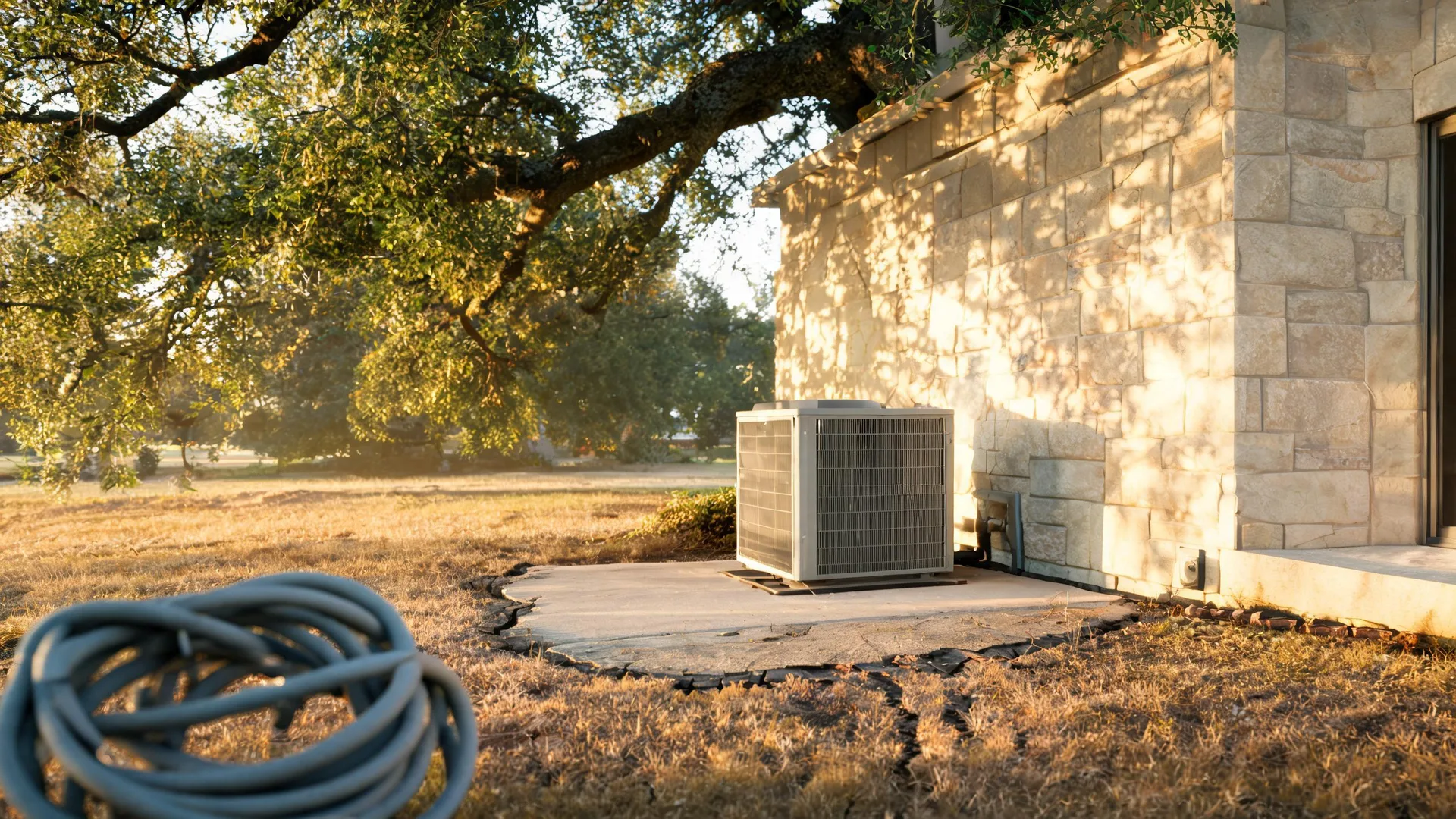
An outdoor air conditioning condenser unit mounted on a concrete pad beside a house, with electrical conduit running to a wall-mounted disconnect box.

What to check before you call

Before anyone comes out, check the thermostat is set to cool and the temperature is actually below room temperature. Go to the outdoor unit and listen. If the fan isn't spinning but you hear a hum, don't stick anything in there, that's a job for the contractor. Check the breaker panel. A tripped breaker is a quick fix and worth ruling out before you pay for a visit. Look at the vents inside. If airflow feels weak everywhere, pull the filter and hold it up to a light. If you can't see light through it, that's likely choking the system. Check around the indoor unit for water, which usually means a clogged condensate line. Last, look at the outdoor unit itself for anything blocking it, leaves, grass clippings, a fence panel too close to the side. None of this fixes a bad capacitor or a refrigerant leak, but it rules out the easy stuff first.

Ice hides the real damage

A low refrigerant charge or weak airflow lets the coil get too cold and frost over. Run the system in that state and the ice spreads down the line, and the compressor ends up pumping liquid refrigerant instead of gas. That's how a coil problem turns into a compressor replacement.

A struggling motor burns itself out

A fan motor or compressor drawing too much current because of a bad capacitor or a dirt-choked coil runs hotter than it should. Keep making it work under that strain and the windings break down for good. A part that would have been a simple swap stops being a repair at all.

An outdoor central air conditioning unit mounted on a concrete pad beside a blue-sided house at sunset.

A new air conditioner would save little on running costs in Pottawattamie County, so the repair decision comes down to the unit's condition.

  • A new one at the federal minimum, 13.4 SEER2$210 a year
  • An older air conditioner$230 a year

Estimates for a typical Pottawattamie County home, compared with an older unit built to the previous federal minimum, from EIA household energy data, Iowa fuel prices and NOAA climate normals. Your home will differ.

Repair makes sense when a part like a capacitor or contactor has failed.

Replacement makes sense when the compressor has failed or the system uses R-22 refrigerant, which is no longer made.

A repair is worth it when the rest of the system is sound and the failure is one part. A capacitor, a contactor, a fan motor, these are routine, and replacing one brings the unit back to normal. Replacement starts to make more sense when the compressor is the problem, since that's the most expensive part to swap and the labor to get to it is involved either way. It also makes sense when the same system keeps coming back with a different failure every year. That pattern means the parts around the one that just broke are close behind it. Age matters too, though not on its own. An aging system that's been maintained can still be worth repairing. One that's been neglected and is now failing is usually telling you it's done.