






An outdoor HVAC condensing unit on a concrete pad next to a beige single-story house with a dark shingle roof.

Heat Pump Repair in Boone, IA

Tell us about the job

Takes about a minute. No obligation.

RepairHeat PumpBoone County, IA
Step 1 of 2

What ZIP code is the job in?

Boone County is zone 5A, a cool climate where heating does more of the work than cooling. Overnight lows average 14°F across December, January and February. That's ordinary cold for this part of Iowa. A heat pump sized right for this area is built to run through it without trouble. When one starts struggling or running nonstop in that stretch, something specific is usually wrong. It could be a failing defrost control. It could be low refrigerant or a worn contactor. The cold here isn't the problem. Something in the unit needs a look.

8 months
October through May, your system heats
3 months
June through August, it cools
14°F
the average winter night it heats against
82°F
the average summer afternoon it cools against
Isometric line illustration of a cutaway single-story house showing interior rooms with furniture and attic ductwork connected to an outdoor condenser unit beside the building.
Your system heats October through May and cools June through August.

NOAA nClimDiv, 1991–2020 normals

Heat pumps here switch over in September and start carrying full heat load by October.

A unit limping along in September usually fails outright once it has to run every day.

At 13.4 cents a kWh, a heat pump running wrong is burning your money every day it waits

Power costs 13.4 cents a kWh statewide
40 hail events from 2015 to 2024
25 winter storms from 2015 to 2024

Half the homes in Boone County were built in 1960 or earlier. A heat pump doesn't last as long as the house around it, so an old house doesn't mean an old unit, but if yours has never been replaced, it's worth finding out how old it actually is. A unit running on borrowed time can still look fine until it doesn't, and a repair that keeps turning up new problems is often the system wearing out rather than one bad part. Before paying for a major repair, ask how much life is left in the rest of the unit. That answer decides whether this repair is worth making or whether it's the last one you should make.

A struggling heat pump costs you every day you wait to fix it

Every extra day a failing heat pump runs is a day it's pulling more power than it should at 13.4 cents a kWh. A unit that's short cycling, running constantly, or blowing cool air is working harder for less heat. Get the actual cause diagnosed now, before the cold months put full load on a system that's already struggling.

Find a contractor
A man in a dark shirt and brown work pants, seen from behind, carries a worn duffel bag up stone steps toward a dark green front door of a house with light siding and a potted shrub.
A white mini-split heat pump outdoor unit mounted on a concrete pad beside a gray-sided house, surrounded by gravel and green shrubs.

Get a life-left number before you pay for the repair

If the unit is original to the house, ask for a straight read on how much life is left before you approve a major repair. A tech checking the time-lapse footage over a full day can see how often the unit cycles and how long it runs each time. A unit that short cycles or runs long stretches without catching up is working harder than it should, and that shows on this kind of clip.

Check the obvious first

Look at the thermostat setting and the batteries in it. Check the breaker for the outdoor unit and for the air handler, both can trip separately. Look at the outdoor unit itself for ice buildup or leaves and debris blocking the coil. Make sure every supply vent in the house is open and nothing is stacked in front of a return.
Know what you can't fix yourself

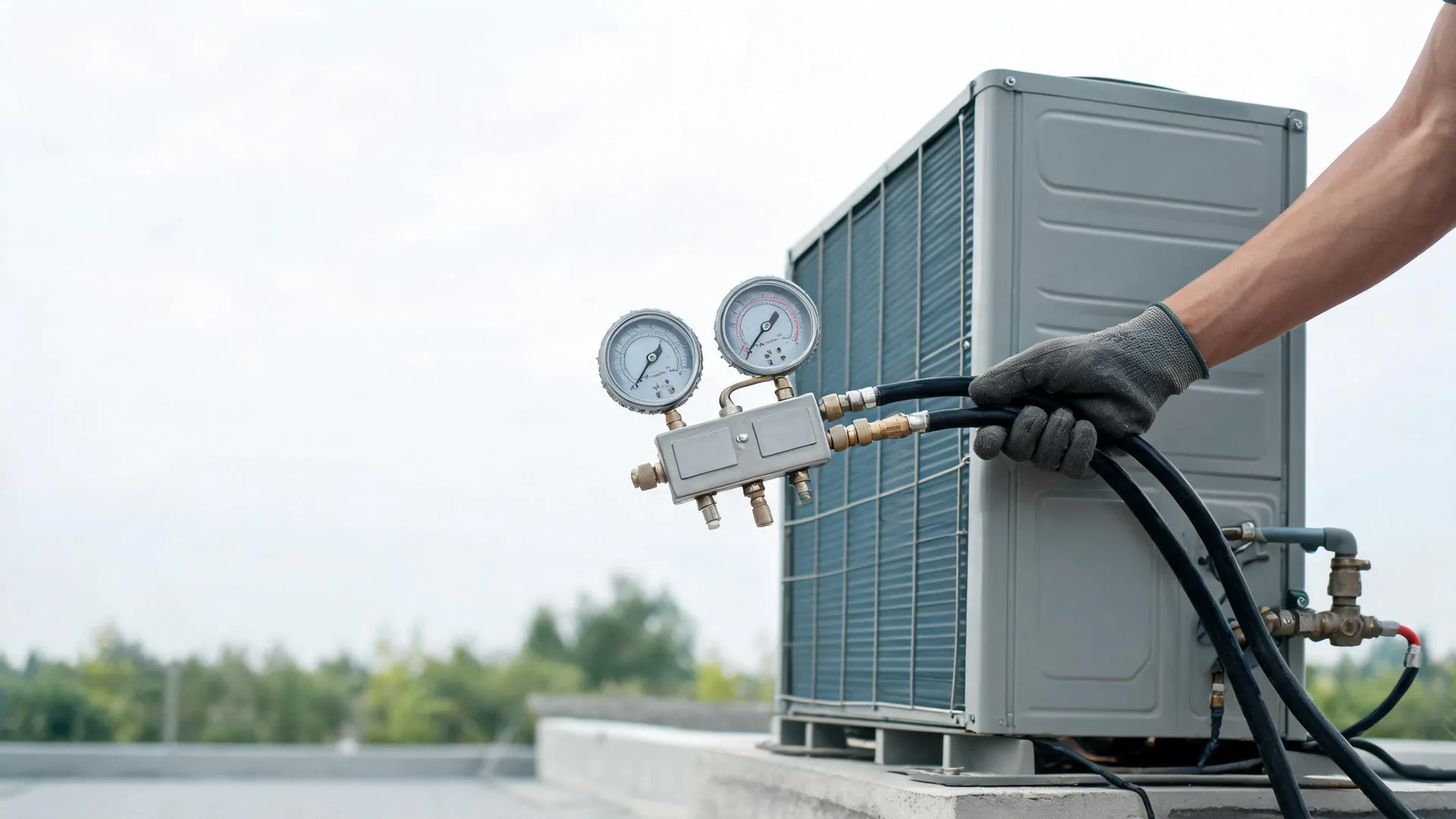
A heat pump that won't switch out of defrost, trips a breaker repeatedly, or blows cold air no matter what you do needs a tech, not a homeowner. Refrigerant charge, a failing reversing valve, and control board faults all require gauges and training to diagnose. If the breaker trips again after you reset it once, stop and call someone rather than resetting it again.

A heat pump in trouble usually tells you in how it runs, not just how it feels. Air coming from the vents that feels cool or barely warm, when the system should be heating, points to a reversing valve stuck in the wrong position or a refrigerant charge that's low. A unit that kicks on and off every few minutes instead of running a steady cycle is short cycling, and that's hard on the compressor every time it happens. Ice building up on the outdoor coil that doesn't clear during the defrost cycle means the defrost control or sensor isn't doing its job. A breaker that trips once might be a fluke. One that trips again after you reset it is telling you something in the system is drawing more current than it should, and that needs a tech with gauges, not another reset.

A repair is worth doing when it fixes one clear problem and the rest of the unit is sound. A failed capacitor, a bad contactor, a defrost sensor that's stopped reading right, these are parts that fail on their own without taking the rest of the system down with them. Replace the part and a heat pump like that can run fine for years. It's a different story when the compressor is failing, or when the repair list keeps growing each time a tech looks at it. A compressor swap on an old unit often costs close to what a new system would, and once refrigerant has been low for a while, other parts have usually been working harder than they should. If a tech finds corrosion inside the cabinet or more than one major component wearing out at the same time, that unit is telling you it's done, not that it needs one more fix.