






A nighttime street view of several illuminated two-story red brick homes with front porches, flanked by a large tree.

Heat Pump Repair in Burlington, IA

Tell us about the job

Takes about a minute. No obligation.

RepairHeat PumpDes Moines County, IA
Step 1 of 2

What ZIP code is the job in?

Winter here averages 19°F overnight through December, January and February, and that's cold enough that your heat pump leans on backup heat more than it would somewhere milder. That's just what zone 5A is like, not a sign anything is wrong with the unit. If yours is short cycling, running nonstop, or blowing cool air on a cold morning, the cause is usually one of a few things. A low refrigerant charge. A failing defrost sensor. A reversing valve stuck in one position. None of that has anything to do with Burlington in particular. It's the same problem and the same fix a heat pump would need in any cold climate.

8 months
October through May, your system heats
4 months
June through September, it cools
19°F
the average winter night it heats against
84°F
the average summer afternoon it cools against
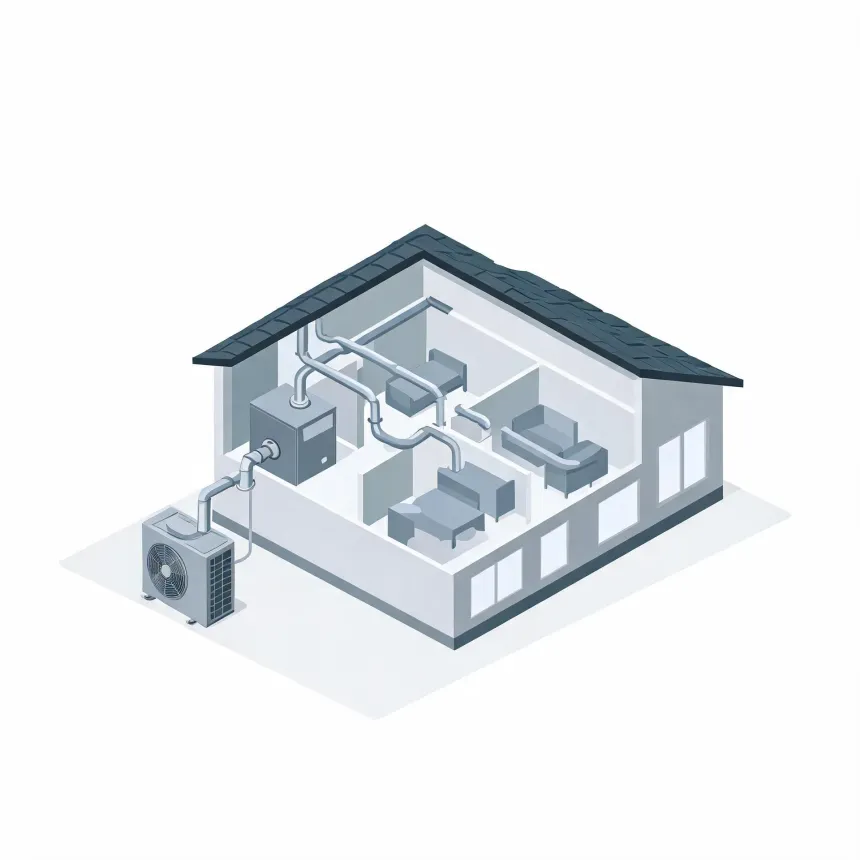
Isometric cutaway illustration of a single-story house showing an indoor air handler, branching ductwork through rooms with furniture, and an outdoor condenser unit connected by a line outside the wall.
Your system heats October through May and cools June through September.

NOAA nClimDiv, 1991–2020 normals

Heat pumps here run heat from October through May, about eight months a year.

A heat pump with a weak part often shows it in October, when the system switches over and starts carrying the heat load every day.

Half the homes in Burlington were built in 1959 or earlier, old enough that a heat pump has already been replaced once

Half the homes here were built by 1959
88 damaging wind events from 2015 to 2024
34 hail events from 2015 to 2024
Burlington gets its share of storms, like anywhere else146 severe weather events hit Des Moines County between 2015 and 2024, nothing unusual for a heat pump built to handle Iowa winters.

Electricity in Iowa ran 13.40 cents per kilowatt-hour in 2024, close to the national average. That matters here because a heat pump with a bad part doesn't just run more, it runs longer to make the same heat, and that shows up on the bill before it shows up as a breakdown. A system that's suddenly costing more to heat the same house the same way is usually telling you a sensor or a valve is already failing, not that the weather got harder on it. Catching that early costs less than waiting for the unit to quit outright.

If this unit already replaced an older one, find out what's left in it before you pay for another repair

A repair call is a good time to ask that question, not after. Have the contractor give you a straight answer on the unit's condition along with the fix.

Find a contractor
A man in a cap, work shirt and tan pants, seen from behind, carries a canvas tool bag up concrete steps toward a dark green front door, with a potted shrub to the right.
A gray outdoor HVAC unit mounted on a concrete pad beside a house with gray lap siding and a stone foundation.

What to check yourself first

Before you call, look at the outdoor unit. Heavy ice over the coil, not just a thin frost layer, means something is off with the defrost cycle. Check the thermostat is set to heat and the temperature is set above room temperature, not sitting right at it. Walk around and feel the vents. Air that's room temperature or a little cool is normal for a heat pump, it doesn't blow hot like a furnace does, but air that's outright cold isn't. Check the breaker panel for anything tripped. Look at the outdoor unit itself and clear away anything blocking airflow around it, leaves, snow, anything piled against the cabinet. If there's a filter, pull it and look at it. A filter packed with dust makes the system work harder and can bring on symptoms that look worse than they are. None of this tells you exactly what's failing inside, but it tells the contractor what's already ruled out before they get there.

A sound that wasn't there before

A heat pump that starts clicking, buzzing, or humming without starting up is usually pointing to the contactor or the capacitor. Those parts wear out from cycling on and off, year after year, and when they go the outdoor unit either won't start or won't stay running. Caught early, it's a part swap. Ignored, the compressor ends up absorbing the strain instead.
What a contractor still has to check

A strange sound, short cycling, or ice on the coil points to a problem but not to the exact part behind it. A contractor puts gauges on the system, checks the defrost board, and tests the reversing valve before naming the fix. Letting the unit run through another cycle of the same symptom just gives a small problem more time to turn into a compressor problem.

A heat pump that's struggling doesn't fail all at once. It fails in stages, and running it through those stages makes each one worse. Low refrigerant means the compressor works harder to move less heat, and it also runs hotter than it's built to run. Ice on the coil follows the same pattern. A little frost is normal, but once it builds past a thin layer it blocks airflow, so the system runs longer to move the same heat, and that lets more ice build. A reversing valve stuck halfway does something similar, forcing the compressor to push against itself instead of moving heat cleanly in one direction. The compressor is the one part in the system that isn't a simple swap, so the longer a bad sensor or a stuck valve keeps running, the more likely it is that the compressor ends up taking the damage instead.

At some point the question isn't what's wrong, it's whether this unit is worth fixing again. Age alone doesn't answer that. A heat pump that's been kept up, with clean coils and a charge that's been checked regularly, can take a repair in stride even after a lot of years. One that's been run hard with small problems ignored is a different case, especially once the compressor is involved. A failing capacitor, contactor, or defrost sensor is a straightforward repair no matter how old the unit is. A compressor going bad is the point where most contractors start talking about replacement instead, because that part carries the rest of the system and a repair there doesn't buy you much time. Ask what's actually failing before deciding either way. The part name tells you more than the age of the unit does.