




A row of dark-painted single-story houses with lawns and large deciduous trees, seen behind a tall trimmed hedge.

Heat Pump Repair in Carroll, IA

Tell us about the job

Takes about a minute. No obligation.

RepairHeat PumpCarroll County, IA
Step 1 of 2

What ZIP code is the job in?

A heat pump in Carroll County works close to eight months a year, October through May, then switches over and covers June through August on the cooling side. That back and forth is hard to beat on a part that is already marginal. September and May are the months to watch, since they sit right before each changeover. A capacitor or a reversing valve that is on its way out can coast through the easy weeks and then fail the first time the system has to really work. If yours struggled to keep up at the start of last season, that is the part worth having looked at now, before it has to prove itself again.

8 months
October through May, your system heats
3 months
June through August, it cools
14°F
the average winter night it heats against
82°F
the average summer afternoon it cools against
Isometric grayscale illustration of a cutaway single-story house showing interior rooms, ductwork and an air handler, an exterior condenser unit connected by lines, and dark solar panels on the roof.
Your system heats October through May and cools June through August.

NOAA nClimDiv, 1991–2020 normals

Carroll County winters average 14°F overnight through December, January and February.

A heat pump has to run its defrost cycle often at that temperature, and that cycle is where a failing part usually shows itself first.

Find out how much life it has left before paying for a repair

Half the homes here were built by 1964
23 winter storms from 2015 to 2024
Winter nights average 14°F

Iowa electricity ran 13.40 cents per kilowatthour in 2024, on the higher side for this part of the country. A heat pump that's short on refrigerant or struggling through a bad defrost cycle draws more power to do the same job, and in Carroll County it's doing that job most of the year. A unit that's running rough right now isn't just uncomfortable, it's adding to every bill until someone finds the actual cause. Worth having looked at soon rather than waiting to see if it sorts itself out.

Know what you're repairing before you pay for it

If the heat pump wasn't swapped out when the house changed hands, it could be well past the point where a repair is the better bet. A technician can look at the age and condition of your unit and give you a straight answer before you spend money fixing something that's on its way out anyway.

Find a contractor
A gray heat pump outdoor unit mounted on a concrete pad next to a residential house with lap siding and stone accents.

The signs show up before the breakdown does

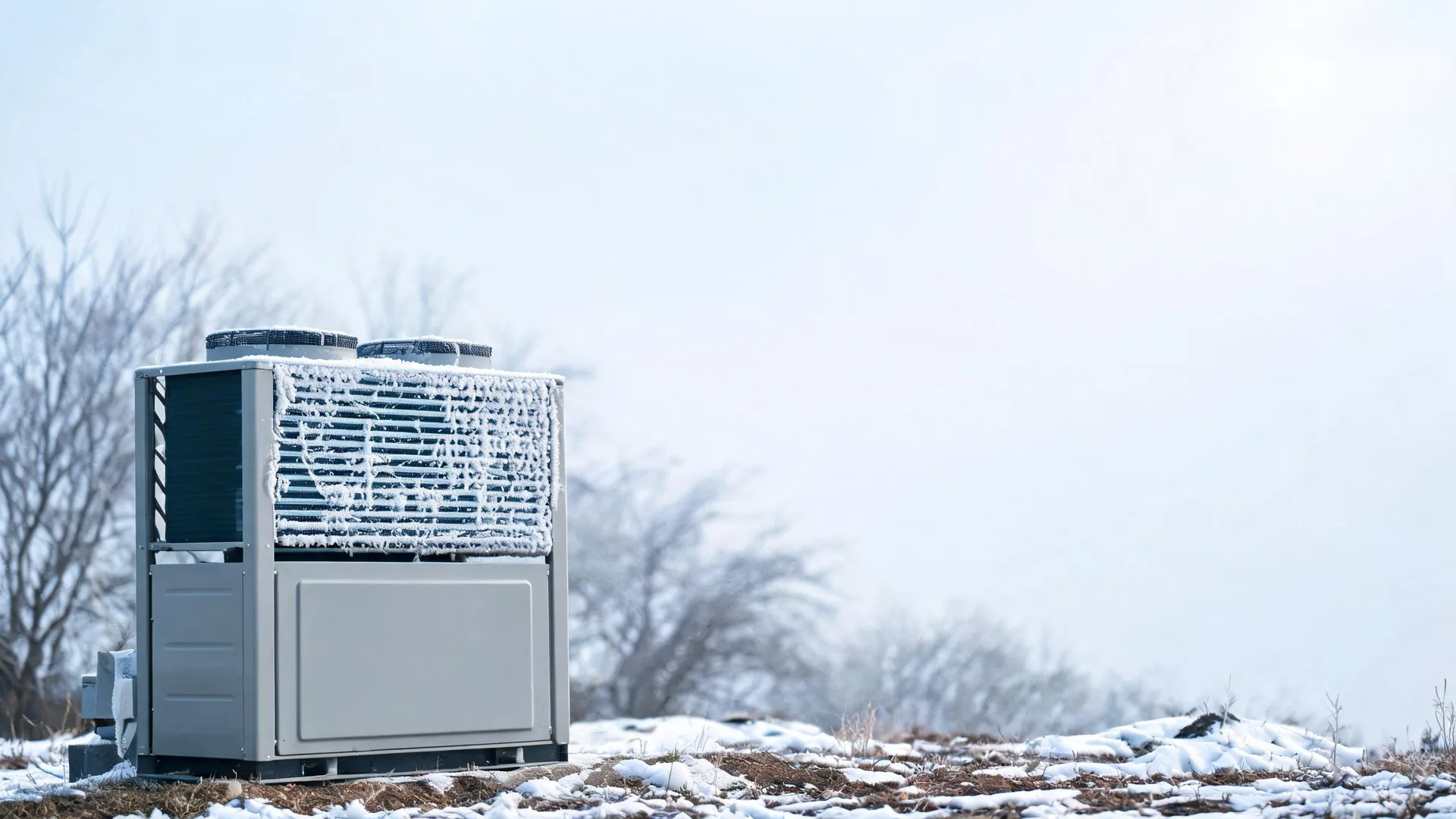
A heat pump that's wearing out gives itself away in how it runs, not just whether it runs. Short cycling is one of the first signs, the system kicking on and off in quick bursts instead of settling into a steady run. Ice on the outdoor coil that stays put after a defrost cycle should have cleared it is another. Air coming out of the vents that feels barely warm, when the thermostat is calling for heat, often points to a reversing valve that isn't shifting all the way. Listen for it too. A hard clunk when the system switches between heating and cooling, or a hum with no response, usually means a contactor or capacitor is going. None of these fix themselves by running longer.

What you can check yourself

Look at the outdoor unit first. Clear away leaves, grass clippings or snow piled against the cabinet, since blocked airflow across that coil can look exactly like a failing part. Check the air filter inside and swap it if it is gray or clogged. Walk around the house and make sure no vents are closed off or blocked by furniture. Check the thermostat batteries and settings, since a thermostat stuck in the wrong mode can mimic a reversing valve problem. These take a few minutes and rule out the simple causes before anything else gets blamed.
What to leave alone

Do not open the outdoor unit's cabinet or touch the wiring inside it. Do not try to chip ice off the coil by hand, since that coil is thin aluminum and bends easily. Do not keep resetting the breaker if it trips more than once, that usually means a short or a locked motor, and running it again can do more damage. If you smell something burning or hear a loud electrical buzz, shut the system off at the thermostat and leave it off until someone looks at it.

A heat pump that's struggling doesn't fail all at once, it fails a little more every cycle it runs. A compressor working against a low refrigerant charge builds up heat it isn't designed to handle, and that heat breaks down the oil that's supposed to protect it. A reversing valve that's sticking partway gets worse each time it's asked to shift, since the parts inside it are wearing against each other instead of sliding clean. Ice on the outdoor coil blocks airflow, so the system pulls harder to move the same amount of air, and that strain lands on the compressor and the fan motor both. A capacitor that's weak but still working will hold on for a while, right up until the moment it doesn't, usually when the system is working hardest to keep up. Turning it off doesn't fix any of that, but it stops the damage from stacking up while someone finds the actual cause.

A diagnostic visit starts outside, at the unit itself. A technician checks the refrigerant charge, since too little means the compressor is working harder than it should and too much causes its own problems. They'll pull the cover and look at the contactor and capacitor, since those tend to go weak before they fail outright. Inside, they check the temperature of the air coming off the coil against what it should be for the mode the system is running in, which tells them whether the reversing valve is shifting all the way or only partway. They'll also run the defrost cycle on purpose and watch it complete, since a cycle that starts but doesn't finish points straight at the part causing it. Most of this is checking what the system is actually doing against what it should be doing, not guesswork.