A row of dark-painted single-story houses with gray shingled roofs behind a tall trimmed hedge, with mown lawn, a walkway, and leafy trees under an overcast sky.

Heat Pump Repair in Decorah, IA

Tell us about the job

Takes about a minute. No obligation.

RepairHeat PumpWinneshiek County, IA
Step 1 of 2

What ZIP code is the job in?

Nine months of heat, three of cooling

A heat pump in Winneshiek County runs heat from September through May and cooling in June through August. There's barely a break between seasons, so a weak part doesn't get much time to show itself before it's back under load.

The first cold snap finds the weak spot

August is the last easy month before heat starts up again in September. If a heat pump has a part that was already struggling, the switch to heating is usually when it quits. That's why repair calls cluster right at the start of a season instead of in the middle of it.

9 months
September through May, your system heats
3 months
June through August, it cools
11°F
the average winter night it heats against
80°F
the average summer afternoon it cools against
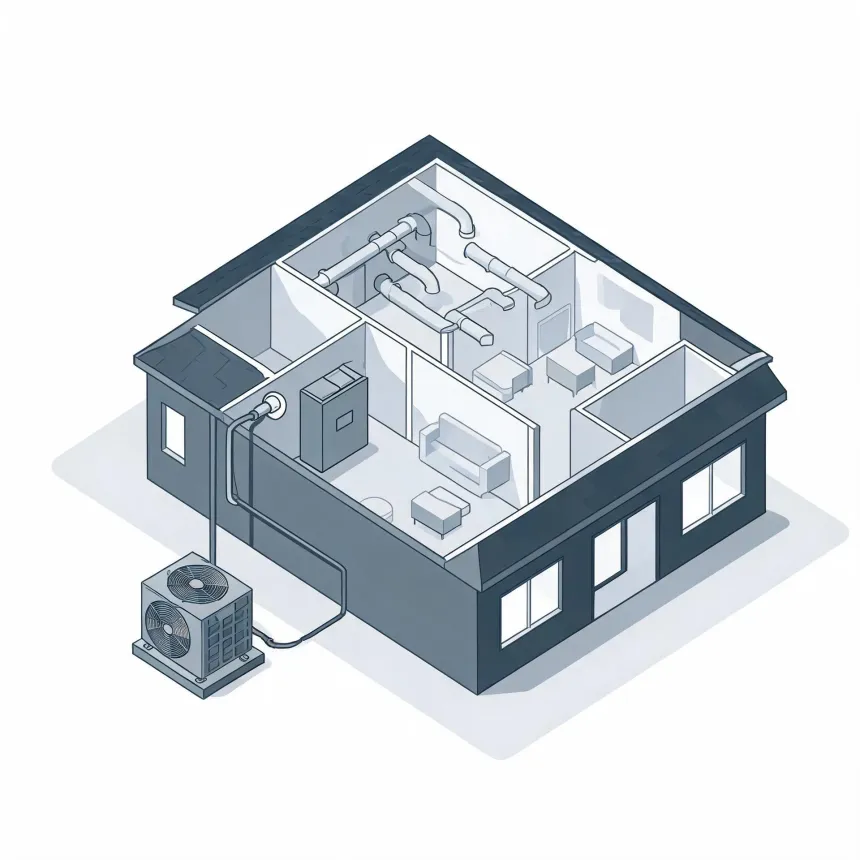
Isometric line illustration of a cutaway single-story house showing interior rooms, ceiling ductwork and an indoor air handler, connected by a line to an outdoor condenser unit on a pad beside the building.
Your system heats September through May and cools June through August.

NOAA nClimDiv, 1991–2020 normals

A heat pump that won't switch over, won't blow warm air, or runs nonstop without warming the house is telling you something before you spend money on a service call.

Check the thermostat batteries, the outdoor unit for ice or debris, and the breaker before you assume the worst, because sometimes the fix is that simple.

Electricity here runs 13.4 cents a kWh, and a heat pump that's struggling pulls more of it every day you wait

Power costs 13.4 cents a kWh statewide
58 damaging wind events from 2015 to 2024
26 winter storms from 2015 to 2024

Half the homes in Winneshiek County were built in 1962 or earlier. If your heat pump came with a house that old, it's worth asking how old the unit itself is, since a house can outlast more than one system. An older heat pump works the same way a new one does, but the parts inside have had more years of starting up and shutting down. A compressor or a reversing valve nearing the end of its life tends to act up right when the load on it changes, which is exactly what happens at the first cold snap. Before you pay for a major repair, it's worth finding out how much life the system has left.

Find out how much life is left before you pay for the repair

A repair call can tell you two things. What's wrong, and how much is left in the system. Ask for both. If the unit is old enough to be original to the house, that's worth knowing before you put money into it.

Find a contractor
A dark gray heat pump unit mounted on a concrete pad next to a house with gray siding and a stone veneer wall.

Most failures aren't sudden, they're overdue

A heat pump fails the same way in any climate. The reversing valve sticks and the system gets stuck in one mode. The defrost control misreads the outdoor coil and either skips a needed cycle or runs one too long. The run capacitor weakens and the compressor starts drawing harder to get going, until one day it doesn't. Refrigerant leaks out slowly at a fitting or coil pinhole, and the system keeps running while it does less and less work. None of these show up on a day when the system is barely working. They show up when it has to run long and hard, because that's when a weak part gets asked for more than it has left.

The air coming out feels wrong first

Warm air that turns lukewarm or cool is usually the first thing anyone notices with a heat pump. A system that runs constantly and never quite reaches the set temperature is the second. Ice on the outdoor coil when the unit isn't in a defrost cycle is worth watching too. That coil should frost lightly at most and clear itself within a few minutes.

Each sign points somewhere different

Air that turns cool partway through a cycle usually points to the reversing valve or a low charge. A system that runs nonstop without warming the house points more toward the compressor or a defrost control that isn't cycling right. Noting when the problem started and what the thermostat was doing at the time gives a technician a head start before the cabinet even comes off.

A heat pump that's struggling doesn't fail cleanly. It fails a little more each cycle. A weak capacitor makes the compressor strain on every start, and every strain takes a little more out of it than the one before. A low charge means the compressor works harder to move the same amount of heat, and the extra heat it generates doing that has nowhere good to go. A reversing valve that's starting to stick gets worse with every switch between heating and defrost, not better. Letting the system keep running on a bad part doesn't give it a chance to recover. It just spends down whatever life the part has left, usually fastest right when you need the heat most.

At some point the question stops being what's wrong and starts being whether it's worth fixing. Age alone doesn't answer that. A heat pump with one failed part and an otherwise sound compressor is usually worth repairing, even late in its life, because the compressor is the expensive part and it's fine. A heat pump where the compressor itself is weak is a different situation, because everything else on the system depends on it and nothing else is worth fixing around a compressor on its way out. The questions worth asking are how old the compressor is, whether this is the first repair or the third, and whether the refrigerant it uses is still easy to get. A system that's needed a few unrelated repairs in close succession is usually telling you it's worn down generally, not that it keeps having bad luck.