






A nighttime view of a tree-lined residential street with illuminated two-story brick houses and street lamps.

Heat Pump Repair in Grinnell, IA

Tell us about the job

Takes about a minute. No obligation.

RepairHeat PumpPoweshiek County, IA
Step 1 of 2

What ZIP code is the job in?

A heat pump in Grinnell earns its keep in winter. Zone 5A means heating is the bigger job most of the year, and overnight lows average 15°F through December, January and February. That's regular, steady work for the compressor and the defrost cycle, not abuse. When a heat pump here needs a repair, it's usually a part worn out from normal running, like a contactor, a defrost board, or a low refrigerant charge, not something the climate did to it. Grinnell doesn't put unusual strain on this equipment. Whatever's going wrong is probably the same thing that goes wrong with heat pumps anywhere, and it has the same fix.

8 months
October through May, your system heats
3 months
June through August, it cools
15°F
the average winter night it heats against
82°F
the average summer afternoon it cools against
Isometric grayscale illustration of a cutaway house showing interior rooms, ductwork and an indoor air handler connected by lines to an outdoor condenser unit on the ground outside.
Your system heats October through May and cools June through August.

NOAA nClimDiv, 1991–2020 normals

Heat here starts in October, and September is the month to get a heat pump checked.

A weak part can hold on through mild days and give out once the system has to run for hours at a stretch.

Grinnell's weather doesn't wear out a heat pump. Normal running does.

Power costs 13.4 cents a kWh statewide
18 hail events from 2015 to 2024
21 winter storms from 2015 to 2024

Half the homes in Grinnell were built in 1971 or earlier. If your heat pump came with a house that old, it's worth asking how old the system itself is, since a furnace or heat pump doesn't usually last as long as the house around it. An old unit can still run and still fail in the middle of a cold stretch, and a repair on a system near the end of its life is money that doesn't carry forward. Before paying for a big fix, it's worth finding out how many years the unit has left in it.

Find out what's left in the system before you fix it

A repair quote is a good time to ask the other question. How many years does this unit have left. A contractor can check that along with whatever's broken now.

Find a contractor
A man in a dark shirt and tan work pants, seen from behind, carries a canvas duffel bag up wooden porch steps toward a dark green front door.
A gray heat pump outdoor unit mounted on a concrete pad next to the stone-accented exterior wall of a house.

What a failing heat pump sounds and feels like

A heat pump that needs repair almost always tells you with sound before it tells you with temperature. A clicking that doesn't lead to startup means the contactor isn't pulling in. A hard clunk followed by a hum means the compressor is trying to start and failing, usually a capacitor going weak. A hissing or bubbling sound from the lines points to refrigerant escaping somewhere it shouldn't. Short cycling, where the system starts, runs a few minutes, and shuts off again, usually means a safety switch is tripping, often from restricted airflow or a refrigerant problem. None of these wait for the coldest day to show up. They show up when a part finally crosses the line from weak to failed, and that can happen on an ordinary afternoon just as easily as a hard freeze.

What you can check yourself

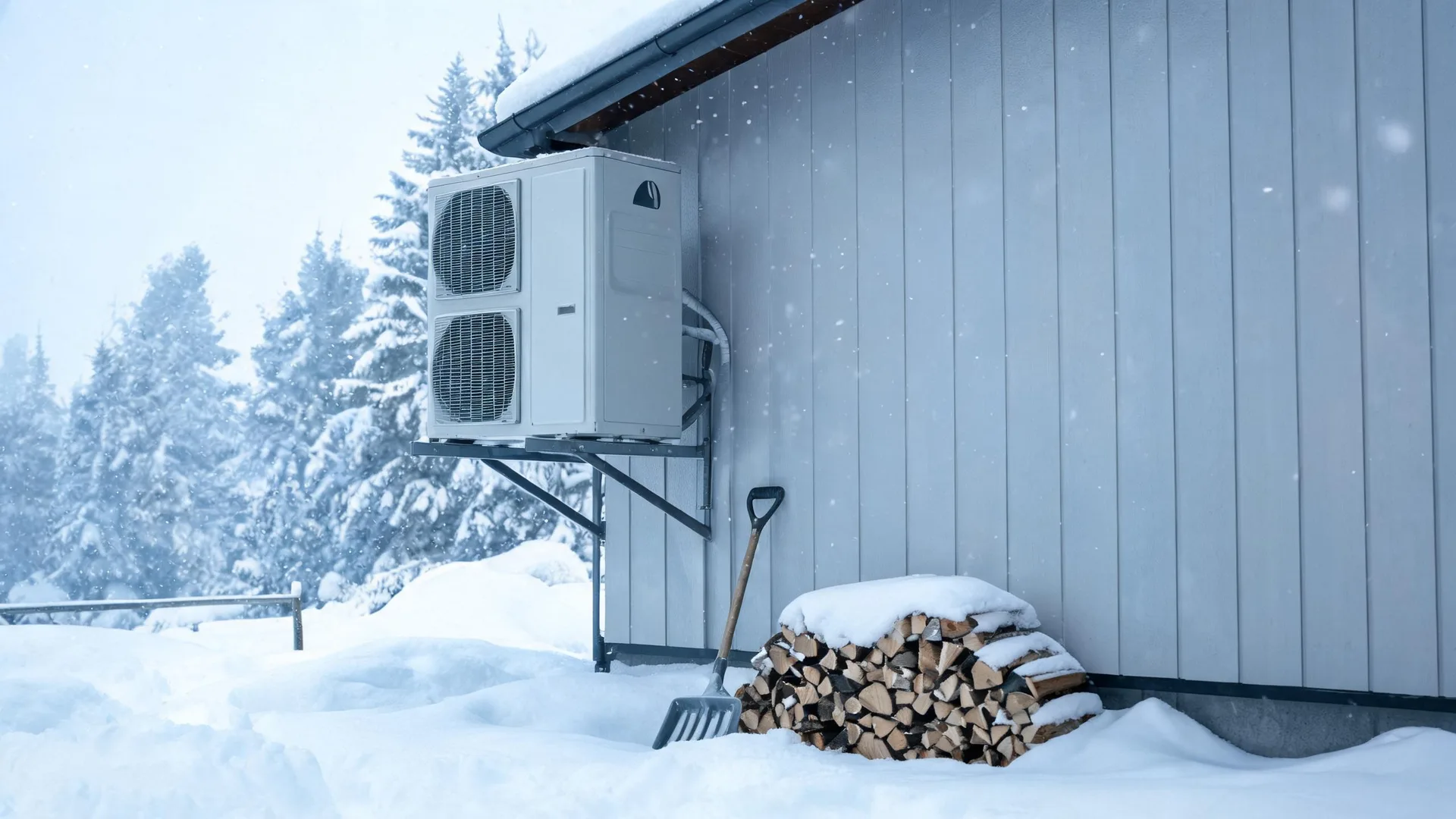
Look at the outdoor unit first. If it's caked in ice beyond the thin frost that clears on its own in a defrost cycle, or if snow is packed around the base blocking airflow, that's worth noting. Check the thermostat is set to heat and the temperature is actually set above room temperature. Go inside and check your breaker panel for a tripped breaker, and check that the furnace filter isn't so clogged you can't see light through it. Walk through the house and feel the vents. Air that's barely moving points to an airflow problem, not the heat pump itself.
What to leave alone

Do not take a cover off the outdoor unit or touch the wiring inside it. Do not try to chip ice off the coil, since that coil is thin aluminum and bends or punctures easily. If you smell anything electrical or hear a grinding or screeching sound from either unit, shut the system off at the thermostat and leave it off. A refrigerant leak isn't something to chase down yourself, and neither is a bad capacitor or a stuck reversing valve. Those need gauges and a meter to diagnose correctly, and guessing wrong on a refrigerant circuit can turn a repair into a bigger one.

A heat pump that's losing capacity keeps trying to make up for it, and that's where small problems turn into big ones. If the reversing valve is starting to leak past its seal, the system runs longer to hit the same temperature, and those longer runs push more refrigerant through a valve that's already failing. A frozen outdoor coil works the same way. Ice blocks airflow across the coil, so the system pulls in less heat per cycle and runs even more to compensate, and that extra runtime is what finally trips the compressor's overload protection. A weak capacitor behaves the same way. It still lets the compressor start, but a harder, slower start each time wears the motor windings down a little more, until one cold morning it doesn't start at all. A refrigerant leak follows its own path regardless of whether the system keeps running. It won't seal itself, and operating low on charge for too long can damage the compressor itself, not just the line it's leaking from. None of these problems fix themselves by waiting it out, and none of them get easier to live with the longer the system runs.

A diagnostic visit starts outside, at the unit itself, before any tool comes out. A tech checks the reversing valve, the defrost board, the contactors, and the refrigerant charge, since those are the parts that wear out from normal cycling. Gauges go on the lines to check the charge, because a system can look fine and still be running low. The defrost sensor gets checked against the actual coil temperature, since a sensor that reads wrong is what leaves a coil iced over. Electrical parts get tested under load, not just looked at, because a capacitor or contactor can look fine sitting still and still fail the moment it has to start a compressor. The point of the visit is to find which of these is actually failing, not to replace parts on a guess.