






Dark-sided single-story buildings with gray shingled roofs behind trimmed hedges, a mown lawn, and large leafy trees overhead.

Heat Pump Repair in Le Mars, IA

Tell us about the job

Takes about a minute. No obligation.

RepairHeat PumpPlymouth County, IA
Step 1 of 2

What ZIP code is the job in?

Plymouth County sits in zone 5A, a cool climate where a heat pump leans on heating more than cooling over the year. That's just the normal duty cycle here, not a strain on the equipment. Summers bring a dew point around 61°F, muggy enough that the system is pulling moisture out of the air along with the heat, which is what it's designed to do. None of that is harder on a heat pump than what the same machine handles in plenty of other places. So when one stops working right in Le Mars, it's usually a known part failing: a contactor, a capacitor, a sensor reading wrong, a low refrigerant charge. The job is finding which one it is, not guessing at what the weather did to it.

8 months
October through May, your system heats
3 months
June through August, it cools
13°F
the average winter night it heats against
83°F
the average summer afternoon it cools against
Isometric illustration of a cutaway single-story house showing interior ductwork, an indoor air handler and simple furniture, connected by lines to an outdoor condenser unit beside the building.
Your system heats October through May and cools June through August.

NOAA nClimDiv, 1991–2020 normals

Heat here starts up in October, right after it idles all through September.

A weak part that made it through summer often gives out the first hard week the heat pump has to work for heat.

Ask about the unit's age before you approve a repair

Half the homes here were built by 1971
53 hail events from 2015 to 2024
26 winter storms from 2015 to 2024

Plymouth County gets its share of rough weather, 136 severe weather events logged between 2015 and 2024, with damaging wind the most common at 51 times and hail close behind at 53. A heat pump sits outside through all of it. None of that means the unit failed because of the weather. A breaker that trips during a storm, a yard full of debris after high wind, a line that got knocked loose, those are things worth ruling out first if the problem showed up right after a bad storm. Most of the time there's no storm to point to at all, and the cause is the same part that fails in any heat pump anywhere: a contactor, a capacitor, a sensor out of range. Power loss is common enough around Iowa that it's worth checking the breaker and the outdoor disconnect before assuming something inside the unit is broken.

Ask what the repair buys you before you pay for it

If this repair is on original equipment, it's worth asking the contractor how much life is left in it before you pay for a major part. Sometimes the right fix is the repair. Sometimes it's knowing not to put more money into a unit that's near the end anyway.

Find a contractor
A man in a cap, dark jacket and olive pants climbs porch steps toward a green front door, carrying a canvas tool bag filled with hand tools, with a potted shrub to the right.
A dark gray heat pump unit mounted on a concrete pad next to a house with gray siding and a stone veneer wall.

What a failing heat pump tells you before it quits

A heat pump that's about to fail doesn't usually just stop. It gives you something to notice first. It might run longer than it used to before it reaches the set temperature, or it might cycle on and off more than it should. The air coming out of the vents might feel cooler than normal in heating mode, or warmer than normal in cooling mode, like the system is working but not quite getting there. You might hear something new: a clicking that repeats before the outdoor unit starts, a buzz that wasn't there before, a hum with no fan turning. Ice on the outdoor coil in weather that shouldn't cause it is worth a call, same as a unit that keeps tripping its breaker. None of these mean the same part is bad every time, but each one is the kind of thing worth mentioning to whoever comes out to look at it.

What's safe to check yourself

Look at the outdoor unit first. Snow, leaves or a cover of ice around the coil blocks airflow and stops the system from working right. Clear away anything piled against it. Check the thermostat batteries and make sure it's set to the mode you want, since a thermostat stuck on the wrong setting looks exactly like a broken heat pump. Go to the breaker panel and look for a tripped breaker on the heat pump circuit, and check the outdoor disconnect box too. Replace the air filter if it's dirty. A clogged filter starves the system of airflow and can make it seem like the unit itself has failed.
What to leave alone

Don't open the outdoor unit's cabinet or touch anything inside it. The electrical components in there can hold a charge even with the power off. Don't try to flush a frozen coil with water or chip ice off it, since that can damage the fins. If the breaker trips a second time after you reset it, stop and leave it off. A breaker that won't hold is telling you there's a short or an overload somewhere, and resetting it again risks more damage. Anything beyond the filter, the thermostat and the breaker panel is a job for someone with the tools and training to open the system safely.

A heat pump fails the same handful of ways no matter whose yard it sits in. The capacitor is the part that gives out most often, since it's what kicks the compressor and fan motors into motion, and it weakens a little every time it does that job until one day it can't anymore. The contactor is the other common one, a switch that pits its contacts down from years of arcing until it sticks or stops making contact at all. A refrigerant leak shows up differently: the system keeps running, but it can't move enough heat, so it runs longer and still falls short. A sensor that's drifted out of range can confuse the defrost cycle, so the unit either frosts over and never clears or defrosts when it doesn't need to. None of these announce themselves as anything more than what they are, a worn part doing less than it used to.

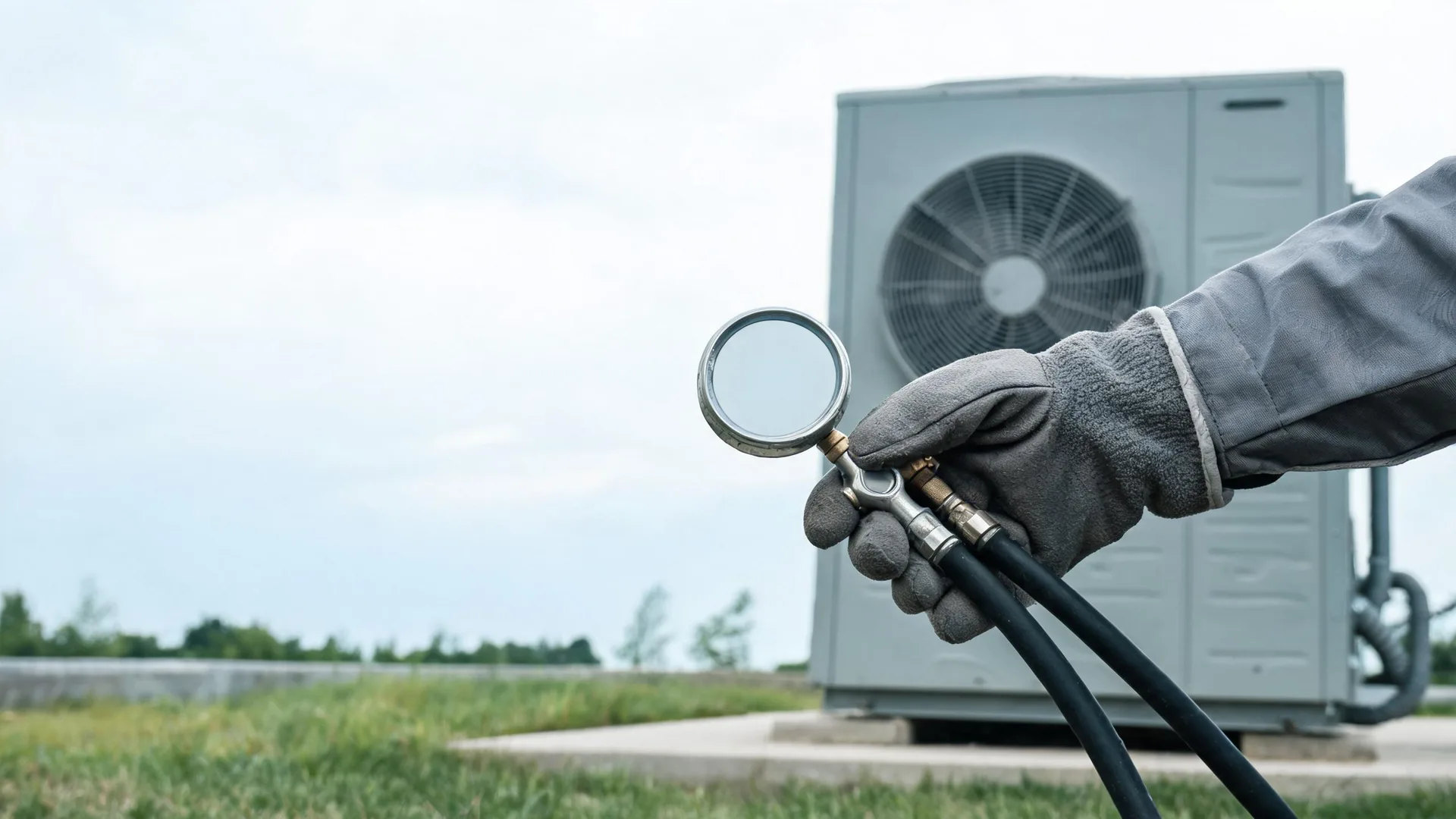
A diagnostic visit starts outside, at the unit itself, before any panel comes off. A tech checks the readings: how the system is running right now, what the pressures are, what the electrical draw looks like on the compressor and fan motors. From there it's a process of ruling things out, checking the contactor and capacitor first since those fail the most, then moving on to the sensors and the refrigerant charge if the first checks come back clean. A gauge set on the refrigerant lines tells them whether the charge is right or whether there's a leak slowly bleeding pressure out of the system. Airflow gets checked too, since a coil that's starved for air can mimic a dozen other problems that have nothing to do with airflow at all. By the end, the goal isn't just naming the failed part. It's knowing why that part failed, so the fix holds instead of failing again the same way in a year.