A row of dark-sided cottages with brown shingled roofs behind a trimmed hedge, beside a mown lawn and large leafy trees under an overcast sky.

Heat Pump Repair in Newton, IA

Tell us about the job

Takes about a minute. No obligation.

RepairHeat PumpJasper County, IA
Step 1 of 2

What ZIP code is the job in?

Air that doesn't feel warm

A heat pump in heating mode puts out air that feels cooler than a furnace would, so that alone isn't a problem. The sign to act on is air barely moving past the vent, or the outdoor unit running nonstop without the house ever warming up. That points to a refrigerant or compressor issue, not just the nature of the equipment.

Ice that won't clear

The outdoor unit frosts over sometimes, and a defrost cycle is supposed to clear it. If you see thick ice staying on the coil for hours, or building up again right after it melts, the reversing valve or defrost control may have failed. Running it that way can damage the compressor, so this isn't one to wait on.

8 months
October through May, your system heats
3 months
June through August, it cools
16°F
the average winter night it heats against
83°F
the average summer afternoon it cools against
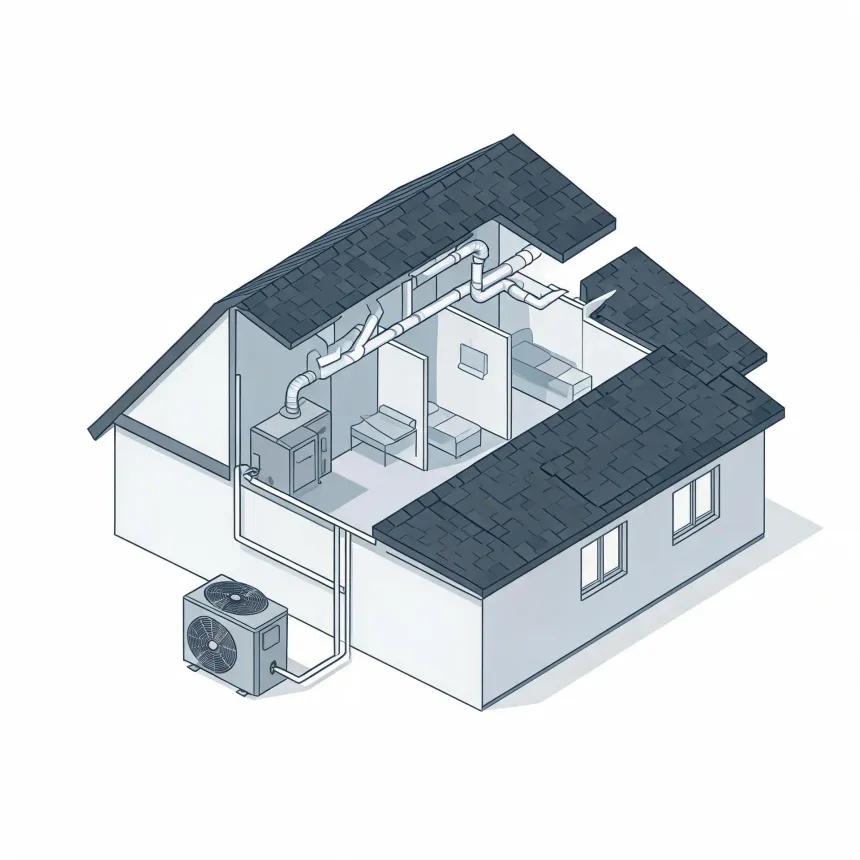
Isometric line illustration of a cutaway single-story house showing interior ductwork, an indoor air handler unit, and an outdoor condenser connected by refrigerant lines, with a dark shingled roof.
Your system heats October through May and cools June through August.

NOAA nClimDiv, 1991–2020 normals

A diagnostic visit starts with the system running, not shut down and taken apart.

The tech watches pressures, temperatures and cycle timing to find which part is actually failing before touching a wrench to it.

Half the homes in Jasper County were built in 1965 or earlier, and a heat pump doesn't outlast the house

Half the homes here were built by 1965
54 hail events from 2015 to 2024
20 winter storms from 2015 to 2024
Nothing unusual here, just the usual fixIowa homes paid 13.40 cents per kilowatthour in 2024, nothing about that points to a harder problem than the ordinary one.

If your heat pump came with the house, ask the tech straight out how many years it has left before you pay to fix it again. Half the homes in Jasper County were built in 1965 or earlier, so plenty of these systems are old enough that the next repair could just be a down payment on the one after it. That's a fair question to ask before any wrench comes out, not after. The tech watching the pressures and cycle timing during diagnosis will have a sense of the compressor's condition, and that's worth asking about directly.

Ask how much life it has left

If your system came with an older house, it may be near the end of its life. Ask how much life it has left before paying for a big repair.

Find a contractor
A man in a cap, dark jacket and tan work pants, seen from behind, carries a canvas tool bag up concrete steps toward a dark green front door of a gray clapboard house with a potted shrub beside it.
A gray heat pump condenser unit mounted on a concrete pad against the gray lap-siding exterior wall of a house.

What to check before the tech shows up

Before anyone comes out, check the thermostat batteries and the setting itself. A thermostat stuck in the wrong mode or with dead batteries looks exactly like a failed system. Go outside and look at the unit. Clear away leaves, mulch or anything piled against it, since blocked airflow across the coil can bring on a lot of what feels like a bigger problem. Check the breaker for both the indoor and outdoor units. A heat pump that trips a breaker repeatedly shouldn't just get reset again and again, but one trip is worth ruling out first. Inside, pull the air filter and hold it up to the light. If you can't see through it, that alone can starve the system of airflow and cause icing or weak heat. None of this calls for taking anything apart. If the system still isn't warming the house after these checks, that's the point to call someone.

The compressor rarely fails on its own

A compressor is built to handle years of cycling. What actually kills it is usually something upstream, a refrigerant leak that went unfixed, or a failed capacitor that made it strain to start every time it kicked on. By the time the compressor itself quits, it's often the last part in a chain that started somewhere else.

Fixing the compressor alone can miss the real problem

A tech checking refrigerant charge and electrical components during a repair is looking for what caused the strain in the first place. Putting in a new compressor without finding that cause just sets up the same failure again.

A heat pump that's low on refrigerant or struggling to start will keep trying anyway, and that's the problem. The compressor doesn't know to stop and ask for help, so it keeps cycling under a strain it wasn't built for. A refrigerant leak left alone wears at the compressor every time it runs, slowly, until the damage is no longer a repair but a replacement. The same goes for ice left to build on the outdoor coil. A few cycles of that won't hurt much, but a system icing over day after day is pushing the compressor to work against a block of ice instead of open air. The longer it runs in that state, the more of the system it tends to take down with it.

Age isn't the only thing that decides this. A heat pump that's otherwise sound but low on refrigerant from a small leak is usually worth fixing, since sealing the leak and recharging it brings the system back to normal. A compressor that's actually failed is a different question, because that part alone can cost as much as a large chunk of a new system, and paying that on an old unit often doesn't make sense. Ask what's actually broken before deciding anything. A cracked capacitor or a bad defrost control is a small job regardless of the system's age. A compressor or a coil with a slow leak that's hard to find is the kind of repair worth weighing against starting over.