May is when to catch it
Heat pumps in Wapello County switch over to cooling in June. May is when a weak part still shows itself before the system is running flat out every day.
Takes about a minute. No obligation.
Heat pumps in Wapello County switch over to cooling in June. May is when a weak part still shows itself before the system is running flat out every day.
A heat pump that already limped through last season and gets ignored tends to fail at the first real demand, in June or in October when heat kicks back on. Fixing the cause now is a smaller job than replacing a part that gave out under full load.
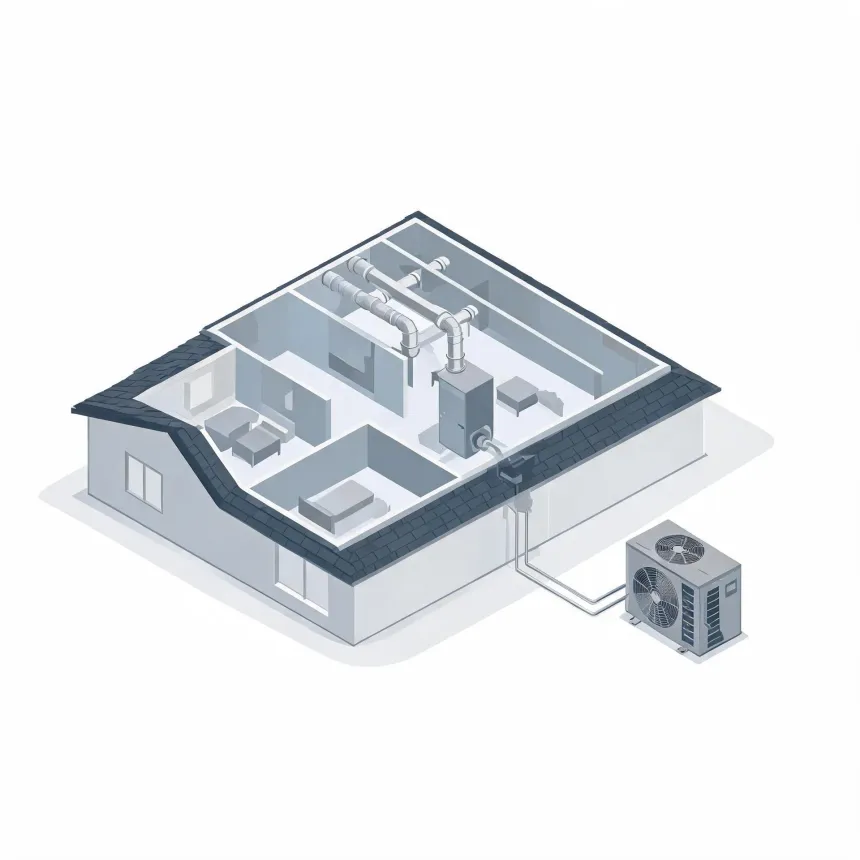
NOAA nClimDiv, 1991–2020 normals
Winter low here averages 18°F, cold enough that a heat pump leans on its backup heat strip some mornings.
If the heat strip is doing all the work and the outdoor unit isn't, that points to a specific failure, not old age.




Most people notice a heat pump problem before they can name it. The air coming out feels lukewarm instead of warm, or the system runs on and on without the house catching up to the thermostat. Short cycling is another sign worth knowing. The unit kicks on, shuts off almost right away, then starts again instead of running a full steady cycle. Listen for noises that weren't there before. A rattle, a new hum, a hard clunk when it starts or switches between heat and cooling all mean something is wearing loose or sticking. Ice on the outdoor unit that doesn't clear on its own is worth paying attention to, and so is a hissing sound near the lines, since that can mean refrigerant escaping. None of these mean the same thing every time. Any of them is a reason to get it looked at rather than wait and see.
Problems tend to show up in the first weeks of the season, when the load hits a part that was already weak.
Find a contractor
Most heat pump failures start with something small that gets asked to work too hard. A capacitor weakens and the compressor or fan motor strains to start, which wears it down faster. A contactor pits from years of switching on and off until it sticks or stops making contact. The reversing valve, the part that switches between heat and cooling, can fail stuck in one mode, so you get heat when you wanted cooling or no switch at all. Outdoor coils get dirty or physically blocked, so the system can't move heat the way it needs to. A refrigerant leak drops the charge slowly, and the system keeps running but moves less heat each week, working harder for less. Thermostats and control boards fail outright sometimes, and that reads like the whole system is dead when it's one part. None of these start big. They start as the system running a little worse, then a little worse than that, until the day it can't keep up at all.
A compressor trying to start against a failing capacitor draws more current than it should. A blower motor pushing air through a dirty coil runs hotter than it was built to run. The part that was already struggling doesn't stay contained to itself. It pulls down whatever is working alongside it.
A refrigerant leak left alone lets the compressor run low on charge, and a compressor that runs low on charge long enough doesn't come back with a recharge. A stuck reversing valve forced to keep cycling wears against the same failure every time it tries. What would have been a simple swap, caught early, becomes the reason the whole unit needs replacing.
Before anyone comes out, check the thermostat is set to heat or cool as needed and the batteries aren't dead. Look at the outdoor unit. If the coil is packed with leaves, grass clippings or ice, that alone can make a heat pump struggle, and clearing debris away from the coil is safe to do yourself. Check the air filter. A filter clogged with dust chokes airflow across the indoor coil the same way a blocked outdoor coil does, and it's the cheapest thing on the system to replace. Walk the breaker panel and make sure the breakers for both the indoor air handler and the outdoor unit are on. If the outdoor unit is coated in ice and it isn't defrosting on its own after a few hours, that's worth mentioning when you call, since it points toward the reversing valve or the defrost control rather than something you can clear by hand.
A diagnostic visit starts outside, at the unit itself, before any gauges come out. A tech checks that the fan spins freely and the coil is clear. Then they listen to the compressor cycling on, since the sound tells them something a gauge can't. Gauges go on next to check refrigerant pressure. That number alone can point to a leak, a bad valve or a compressor working harder than it should. Electrical testing comes after. The capacitor's actual output gets checked against what it's rated for, the contactor gets checked for pitting, and the board gets checked to see it's sending the signals it should. A heat pump has to be tested in both heat and cooling, because a reversing valve can work fine one way and fail the other. Only once all of that lines up does a tech say what's actually wrong, instead of guessing from one symptom.