




A low ground-level view across a mown lawn toward a dark two-story house with a covered front porch, flanked by large leafy trees under an overcast sky.

Heat Pump Repair in Storm Lake, IA

Tell us about the job

Takes about a minute. No obligation.

RepairHeat PumpBuena Vista County, IA
Step 1 of 2

What ZIP code is the job in?

A heat pump in Storm Lake works through winters that average 12°F overnight, and that's well within what the system is built for. The strain on a heat pump here is the same as anywhere else in this kind of climate. Winter storms have hit the county 31 times in the past decade, and that kind of weather can mean ice or snow built up around the outdoor unit, blocking airflow and making it run harder than it should. Hail has come through here too, so a bent fin or a dented cabinet isn't out of the question. None of that means something unusual is wrong. It means the usual causes are worth checking first, and a contractor who knows what to look for can tell you quickly which one it is.

8 months
October through May, your system heats
3 months
June through August, it cools
12°F
the average winter night it heats against
81°F
the average summer afternoon it cools against
Isometric line illustration of a cutaway single-story house showing interior rooms with furniture and ceiling ductwork, connected to an outdoor condenser unit on the ground outside the left wall.
Your system heats October through May and cools June through August.

NOAA nClimDiv, 1991–2020 normals

Heat here runs October through May, about eight months of the year.

September is the month to get a weak heat pump looked at, before the first cold stretch finds the problem for you.

At 13.4 cents a kilowatt-hour, a heat pump running poorly costs you every month it's ignored

Power costs 13.4 cents a kWh statewide
23 hail events from 2015 to 2024
31 winter storms from 2015 to 2024

Half the homes in Buena Vista County were built in 1964 or earlier. The house doesn't tell you the age of the heat pump itself, since a system gets replaced long before the house does. Still, if yours came with an older home and nobody's swapped it since, it's worth finding out how old it actually is. A heat pump past its years can run fine on a mild evening and still struggle once it has to work harder, and that's a different problem than ice on the coil or a bent fin. Before paying for a repair, ask how much life the unit has left in it.

Find out if it's worth fixing before you pay for the repair

A contractor can look at the repair and the age of the system together, and tell you whether fixing it makes sense or whether you'd just be putting money into a machine on its way out.

Find a contractor
A gray outdoor HVAC unit mounted on a concrete pad beside a house with gray lap siding and a stone foundation.

What you can check before the cold finds the problem for you

Go outside and look at the outdoor unit first. If snow or ice is built up around it, or leaves and debris are packed into the coil, clear what you can reach by hand. That alone solves more no-heat calls than anything else. Next check the air filter inside. A clogged filter starves the system of airflow and can make it run constantly without warming the house. Look at the outdoor fan while the system is running. It should be spinning freely. If it's iced over or not turning at all, that's not something to force or chip at yourself. Check your thermostat is set to heat and the batteries aren't dead if it uses them. Look at your breaker panel for a tripped breaker, since a heat pump that won't start at all sometimes comes down to nothing more than that. If you hear the system running but feel no warm air, or it's blowing air that feels cold to the touch, that points to something inside the refrigerant system, and that's beyond what any homeowner can check safely.

It's not keeping up, not blowing cold

A failing heat pump in winter rarely stops outright. It runs longer than it used to, or the air coming out feels lukewarm instead of warm, or one room stays cold no matter what the thermostat says. Short cycling, where it turns on and off in quick bursts instead of running a steady stretch, points to a different problem than a system that just runs nonstop and never catches up.
Sounds and smells are the system telling you something specific

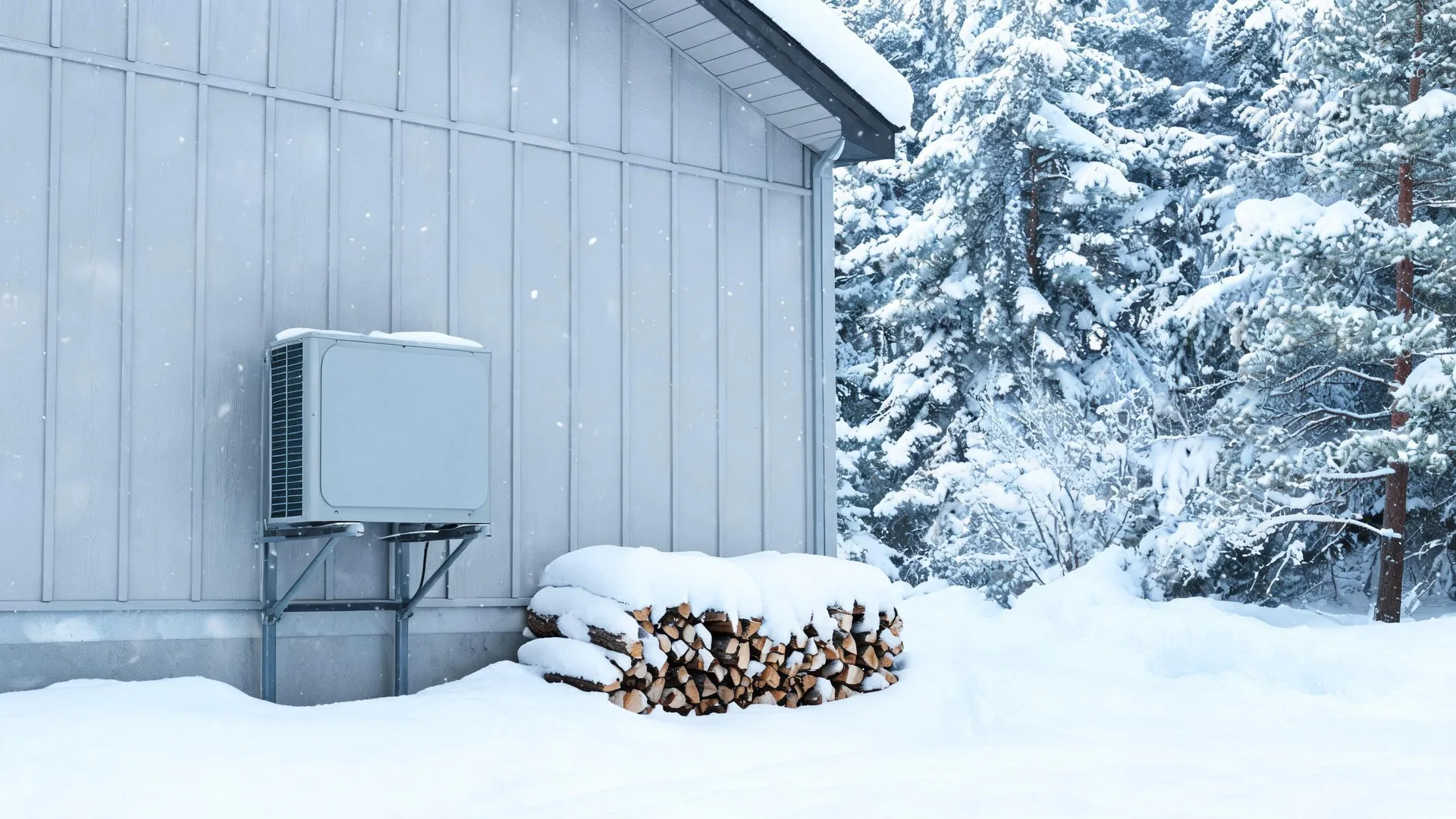
A hard clunk at startup, a steady clicking that doesn't stop, or a hiss near the lines usually points to a particular part, not general wear. A burning smell from the vents means an electrical issue and the system should be shut off until someone looks at it. Ice on the outdoor unit that doesn't clear during the defrost cycle means that cycle isn't working right, and that's a repair, not something to chip away at yourself.

A heat pump that's struggling doesn't fail cleanly. It fails slower, and running it while it struggles is usually what turns a repair into a replacement. A compressor working against a low refrigerant charge runs hotter than it should every minute it's on, and that heat is what wears it down faster than the original leak ever would have. A failing capacitor makes the compressor or fan motor strain to start, and that extra draw is what finally kills the motor. Ice that builds on the outdoor coil blocks airflow, so the system works harder to move the same heat, and that extra load lands on the same compressor. None of this gets better with time. The machine doesn't rest and recover between cycles. It just keeps straining until something gives out for good.

A diagnostic visit starts outside at the unit. The coil, the fan and the refrigerant lines get looked at before anything gets opened up. Gauges go on the refrigerant lines to check the charge, since too little or too much both change how the system runs. The capacitor, the contactor and the wiring to the compressor get tested too. A part can be weak without being dead yet. The reversing valve gets checked, since that's what lets a heat pump switch between heating and cooling, and a stuck valve explains a lot of strange symptoms on its own. Airflow gets measured rather than assumed, because a system can have a full charge and sound wiring and still underperform if air isn't moving through it right. By the end, the problem usually has a name, not a guess.