A trimmed hedge borders a mown lawn in front of single-story houses with dark siding and shingled roofs, surrounded by large leafy trees under an overcast sky.

Heat Pump Repair in Vinton, IA

Tell us about the job

Takes about a minute. No obligation.

RepairHeat PumpBenton County, IA
Step 1 of 2

What ZIP code is the job in?

September is the month to get this looked at

Heat pumps in Benton County switch over to heat in October, so September is when a weak part gets found before it has to carry a full season. A heat pump that struggled last winter will show it again under the same load.

A breakdown now means it was already weak

A heat pump here runs heat about eight months a year, October through May. That is most of the year on one system, and a part that was marginal in the spring is often the one that gives out when the first real cold hits.

8 months
October through May, your system heats
3 months
June through August, it cools
14°F
the average winter night it heats against
82°F
the average summer afternoon it cools against
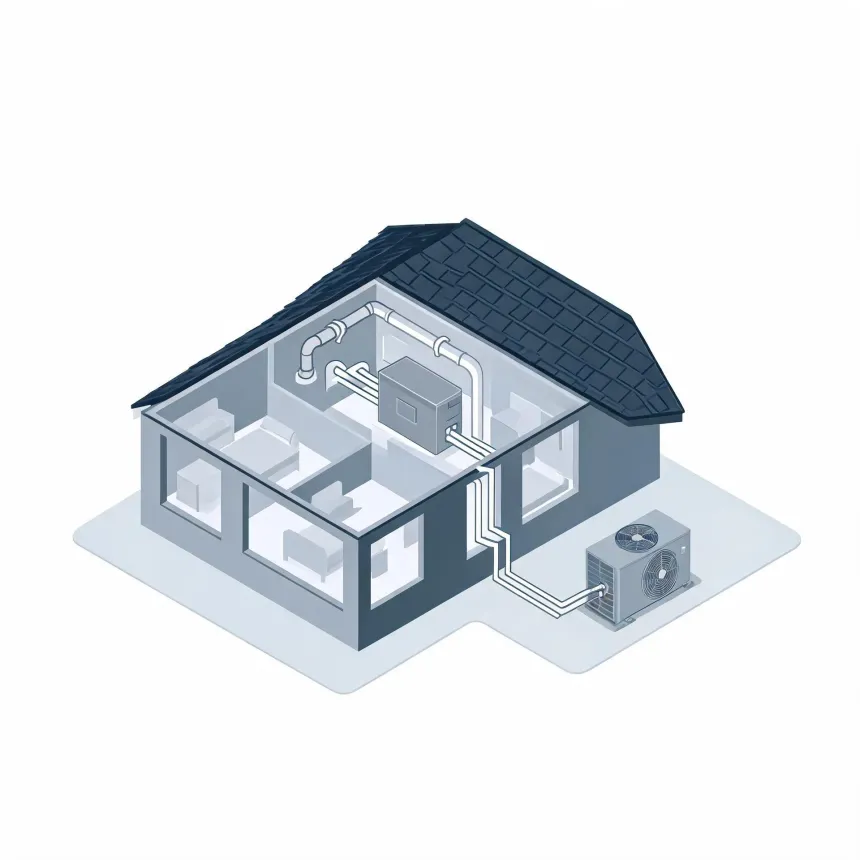
Isometric cutaway illustration of a gray house showing interior rooms, a central air handler with ducts in the attic, and refrigerant lines running to an outdoor condenser unit beside the building.
Your system heats October through May and cools June through August.

NOAA nClimDiv, 1991–2020 normals

Vinton gets to 14 degrees on a winter night, nothing a heat pump built for this zone can't handle.

When a heat pump in Benton County struggles, it's almost always a part that needs attention, not the cold outside.

Half the homes here are old enough that their heat pump isn't the first one

Half the homes here were built by 1964
52 damaging wind events from 2015 to 2024
64 hail events from 2015 to 2024

Benton County sees its share of wind, hail and the occasional tornado, same as most of this part of Iowa. None of that is what takes down a heat pump. Severe weather might knock out power for a while, and when it comes back the system should start up on its own and pick up where it left off. If yours doesn't, that's a control board or a switch that needs attention, not a sign the unit took damage. The weather here explains power outages. It doesn't explain a heat pump that won't run.

A heat pump running badly costs you every month it's ignored

Electricity in Iowa ran 13.40 cents per kilowatthour in 2024, and a heat pump here runs most of the year. A part that's making the system work harder shows up on the bill before it shows up as a breakdown.

Find a contractor
A man in a cap, gray shirt and brown work pants walks up steps toward a dark green front door, carrying a canvas tool bag beside a potted shrub.
A gray air-source heat pump mounted on a concrete pad next to a house with gray vinyl siding, surrounded by gravel and flanked by green shrubs and white hydrangea flowers.

Ask what the repair is buying you

If the heat pump outside your house is original to it, and the house dates to 1964 or earlier, that system has had a long run already. Most heat pumps don't last as long as the house around them. Before paying for a repair, ask the contractor how many years are likely left on the unit. Sometimes the fix is small and worth doing. Sometimes the unit is close enough to the end that the honest answer is to replace it instead of patching it again this winter.

What you'll notice first

Air coming from the vents that's cooler than it should be, a system that runs long stretches without shutting off, or one that short cycles on and off. Ice building up on the outdoor unit when it isn't in defrost. A room that won't hold temperature no matter where the thermostat is set. A low hum or buzz from the outdoor unit that wasn't there before. These are the signs that show up before a heat pump quits outright.

Why those signs are worth acting on

A heat pump rarely fails all at once. The noise, the weak airflow, the ice, these are the system telling you a part is already struggling, a contactor, a capacitor, a reversing valve, before it gives out completely. Catching it at that stage usually means a repair. Waiting until the unit won't run at all takes that choice away.

A heat pump that's struggling doesn't stay a small problem if it keeps running. A weak capacitor makes the compressor pull harder every time it starts, and each hard start wears it down further. A low charge makes the compressor work against itself, building up heat it isn't built to handle. A failing contactor arcs a little more each time it closes, until it welds shut or stops closing at all. None of this fails the unit outright on day one. It lets the system keep running while something inside pays for it. Shutting it down and calling for a look means living without heat for a day. Running it until the compressor gives out means replacing the whole unit instead of the part that started the trouble.

A diagnostic visit starts outside, at the unit itself. A contractor checks the refrigerant charge, because too little or too much changes how hard the compressor has to work. They'll check the contactor and capacitor, since those wear out from the simple act of starting the system up again and again. Airflow gets checked too, at the coil and at the vents, because a heat pump starved for air runs cold and strains to keep up. Most of this is done with gauges and a meter, not guesswork. The point is to find which part failed and whether anything else was struggling along with it before deciding what to fix.