Gas heats most of Boone County
Utility gas heats 57.3% of occupied homes in Boone County, with LP or bottled gas heating another 20%. Electric furnaces and baseboard make up most of the rest, at 19.6%.
Takes about a minute. No obligation.
Utility gas heats 57.3% of occupied homes in Boone County, with LP or bottled gas heating another 20%. Electric furnaces and baseboard make up most of the rest, at 19.6%.
Most homeowners here are not replacing their furnace with a mini split. They're adding one to cover a room the furnace and ducts don't reach well, or to get cooling and shoulder-season heat without running gas or electric heat for it.
NOAA nClimDiv, 1991–2020 normals
Cooling in Boone County starts in June and runs through August.
Get a mini split installed before May ends, so it's already running when the first hot week hits.




Boone County falls in climate zone 5A, where heating is the bigger load on a system than cooling. Any mini split sold new here has to meet 14.3 SEER2 for cooling and 7.5 HSPF2 for heating. That's the federal minimum for split-system heat pumps, and the standard doesn't treat ductless as its own category. So a mini split has to clear the same bar as a central heat pump would. In zone 5A, that efficiency gets used mostly on the heating side, since that's what the system runs for most of the year.
Electricity in Iowa runs 13.40 cents per kilowatt-hour, cheaper than most of the country. Every mini split sold here has to clear the same efficiency floor, so that part is already decided. What's left to choose is the size and the install, matched to the room it's heating and cooling and the house it's going into.
Find a contractorIf your panel dates back to when the house was built, that's the thing to check first. The outdoor unit needs a dedicated circuit. What's already in the panel decides whether that's a simple hookup or more work. A contractor sizing the system plans around what's actually in your house, not around a blank slate.
A mini split is being added, not swapped in, so the furnace or baseboard heat that's already there keeps running. There's no old equipment to haul away unless something separate is being replaced at the same time.
A mini split can be shut off or turned down without touching the rest of the house. The existing heat stays in place as the fallback for that room, so nothing is lost if the mini split ever needs service.
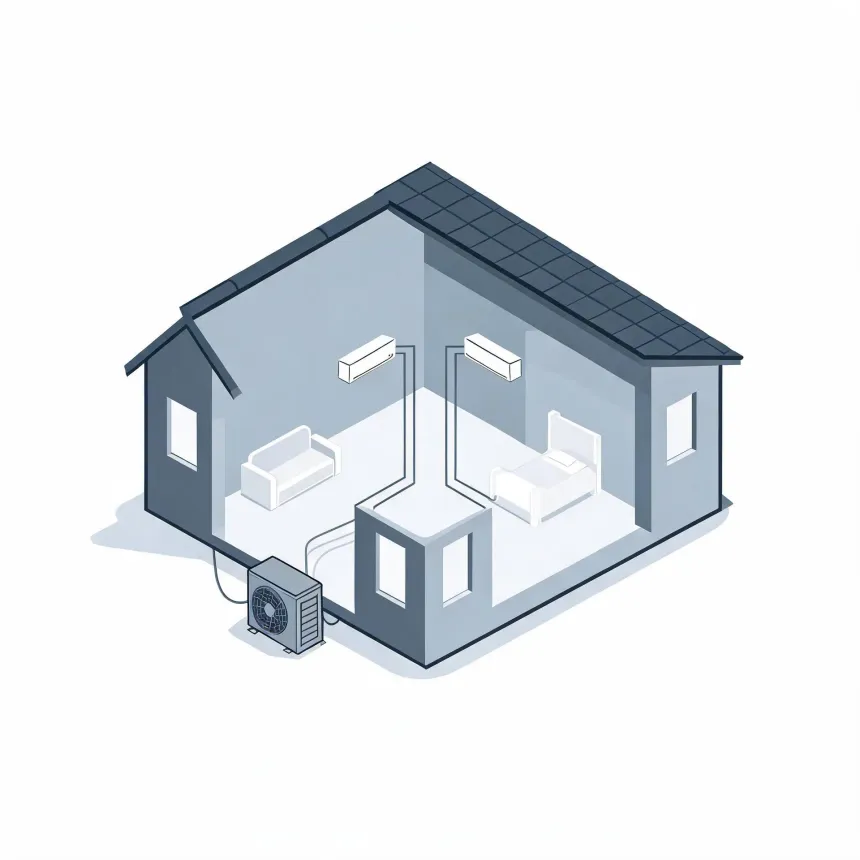
What you're paying for with a mini split is mostly the parts you don't see. The line set carries refrigerant between the outdoor unit and the indoor head, and running it clean through a wall, around framing, up to where the indoor head sits takes time whether the wall is open or finished. A longer run or one that has to turn a corner or cross a floor costs more than a short straight shot. Every indoor head needs its own line set and its own wiring back to the outdoor unit, so adding a second zone still takes real work even with the outdoor unit and the electrical groundwork already in place. The outdoor unit itself has to sit somewhere with clearance on all sides for airflow and service access, and if the spot that makes sense means a longer run or extra mounting work, that shows up in the price too. None of this shows once the covers are on and the unit is running, but it's what decides whether the system holds up and runs quiet for years.
Installation starts with the outdoor unit and the indoor head going up, but most of the day goes to the line set and the wiring between them. A tech drills a hole for the conduit, runs the line set through the wall, and connects it to both the indoor head and the outdoor unit. Once that's together, the line gets evacuated with a vacuum pump to pull out air and moisture, because either one left in the line will keep the system from running right. Only after it holds a vacuum does the refrigerant get released into the line. The last part is the electrical hookup to its own circuit, then powering it on to check that it heats, cools, and the head responds to the thermostat or remote. A tech won't leave until it's been run through both modes and the drain line is confirmed to be clearing condensate the way it should.