Gas heat is the default here
Utility gas heats 58% of homes in Carroll County. Most furnaces out there are gas furnaces, and a lot of the ductwork already in place was built around one.
Takes about a minute. No obligation.
Utility gas heats 58% of homes in Carroll County. Most furnaces out there are gas furnaces, and a lot of the ductwork already in place was built around one.
A mini split doesn't tie into that gas furnace or its ducts at all. It heats and cools through its own indoor unit, which makes it a fit for a room an existing system doesn't reach well, or for a home without ductwork to begin with.
NOAA nClimDiv, 1991–2020 normals
Cooling runs about three months a year here, June through August.
A mini split in Carroll County spends most of its life idle, so a mid-range system holds up fine.




Electricity in Iowa ran about 13.4 cents per kilowatt-hour in 2024, cheaper than most of the country. That changes the math on a mini split. The highest-efficiency models cost more up front, and the extra you pay back slowly when power is this cheap. A mid-efficiency unit that's built well and sized right for the room will cost less to run than people expect, and it'll do the job for years. Put the money into a good installer and the right size unit for the space, not the top efficiency number on the spec sheet.
Carroll County falls under zone 5A, a cool climate where heating does the heavier work over the year. A new ductless mini-split has to meet 14.3 SEER2 for cooling and 7.5 HSPF2 for heating under the federal standard. A federal tax credit is available toward a qualifying system. Get a quote to see what fits.
Find a contractor
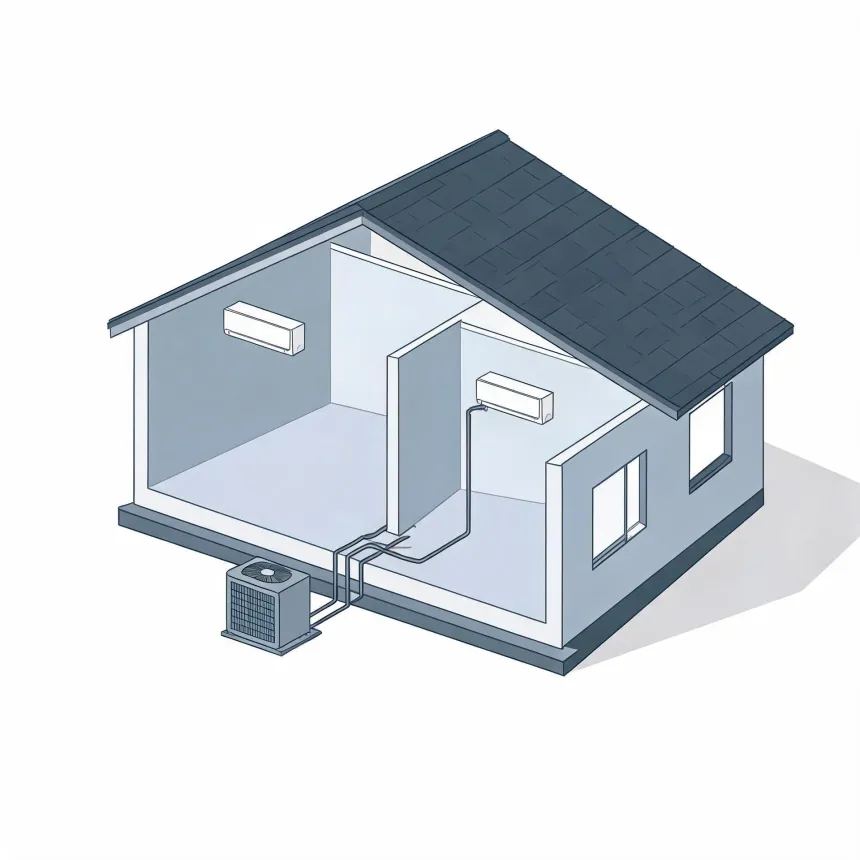
The crew mounts the indoor head high on an exterior wall, where it can move air across the room. The outdoor unit goes on a pad or bracket outside. Running the line set between them takes the most time, since it carries the refrigerant lines, the wiring, and the condensate drain through a hole drilled in the wall. Once that's connected, the installer pressure tests the line to check for leaks, then pulls a vacuum on it to draw out any air and moisture before refrigerant goes in. Skip that step, and moisture left behind can freeze or corrode the line from the inside later on. Only once the line holds vacuum does the system get charged with refrigerant. Then it runs, heating and cooling, while the installer checks that it's working the way it should before calling the job finished.
A single indoor unit tied to one outdoor unit is the simplest job there is, and the price reflects that. Add another zone off the same outdoor unit, and the installer is running more line set, more wiring, and mounting another indoor head. Each zone adds its own labor and its own materials, so a system covering several rooms costs more than a one-room system in a straightforward, predictable way.
Every mini split needs a line set running between the outdoor unit and each indoor head, carrying refrigerant through the wall. If the outdoor unit can sit close to the indoor head, on an exterior wall nearby, that line is short and the wall penetration is simple. If the outdoor unit has to go around a corner, up a floor, or along a long exterior wall, the installer needs more line set, more mounting hardware, and more time to route it cleanly.
Sizing a mini split comes down to matching the unit's output to the heat gain and heat loss of the specific room, not the square footage alone. An installer works through a load calculation that accounts for the room's windows, how many exterior walls it has, the ceiling height, and what's on the other side of each wall. Skip that step and guess instead, and the system runs into trouble either way. A unit that's too big cools the room fast, shuts off, and starts again a few minutes later, cycling on and off all day instead of running steady. That short cycling keeps the room feeling damp because the system never runs long enough to pull moisture out of the air. A unit that's too small runs constantly and still can't hold the temperature you set, especially on the hottest afternoons. Getting the size right the first time means the compressor runs in long, steady stretches, which is exactly how these systems are built to operate.
If the mini split is going in where a window unit or electric baseboard used to do the job, that old equipment comes out as part of the install. A window unit lifts out and the opening gets closed up properly, not just patched. Baseboard heaters get disconnected by someone who can handle the wiring safely, since they're tied into a circuit, not plugged into an outlet. If this is a zone the gas furnace already heats through ductwork, nothing about that system changes. The mini split runs alongside it, not instead of it, and the old equipment stays exactly where it is, doing what it's always done.