




A dark horizontal-sided building corner in the left foreground beside a mowed lawn, with a light-colored single-story house and large deciduous trees under a pale sky in the background.

Mini Split Installation in Fort Dodge, IA

Tell us about the job

Takes about a minute. No obligation.

New system or replacementMini-splitWebster County, IA
Step 1 of 2

What ZIP code is the job in?

Most homes in Webster County heat with utility gas, 63.2% of them. Electricity comes next at 21.9%, with propane making up most of the rest. A mini split works differently than any of those. It doesn't burn fuel and it doesn't rely on ductwork to move air, which makes it a fit for additions, garages, or rooms a gas furnace never reached well. For a home already on gas heat, a mini split usually isn't replacing the furnace. It's covering the room or two that furnace never handled right, and it handles cooling for that space too.

8 months
October through May, your system heats
3 months
June through August, it cools
13°F
the average winter night it heats against
82°F
the average summer afternoon it cools against
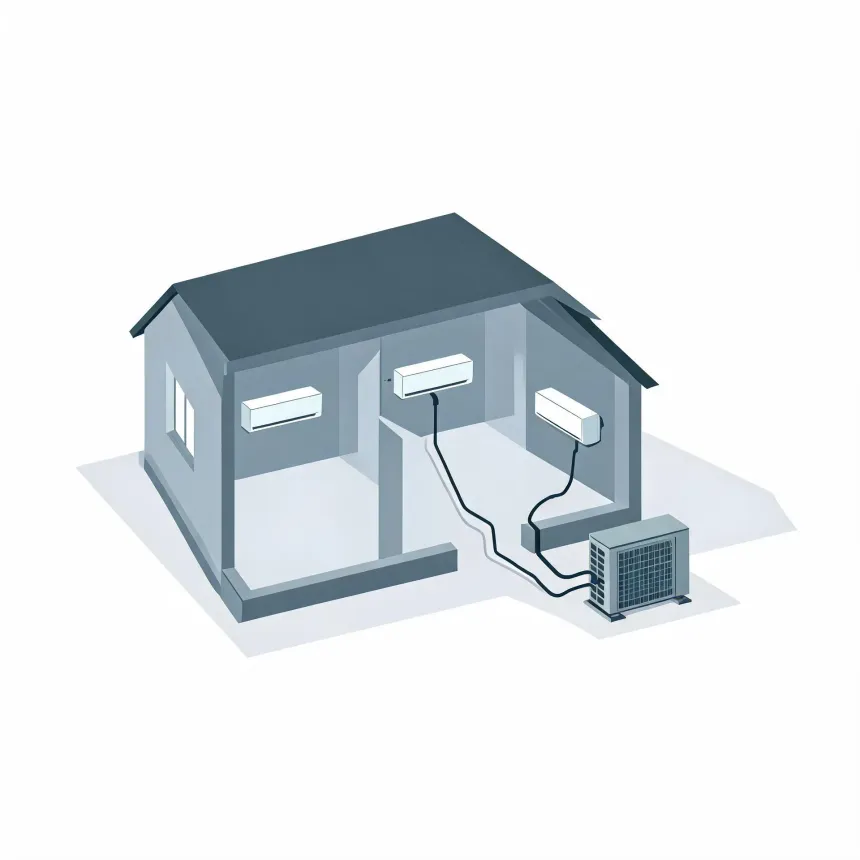
Isometric illustration of a cutaway single-story house with three wall-mounted indoor air conditioning units connected by lines to an outdoor condenser unit on the ground outside.
Your system heats October through May and cools June through August.

NOAA nClimDiv, 1991–2020 normals

Electricity in Iowa runs 13.40 cents per kilowatt-hour, below the national average.

A mini split earns its keep on comfort in the rooms the furnace missed, not on shaving a power bill that's already low.

Put in before June, a mini split is cooling on day one instead of during the first heat wave

Cooling runs June through August
Summer afternoons average 82°F
39 damaging wind events from 2015 to 2024
A mini split built for this place, not against itStandard sizing holds up fine through Webster County weather

Cooling only runs about three months here, June through August, with afternoon highs averaging 82. That's a mild load for a mini split to carry, nowhere near the stretch a unit in a hotter state would put in. Most of the year the system is either off or handling a room the furnace never heated evenly, not fighting triple-digit heat day after day. That matters when you're comparing models, because you don't need to pay for top-tier efficiency to get good results here. A reliable mid-range unit, installed right, will keep up with what this climate actually asks of it.

An older home needs a mini split sized for the house it's going into

Half the homes in Webster County were built in 1957 or earlier. A mini split going into a house that age has to work with the walls, the room layout, and the electrical panel that are already there, not a blank slate. Sizing and placement matter more when the house wasn't built with this kind of system in mind.

Find a contractor
A white mini-split air conditioner outdoor condenser unit mounted on metal brackets against a beige stucco exterior wall, with a blue sky and scattered clouds in the background.

One unit, running day into night

Watch this unit through a full day and you'll see it step up and down rather than switch off and on. That's how a mini split holds a room at temperature, by modulating the outdoor unit instead of cycling like a furnace or a window AC. Half the homes in Webster County were built in 1957 or earlier, on an electrical panel sized for whatever that house needed at the time. Running a new line to the outdoor unit is part of the installation in a house like that, and it's worth asking about before the crew shows up.

The outdoor unit and the indoor head are a matched pair

A mini split is sized as a system, not a single box. The outdoor compressor has to match the indoor head it's running, and that pairing is part of what determines the final price. More indoor heads off one outdoor unit costs more than a single zone, since each head needs its own line set and its own place on the wall or ceiling.

Where the lines run decides a lot of the labor

The refrigerant lines and the wiring have to travel from outdoor unit to indoor head, through a wall or along one, sometimes up through a floor. A short, straight run costs less to install than one that has to cross framing or climb between floors. The path those lines take, more than the equipment itself, often sets how long the job takes.

Sizing a mini split means matching the indoor head's output to the room it's cooling and heating, not just picking the biggest unit available. Too big and the system short cycles, hitting the setpoint fast and shutting off before it pulls the moisture out of the air, which leaves a room feeling clammy even at the right temperature. Too small and it runs flat out without ever catching up on the coldest or hottest days. Getting it right means accounting for the room's floor space, but also its windows, its insulation, what's above and below it, and how many walls it shares with conditioned space versus outside air. A sunroom with exposed walls on most sides needs more capacity than a bedroom buried in the middle of the house. That's a room-by-room judgment, not a chart lookup, and it's why the walk-through matters as much as the equipment itself.

Installation starts with a walk-through, deciding where the indoor head goes and where the outdoor unit sits outside. That decision drives everything after it. It sets the line set path, how much wall gets opened up, how the crew runs power to the outdoor unit. Once that's settled, the indoor head gets mounted and a small hole gets drilled through the wall behind it. The refrigerant lines, the wiring, and the condensate drain all pass through that one hole. The outdoor unit goes on a pad or a mounting bracket, set far enough off the wall to pull air freely. After the lines are connected at both ends, the system gets evacuated, pulling moisture and air out before refrigerant ever enters them. Nobody doing the job right skips that step. Air left in the lines will hold a system back for as long as it runs. Once it holds vacuum, the lines get charged and the system gets powered up. Before the crew leaves, they check temperatures at the head to confirm it's heating or cooling the way it should.