





A row of dark-sided single-story houses behind a long trimmed hedge, with mown lawn, a paved path and large leafy trees under an overcast sky.

Mini Split Installation in Maquoketa, IA

Tell us about the job

Takes about a minute. No obligation.

New system or replacementMini-splitJackson County, IA
Step 1 of 2

What ZIP code is the job in?

Gas heats most homes in Jackson County, better than half. LP gas covers a lot of the rest, close to three in ten homes. Electric heat is the exception here, not the rule. A mini split works alongside a gas or LP furnace rather than replacing it outright, handling the shoulder seasons or a room the main system doesn't reach well. If your home runs on gas or LP, the furnace stays as backup for the coldest stretches, and the mini split takes the load the rest of the year.

8 months
October through May, your system heats
3 months
June through August, it cools
16°F
the average winter night it heats against
82°F
the average summer afternoon it cools against
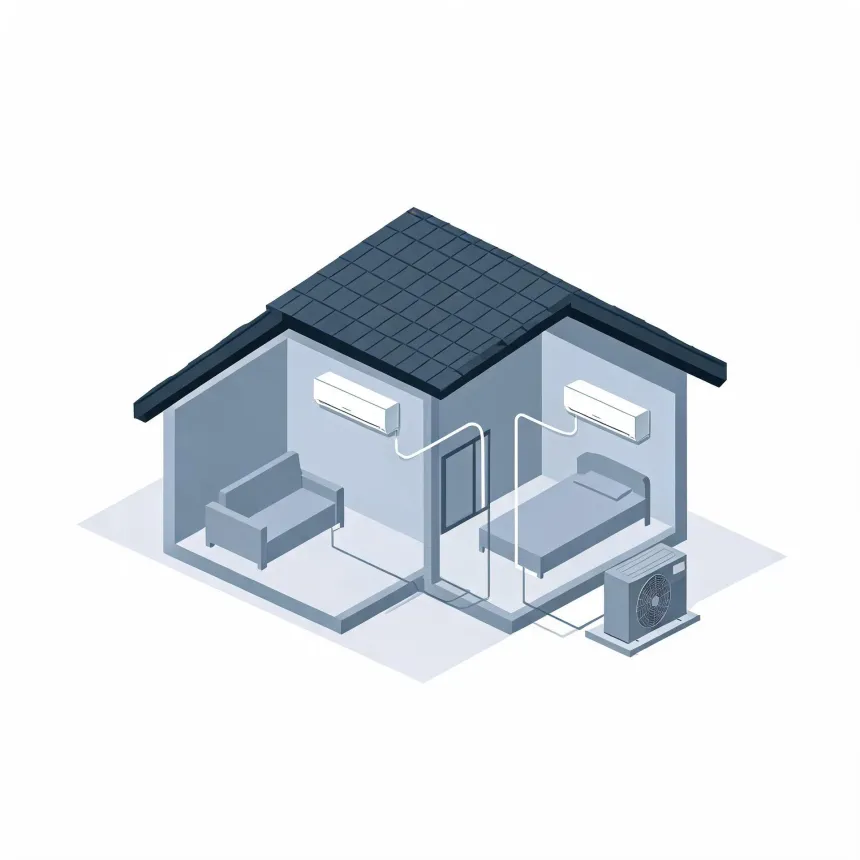
Isometric illustration of a cutaway house with two rooms, showing two wall-mounted indoor air conditioning units connected by lines to a single outdoor condenser unit outside the building.
Your system heats October through May and cools June through August.

NOAA nClimDiv, 1991–2020 normals

Summer here runs June through August, with afternoon highs around 82°F.

A mini split isn't working against a long, brutal summer, so a mid-range system holds up fine without reaching for the top efficiency tier.

Half the homes here were built in 1970 or earlier, and a mini split has to fit that house, not a new one

Half the homes here were built by 1970
Cooling runs June through August
Summer afternoons average 82°F
Get it in before JuneCooling starts in June here. Install in May and it's ready, not rushed.

Electricity in Iowa runs 13.40 cents per kilowatt-hour, cheaper than most of the country. That changes the math on which mini split to buy. A top-tier system with the highest efficiency rating costs more up front, and here it takes longer to earn that difference back in lower bills. Spending less on the efficiency tier and more attention on getting the right size for the room often makes more sense. A unit that's sized wrong for the space will cost you in comfort no matter what its rating says.

Know the minimum before you buy

Jackson County is in climate zone 5A. Any mini split installed here has to meet the federal minimum for a split system. That means 14.3 SEER2 for cooling and 7.5 HSPF2 for heating, no matter which brand or model you pick. A federal tax credit is available on top of that for equipment that qualifies. Worth sorting out which systems meet it before you decide.

Find a contractor
A man in a dark T-shirt, tan work pants and a backward cap walks up stone steps toward a dark green door, carrying a worn canvas tool bag, with a potted shrub in a green ceramic planter beside him.
A white mini-split air conditioner outdoor condenser unit mounted on metal brackets against a beige stucco exterior wall, with a blue sky and scattered clouds in the background.

Size it to the room you have

Before the crew shows up, know what room you're putting this in and how it's built. An installer sizing the unit needs the square footage, the ceiling height, and how many windows the room has, because a mini split sized for a new, tight addition will run wrong in an older room with more drafts. Ask whoever quotes the job how they're accounting for your walls, not just the floor space.

Where the line is longer costs more

Running refrigerant line between the outdoor unit and the indoor head costs more the farther apart they sit, and more again if the line has to go up a floor or around corners. A straight run through one wall is the cheapest path there is. If the outdoor unit ends up far from the best spot for the indoor head, that distance shows up in the price.

Multi-zone systems add up fast

One outdoor unit can run several indoor heads, but each zone needs its own line set, its own mounting work, and its own place to drain condensate. Pricing a multi-zone job means pricing each head almost like its own installation, not just adding a small fee per room.

The old system doesn't have to come out for a mini split to go in. If it's ducted, a working furnace or central air unit can stay right where it is and keep doing its job while the mini split takes over specific rooms or seasons. If the old equipment is actually failing, that's a separate decision from the mini split install, not something the mini split forces. When a window unit or an old ductless system is what's getting replaced, the outdoor condenser and indoor head come out together, and whoever handles the install should also handle getting rid of the old refrigerant properly rather than just hauling the unit to the curb. Refrigerant can't legally be vented into the air, so ask how that part gets handled before the job starts.

Installation starts outside, with the outdoor unit set on a pad or bracket and leveled, since a unit that sits crooked drains wrong over time. Indoors, the installer mounts the indoor head on the wall, drills a hole through to the outside, and runs the line set, the drain line, and the electrical whip through that same hole. The refrigerant lines get connected, then the whole system gets pulled down to a vacuum before any refrigerant moves, which clears out air and moisture that would otherwise sit in the lines and cause problems later. Once the vacuum holds, the system gets charged, and the installer checks the line pressures against what the equipment calls for rather than just turning it on and hoping it's cold. The last part is running the system through both heating and cooling, checking the head for airflow and the outdoor unit for noise or vibration, and sealing up the wall penetration so nothing gets in behind it.