A dark, minimalist bedroom featuring a sleeping cat on a grey-quilted bed, a wall-mounted air-conditioning unit, warm cove ceiling lighting, and a pendant lamp illuminating the bedside table.

Mini Split Installation in Newton, IA

Tell us about the job

Takes about a minute. No obligation.

New system or replacementMini-splitJasper County, IA
Step 1 of 2

What ZIP code is the job in?

Most of Newton heats with gas

Utility gas heats 56% of homes in Jasper County, with another 19.9% on bottled or LP gas. Electric heat covers 21%. A mini split doesn't replace that furnace, it adds a way to heat and cool specific rooms without running ductwork.

What this means for an install

If your house already has a gas furnace, the mini split's job is usually a room the furnace doesn't reach well, or year-round cooling without extending ducts. The contractor sizing the system will want to know what's heating the rest of the house now.

8 months
October through May, your system heats
3 months
June through August, it cools
16°F
the average winter night it heats against
83°F
the average summer afternoon it cools against
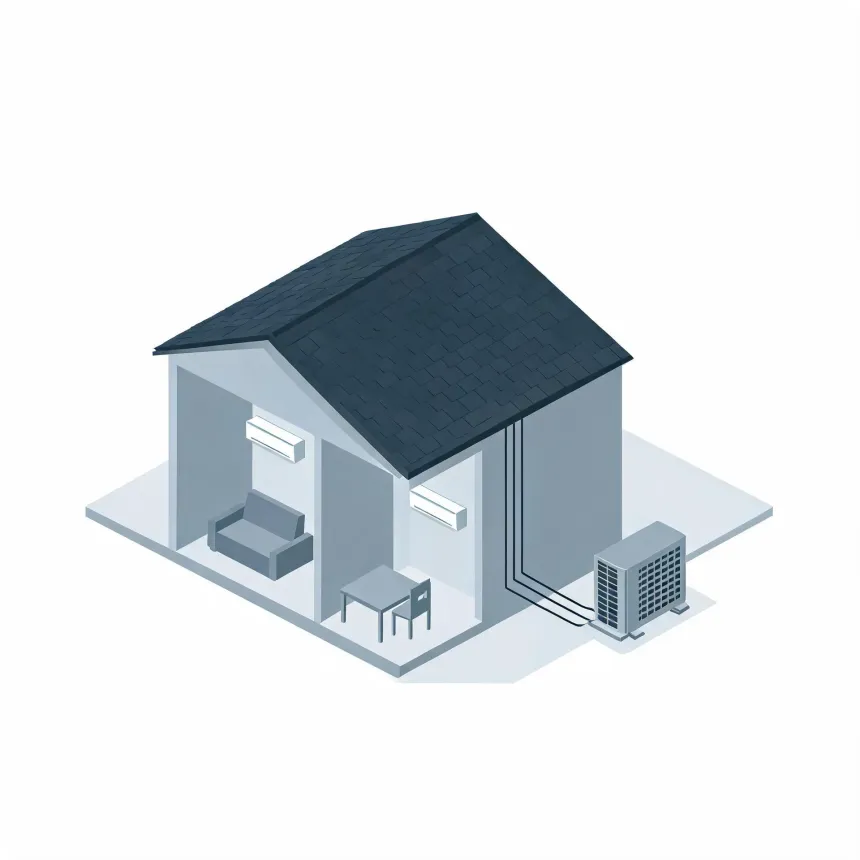
Isometric illustration of a cutaway house with a dark shingled gable roof, showing two wall-mounted indoor air handlers, a sofa, table and chair inside, and refrigerant lines running to an outdoor condenser unit beside the building.
Your system heats October through May and cools June through August.

NOAA nClimDiv, 1991–2020 normals

Summers in Jasper County run about three months, June through August, with afternoon highs near 83°F.

A mini split built for an 83°F afternoon is standard equipment, nothing oversized or special ordered.

May is the month to put in a mini split, before June asks it to work

Cooling runs June through August
Summer afternoons average 83°F
39 damaging wind events from 2015 to 2024
Built for Newton's cheap powerIowa electricity ran 13.40 cents per kilowatthour in 2024, so pick a mini split for fit and reliability, not just the efficiency number.

Half the houses in Jasper County were built in 1965 or earlier. A mini split going into a house that age is going into walls and rooms that weren't planned around it. Where the indoor head can go, and where the line set can run to reach the outdoor unit, depends on how that particular house was framed. None of that shows up from the street. It's something the contractor sizing the job has to look at room by room, because a mini split sized for the room, not just the house, is the one that keeps up without running longer than it should.

Any system going in here has to clear zone 5A

Jasper County falls under climate zone 5A, a cool zone where heating carries most of the load. A ductless mini split counts as a split-system heat pump under the federal standard, so one installed now has to hit 14.3 SEER2 for cooling and 7.5 HSPF2 for heating. That's the floor a contractor is working from before they even look at your rooms.

Find a contractor
A man in a cap, dark work jacket and tan pants climbs porch steps toward a green front door, carrying a worn tool bag in his right hand, with a potted shrub beside the entry.
A white outdoor air conditioner condenser unit mounted on metal wall brackets against gray horizontal siding, with a blue sky and white clouds behind it.

Built into a house, for as long as it runs

A mini split runs for years once it's in, so the walk-through before it goes in is worth the time. Have the contractor confirm the indoor head location and the line set path for your specific room before anything gets mounted, not just a walk around the outside of the house. That's what decides whether the unit keeps up on the hottest afternoon or runs longer than it should trying to.

How many rooms it's covering

A single indoor head handles one room or an open area well. Add a second or third head off the same outdoor unit, and the price climbs with each one, because now the contractor is running a line set to each location and the outdoor unit has to be sized to carry all of them at once.

What the line set has to get through

The refrigerant line runs from the outdoor unit to each indoor head, usually through a hole drilled in the wall behind it. A straight shot through one wall is quick work. A run that has to go up through an attic, across a soffit, or down through a finished ceiling takes longer and needs more material, and that shows up in the price.

When you're comparing quotes, ask each contractor what size unit they're putting in each room and how they got that number. The right size comes from a load calculation that looks at the room's square footage, how many windows it has, which way it faces, and how well it's insulated, not a guess based on square footage alone. A unit too big for the room cools it fast, shuts off, and turns back on again and again, which leaves the room clammy and wears the compressor harder over the years. A unit too small runs constantly and never quite catches up on the hottest days. Ask what happens to the old line set holes and wall penetrations if a previous system is coming out. Ask how many indoor heads the outdoor unit is rated to run at once, and whether adding a room later means a new outdoor unit or just another head on this one.

Installation day starts with the outdoor unit and the indoor head going up before any wire gets connected. The outdoor unit sits on a pad or wall bracket, away from the wall where it can pull air freely. The indoor head gets mounted at the height and spot the contractor marked out on the walk-through, with the hole for the line set already drilled. Once both are in place, the line set gets run, connected, and the system gets evacuated to pull moisture and air out of the lines before refrigerant ever enters them. That step matters more than it looks. A line that isn't properly evacuated can trap moisture that corrodes the coil years down the road, long after the install crew is gone. Once the system is charged, it gets tested in both heating and cooling before anyone calls the job done.