Most homes here run on gas
Utility gas heats 60.1% of occupied homes in Marion County, with electricity and LP gas splitting most of the rest. A furnace handles the cold months in most houses here.
Takes about a minute. No obligation.
Utility gas heats 60.1% of occupied homes in Marion County, with electricity and LP gas splitting most of the rest. A furnace handles the cold months in most houses here.
For a mini split job in a gas-heated house, the work is usually about one room or zone, not the whole house. The furnace keeps doing winter, and the mini split covers the space it's installed in.
NOAA nClimDiv, 1991–2020 normals
Marion County logged 79 damaging wind events between 2015 and 2024.
A mini split mounted on a secure wall bracket holds up through that without special equipment.



Half the homes in Marion County were built in 1975 or earlier, half in 1975 or later. That split doesn't point a mini split install toward anything unusual. A room in an older house and a room in a newer one both take the same range of indoor and outdoor unit sizes. Sizing comes from the square footage and layout of the space getting the new zone, not the year the house went up. A contractor sizing the unit measures that room.
Summers in Marion County top out around 83°F, three months of the year. That's a normal cooling load, nothing that calls for an oversized unit or a special setup. A properly sized mini split, matched to the room, handles it.
Find a contractor
Cooling runs June through August here. Outside that stretch the outdoor unit sits idle, so an install in May means the system is ready before the first hot week instead of going in while a room is already uncomfortable. Scheduling it before June also means the contractor isn't fitting the job in around calls from people whose systems just failed in the heat.
A mini split sized too large for the room cools fast and shuts off before it pulls the moisture out of the air. The room ends up cold and clammy instead of comfortable. It also cycles on and off more, which wears the compressor harder than a unit sized to run steady.
A contractor works out the load by measuring the square footage, the ceiling height, the windows and which way they face, and what's on the other side of the walls. That load points to a specific capacity for the indoor and outdoor unit. Skip the measuring and the unit is just a guess bolted to the wall.
When you're comparing systems, ask what each one is rated to do at the temperature extremes you'll actually see, not just the middle of the range. Every mini split has a capacity number, but that number can drop off in very cold or very hot weather depending on the compressor inside it. Ask about the indoor unit's sound level too, since it's usually mounted in a room people sit and sleep in, and a noisy unit is something you notice every day. Ask how the line set routing works for your room, because a longer run between indoor and outdoor units can affect performance and where the outdoor unit ends up sitting. Ask what the warranty covers on the compressor versus the rest of the parts, since that's usually the most expensive thing to replace. And ask who services the brand locally, because a system nobody nearby can get parts for is a problem down the road, not on install day.
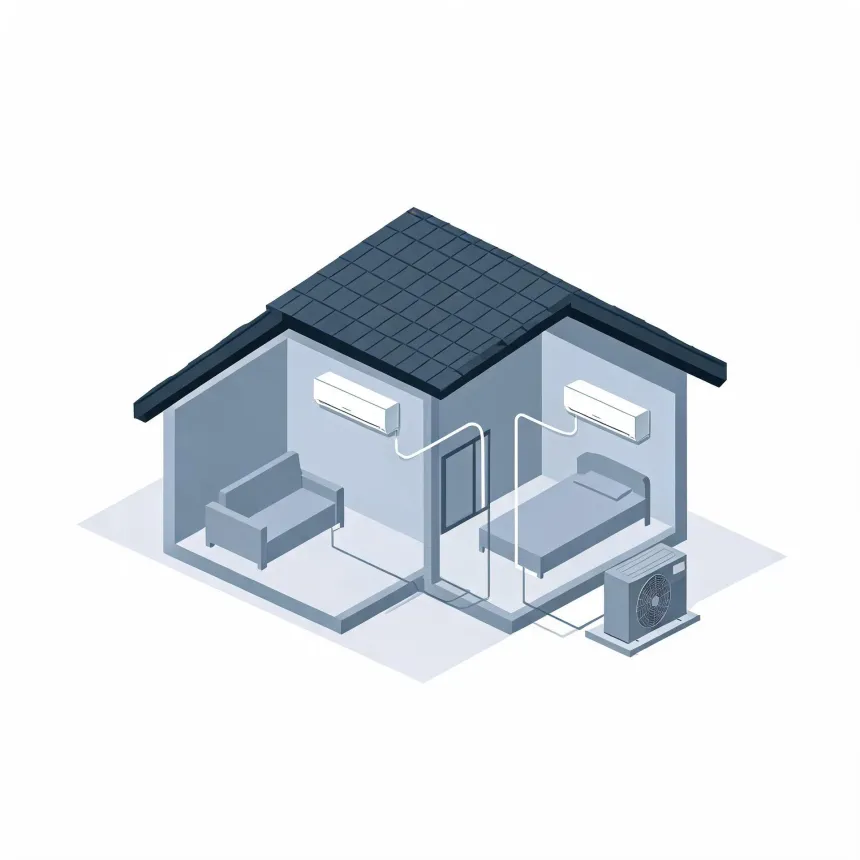
The outdoor unit gets mounted on brackets against an exterior wall, or sits on a pad at ground level if that's a better fit. A hole gets drilled through the wall for the line set, the set of refrigerant lines and wiring that connects outdoor to indoor. The indoor unit hangs on the wall or ceiling, usually high up where it can move air across the whole room. Once both units are set, the lines get connected and the system is checked for leaks before it's charged with refrigerant and powered on. Most of the work is the mounting and the wall penetration. The electrical hookup is usually its own dedicated circuit, separate from whatever else is on that wall.