Most homes here run on gas
Utility gas heats 63.4% of homes in Black Hawk County, more than any other fuel. Electricity comes in second at 30.2%, and a small share use LP gas.
Takes about a minute. No obligation.
Utility gas heats 63.4% of homes in Black Hawk County, more than any other fuel. Electricity comes in second at 30.2%, and a small share use LP gas.
If your home has a gas furnace, a mini split doesn't replace it. It adds cooling, or heating in rooms the furnace doesn't reach well, like an addition or a finished basement.
NOAA nClimDiv, 1991–2020 normals
Electricity in Iowa runs 13.40 cents per kilowatt-hour, cheaper than in most states.
A high-efficiency mini split still costs more up front, and that gap takes longer to earn back here.



Black Hawk County sits in climate zone 6A, a cold zone with winters that run long. Any mini split installed here still has to meet the federal minimum for its type. A ductless heat pump counts as a split system under that standard, so units made from January 2023 onward need to hit at least 14.3 SEER2 for cooling and 7.5 HSPF2 for heating. That rules out older or budget models still sitting on some shelves. The number on the spec sheet isn't a suggestion, it's the floor.
A standard mini split, sized and rated for zone 6A, is enough for a home here. Nothing about Black Hawk County's weather calls for oversizing the unit or paying for a higher tier than the federal minimum already sets.
Find a contractor
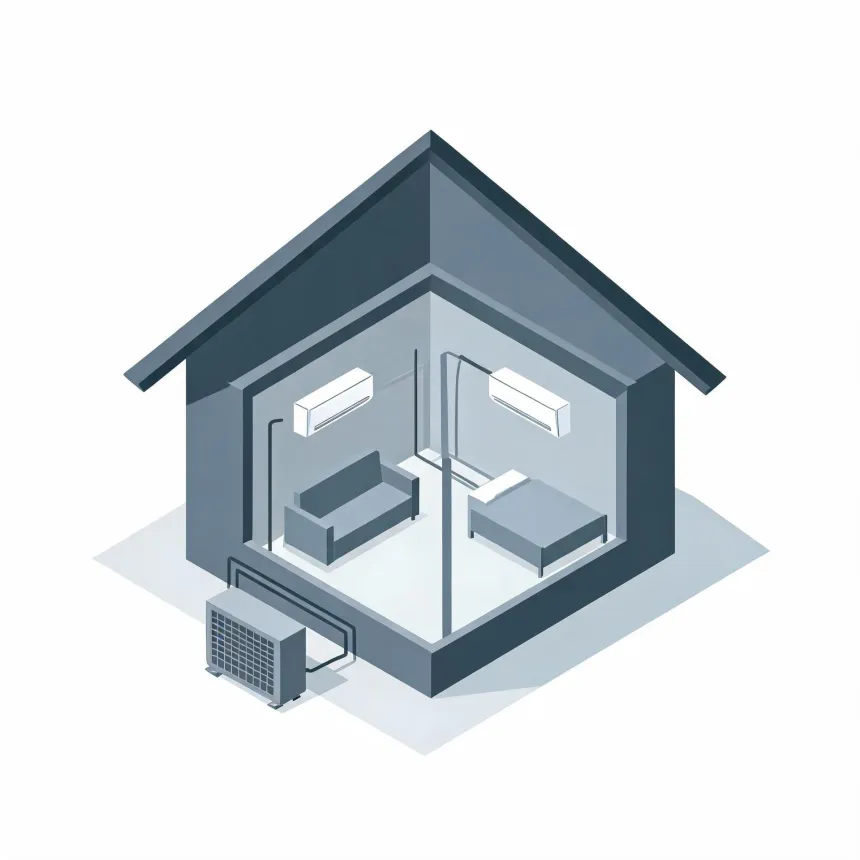
An installer prices the job on what it takes to get refrigerant line from the outdoor unit to each indoor head, not just the equipment sitting in the truck. Longer line runs, line sets that have to go through brick or block instead of siding, and a condensing unit that needs a bracket or pad all add labor before anyone mounts the first head.每 additional zone means another indoor unit, another line set, another spot on the wall or ceiling that has to hit a stud or joist and still look right. The electrical side matters too. A multi-zone system often needs its own circuit and disconnect, and if the panel is already full, that's its own piece of work. None of this shows up on the spec sheet. It shows up when the installer walks the house and figures out where the lines can actually run.
Multi-zone systems share a single outdoor unit across several indoor heads. Ask whether a problem with one head takes down the others, or if the system can keep running the rest of the house while that zone gets fixed. Some outdoor units isolate each zone, some don't.
A mini split is only as good as the contractor who can get parts for it later. Ask whether the installer stocks parts for the brand they're quoting, or whether a warranty repair means waiting on a shipment. A well-rated system nobody nearby can service becomes a hard call down the road.
If the furnace stays, the old cooling setup still has to go somewhere. A window unit or an old central air condenser gets disconnected and hauled off once the mini split is in place, since running both to cool the same room does nothing but waste power. Central air is a different case. If the plan is to replace ducted cooling entirely, the old condenser outside gets disconnected and removed, but the indoor coil and ductwork usually stay put for the furnace's blower to keep using for heat. A line set that isn't being reused gets capped or pulled, not just left hanging on the wall. Whoever does the install should tell you up front what gets hauled away and what stays, because that's a labor question, not a parts question.
The outdoor unit goes in first, set on a pad or bracket where it won't vibrate against the wall. From there the installer runs refrigerant line to each indoor head, cut to length and connected at both ends. Before any refrigerant goes in, that line gets pressure tested, because a joint that leaks slowly is hard to catch later and easy to catch now. Once it holds pressure, a vacuum pump pulls moisture and air out of the line, since either one left behind causes problems once the system runs. Only then does the refrigerant go in, charged to what the line length calls for. The indoor head gets mounted, wired, and connected to a condensate drain so the water it pulls from the air has somewhere to go. Startup comes last, checking pressures and airflow to confirm the system is actually doing what it's supposed to before the installer calls it finished.