






Why mini splits drip inside in sticky Iowa summers

RepairMini-splitIowa
Step 1 of 2

What ZIP code is the job in?

Why does my mini split drip water inside during summer?

A mini split that drips or pools water inside the house is usually fine mechanically, but with Iowa summers running so humid, it's worth catching early before it stains a wall or warps a floor.

A clogged condensate drain is the usual cause

Your mini split pulls moisture out of the air all summer and that water has to go somewhere. It runs through a small drain line and out of the house. When that line clogs with algae or dust, the water backs up into the indoor unit and drips out instead, sometimes through the front panel, sometimes down the wall behind it. A dirty filter can cause the same thing by icing the coil, which then melts and overflows the pan. With how humid Iowa summers get, the unit is removing more water than it would in a dry climate, so a partial clog that would barely matter elsewhere here fills the pan fast.

A woman in a gray turtleneck sweater stands near a window with snow outside, in a dimly lit living room with a lit Christmas tree, table lamp, sofa and bookshelf.
A woman in a cream knit sweater with her hair in a bun stands in a dimly lit living room looking out a large window at snow-covered evergreen trees, with a lamp, sofa, framed picture and lit candle behind her.
A woman in a thick gray knit sweater stands beside a window looking out at falling snow, with a dimly lit living room containing a lamp, sofa, string lights and a candle behind her.
A woman in a gray turtleneck sweater stands in a dimly lit room with a lit table lamp, framed picture and sofa, looking toward a window with snow outside.

Is this a small drip or a bigger problem?

Look at where the water is showing up. A little moisture on the wall below the indoor unit, or a drip that only happens on the muggiest days, usually means the condensate line is slow to drain or the drain pan has an algae buildup. That's worth fixing before it spreads. But if the floor underneath is wet, if you're seeing a stain spreading across the ceiling or wall, or if the unit is pooling water steadily instead of dripping, the water has somewhere to go that it shouldn't. Left alone through a humid Iowa summer, that kind of leak can warp wood flooring, stain drywall, or start mold growing behind the wall where you can't see it. Either way, the fix is usually straightforward once someone gets eyes on the line and the pan.

A white wall-mounted mini-split air conditioner installed high on a plain light-colored interior wall near a corner, with a window frame at the left edge.

Why humidity drives the drip

A mini split pulls moisture out of the air as it cools, and that water has to go somewhere. In a dry climate the amount is small enough that the drain line handles it without trouble. Iowa summers push far more water through the system because the air holds more moisture to begin with. The same unit that drains fine in April can start overwhelming a partly clogged line in July or August, simply because there's more condensate asking to get out.

A white wall-mounted mini-split air conditioner installed near the top of an interior corner wall, with large blank light-colored wall space to the left.

What the drain line does

Condensate forms on the indoor coil and runs down into a pan, then out through a thin plastic line that usually ends outside the house. That line relies on gravity and a clear path, nothing more. Algae, dust, or a bit of debris can narrow it enough to slow the flow without blocking it completely. On a humid day, that narrowed line can't keep pace with how much water the coil is producing, and it backs up into the pan or drips out where the line connects to the unit.

A man with a duffel bag walks up a concrete path toward a white board-and-batten house where a woman stands in the open wooden front door, flanked by potted plants and black lanterns.

Where the water actually goes

Inside the indoor unit, the cold evaporator coil sits right behind the filter. Humid air passes over it, the moisture gives up its heat, and it turns to water on the coil's surface. That water runs down into a drain pan underneath, then out through a condensate line that either drains by gravity or feeds a small condensate pump. Any one of those three spots, the pan, the line, or the pump, can be where things back up. A tech who works on mini splits all summer can usually tell which one just from where the water shows up and how often.

Some systems also route that line through a trap or tie it into a larger drain. If the trap runs dry or the tie-in backs up, water finds the nearest low point and that's often the wall below the unit. A local contractor who gets called out for this kind of thing every summer will know which models in your area tend to have a pan that's slightly undersized or a pump that fails early, and can check that first instead of guessing. Getting matched with one contractor instead of several means you explain the problem once.

A living room with a cream sofa and knit throw beside a window, with a wooden coffee table in the foreground holding a round woven tray, a small bowl, and a speckled vase of green leafy branches.
A white wall-mounted mini-split air conditioner installed near the ceiling on a beige interior wall, with a window and bamboo blind at the left edge showing green foliage outside.

Draining the way it should

This is a mini split doing its job. Air moves through the filter, over the coil, and out into the room, while the condensate runs off through the drain line without any of it showing up on your wall or floor. No staining, no drip, no sound of water where it shouldn't be.


A wall-mounted mini-split air conditioner indoor unit with discolored casing and dusty vents, installed near the ceiling on a plain light-colored wall.

Dirty and backing up

Dust and grime built up on the front panel and louvers like this usually means the filter behind it is just as clogged. Airflow slows, the coil can ice over, and when it thaws, the drain pan gets more water than the line can carry off, which is when it starts showing up inside.

Wait It Out or Call Now

Let it run

  • A slow drip that only shows up on the muggiest days often just means the drain line is keeping up but barely, and it can go on like that for a while without getting worse.
  • If the water is only ever on the coil or in the drain pan itself, the system is still doing what it's supposed to do.
  • A unit that drains fine most of the summer and only struggles during a stretch of 90 percent humidity may just need the line checked once conditions ease up.
  • Waiting makes sense if there's no staining on the wall or floor yet and the water has stayed contained inside the unit so far.

Get it looked at

  • Water on the wall below the unit or a drip that's started showing up more often than just the worst days usually means the drain pan or line needs attention now, not later.
  • A clogged drain line can back up fast once Iowa humidity peaks, and what started as a slow drip can turn into standing water in the pan within days.
  • Staining or warping on a wall or floor means water has already gotten past where it should, and that damage doesn't reverse itself once the drain is cleared.
  • A local contractor who services mini splits through Iowa summers every year knows which models tend to clog first and can get the drain line cleared before the next humid stretch hits.
  • Getting matched with one contractor who already knows this equipment means one call, one visit, instead of chasing down someone who's never seen your unit before.
  1. Humid air crosses the cold evaporator coil inside.

  2. Moisture condenses on the coil and drips downward.

  3. Water collects in the drain pan below the coil.

  4. The drain line carries that water outside the house.

A dusty, discolored wall-mounted mini-split air conditioner indoor unit near the top of a plain light-colored interior wall below a white molding strip.
Before you get your mini split repair
A white wall-mounted mini-split indoor unit on a beige interior wall, with a potted leafy plant at the left and a curtain edge at the right.
After you get your mini split repair
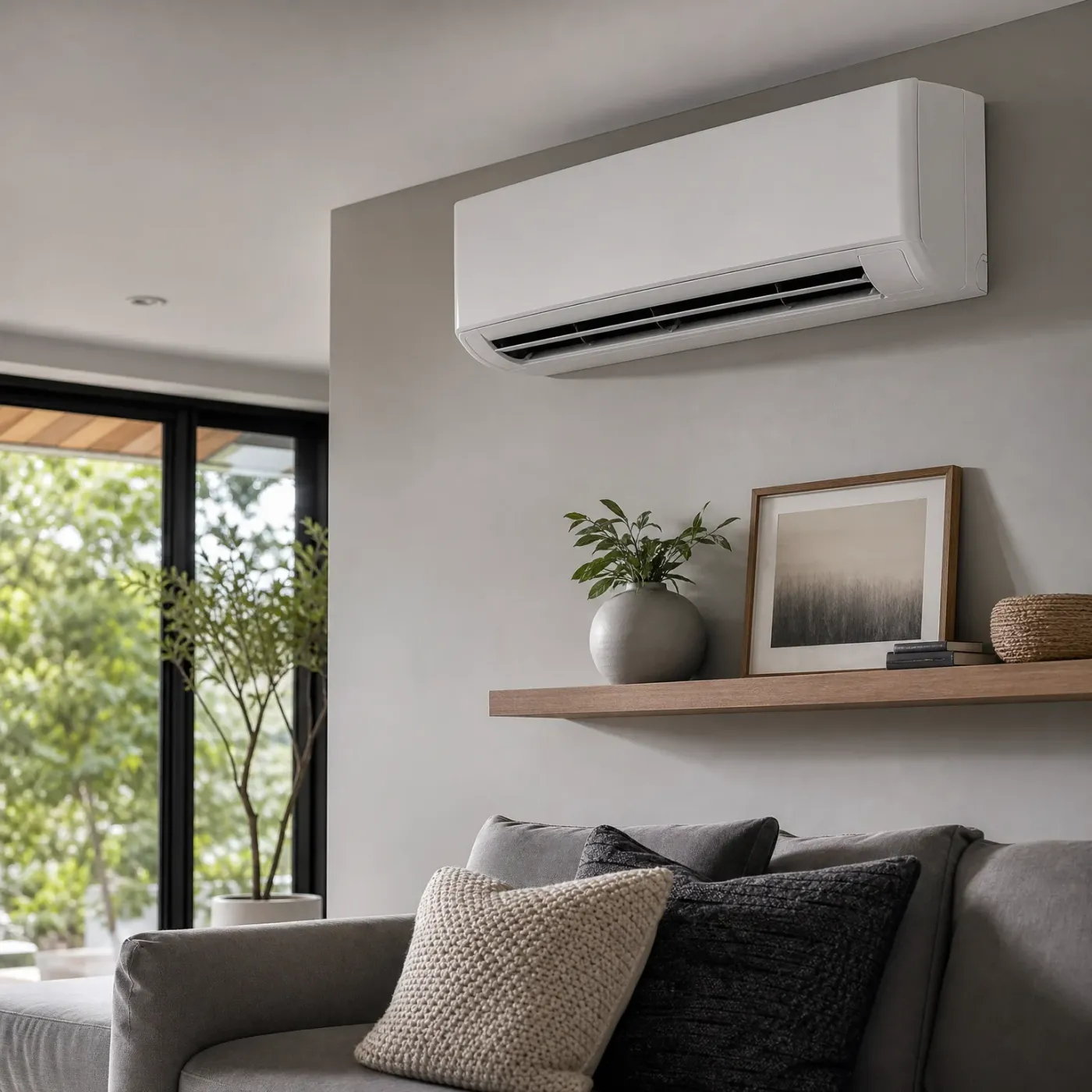
A white wall-mounted mini-split air conditioner near the ceiling of a living room with a gray sofa, knit cushions, a wooden floating shelf holding a plant in a round vase, a framed print and a woven basket, and a large window showing green trees.

The right pro for this job

The pro who reaches out is licensed in Iowa.

Say what's going on with your mini split, and a pro who works on them reaches out.

Reach a local pro

No charge to send it. You decide if you hire them.

Power costs 13.62 cents per kilowatt-hour statewide

Running the mini split harder on a sticky day costs you less here than it would in most states, since Iowa power runs 13.62 cents per kilowatt-hour. That makes it worth having a slow drain or a dirty coil fixed rather than just turning the unit down to cope with it.

EIA-861 2025 statewide residential average

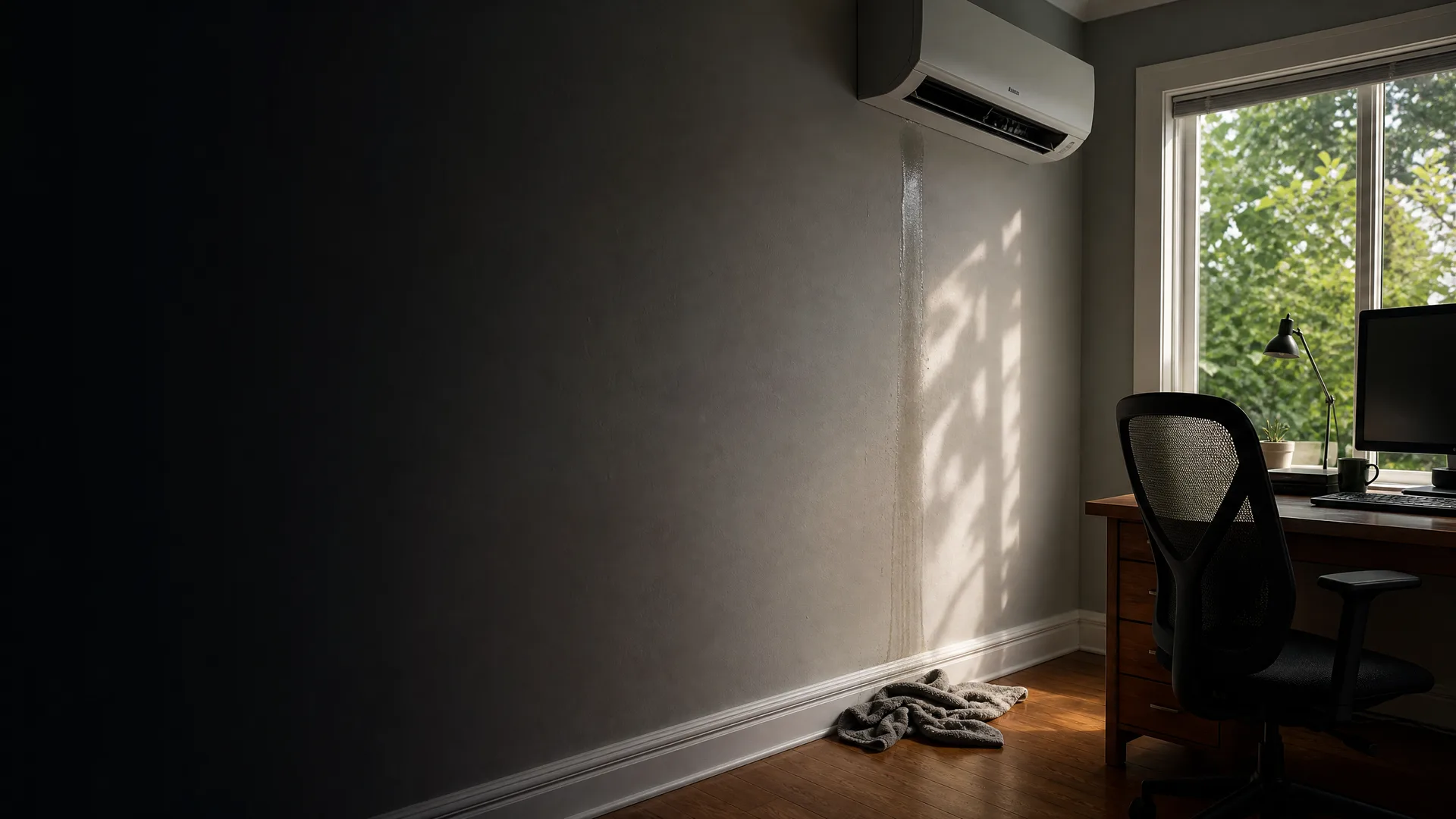
A wall-mounted mini-split air conditioner in a dim room, with a water streak running down the wall below it to a towel on the floor near the baseboard, beside a desk, office chair and monitor by a window.

It's late afternoon, close to ninety outside, the kind of sticky that settles into a room even with the mini split running. You're at the desk working when you notice the baseboard looks dark. You get up and find a wet streak running down the wall under the indoor unit, already a few inches long. You grab a towel from the hall bathroom and press it against the wall, then lay it along the floor where the water's pooling. The unit keeps blowing cold air like nothing's wrong. You stand there a second, towel under your foot, trying to remember if it did this yesterday too.

A white wall-mounted mini-split air conditioner installed high on a beige interior wall near the ceiling, with a sheer curtain and window at the left edge.
A clean coil and clear drain line move condensate out as fast as the coil makes it.
A white wall-mounted mini-split air conditioner indoor unit with visible dust and discoloration, installed near the ceiling on a plain beige wall.
Dust on the coil and a clouded indicator panel usually mean the drain is already behind.
Single-story gray horizontal-siding house with white trim, gabled roof, white front door, and two windows, fronted by a concrete walkway through a patchy lawn under a clear blue sky.

Iowa summer air carries a dew point around 62°F on average across June, July and August, a figure from NOAA climate data. That's heavy air, the kind that feels damp even standing still. For your mini split, it means the coil is pulling a steady load of moisture out of every room all summer, not just on the worst days. A drain line and pan sized for an average year still have to keep up with that pace day after day. When a clog or a slow tilt in the line cuts into that margin, there's less room to absorb it before water backs up into the pan and starts showing up where you can see it.

NASA POWER T2MDEW county cells weighted by homes

A bearded man in a plaid flannel shirt stands indoors beside a wood-framed, frost-covered window, looking outside, with a steaming brown mug on the sill and a wooden cabinet behind him.
A bearded man in a dark blue T-shirt sits on a gray couch, smiling and looking down to his left, with a bookshelf and a bright window behind him.

What the drip is telling you

  • A drip that shows up on the muggiest days almost always traces back to a slow drain line or a dirty coil, not a failing unit.
  • Catching it early usually means clearing a line or a coil before a wet wall or a warped floor turns it into bigger work.
  • Iowa's humid summers keep the coil working harder than it would in a dry climate, so condensate problems tend to repeat each season.
  • A local contractor who services mini splits all summer has usually already seen whatever is causing your drip.
  • Getting matched with one contractor instead of several means one visit, one diagnosis, and no juggling calls from different companies.
  • Where you live, with power this cheap, fixing the drain or coil costs less than running the unit harder to compensate.

A mini split that drips in summer is almost always a drain line or a coil, not a unit on its way out. The humidity that sits over Iowa from June through August keeps that coil working harder than it would almost anywhere else, so the condensate problem that shows up this year is likely to show up again next August unless the line or the coil gets cleared. That's worth doing now, while it's a wet streak on the baseboard and not a warped section of floor or a stain that's worked its way into the drywall.

Finding someone to look at it shouldn't be its own chore. A contractor who works on mini splits through an Iowa summer has already cleared plenty of slow drain lines and scraped dust off plenty of coils. They know the drain pans that sit a little off level and the lines that clog in the same spot every year, because they've been pulling the same unit apart all season. That's not a guess about your system specifically, it's what the job looks like for anyone servicing this equipment here.

Getting matched means one contractor looks at your mini split, not three or four competing for the job. One visit, one diagnosis, no sorting through calls from companies you didn't ask to hear from. With power priced the way it is here, clearing the line or the coil costs less than leaning on the unit to keep up while the drip gets worse. The fix is usually small. Left alone, the water damage isn't.

Elevated view over a slate roof with a brick chimney and dormer window, surrounded by dense green trees, looking out across flat farmland fields and a winding river under a hazy sky.

Matched to your mini split job

Find a licensed mini split pro

There's no charge for the request.

A mini split that's draining the way it should won't leave a mark on your wall or your floor. If yours is, a local contractor who works on these units all summer can usually clear the line or the coil in one visit, before the water does any real damage.